Blog
Serverless Ecommerce Architecture Explained (Complete 2026 Guide for Scalable Online Stores)

📘 Introduction: Why Serverless is the Next Evolution of Ecommerce Infrastructure
Ecommerce has rapidly evolved from simple online storefronts into complex digital ecosystems that must handle high traffic, real-time data processing, global customers, and seamless integrations with multiple third-party services. Traditional hosting models and even container-based architectures often struggle to deliver the flexibility, scalability, and cost efficiency required by modern ecommerce businesses.
Serverless architecture has emerged as a powerful solution to these challenges. Despite its name, “serverless” does not mean there are no servers. Instead, it refers to a cloud computing model where infrastructure management is handled entirely by cloud providers, allowing developers to focus solely on writing and deploying code.
For ecommerce businesses, this shift represents a fundamental transformation. Instead of provisioning servers, managing scaling, and handling infrastructure complexity, businesses can build applications that automatically scale based on demand, reduce operational overhead, and improve performance.
In this comprehensive guide, we will explore serverless ecommerce architecture in depth, covering how it works, its core components, advantages, challenges, implementation strategies, and future trends.
🧠 What is Serverless Architecture?
Serverless architecture is a cloud computing model where applications are built using managed services and functions that run on demand. Instead of running continuously on dedicated servers, code is executed in response to specific events, such as a user action or an API request.
This model relies heavily on Function-as-a-Service (FaaS), where individual functions perform specific tasks and are triggered when needed. These functions are stateless, meaning they do not retain data between executions, and they can scale automatically based on incoming requests.
👉 Learn more about serverless computing:
https://aws.amazon.com/serverless/
⚙️ How Serverless Ecommerce Architecture Works
In a serverless ecommerce system, different components work together to deliver a seamless shopping experience without requiring traditional server management.
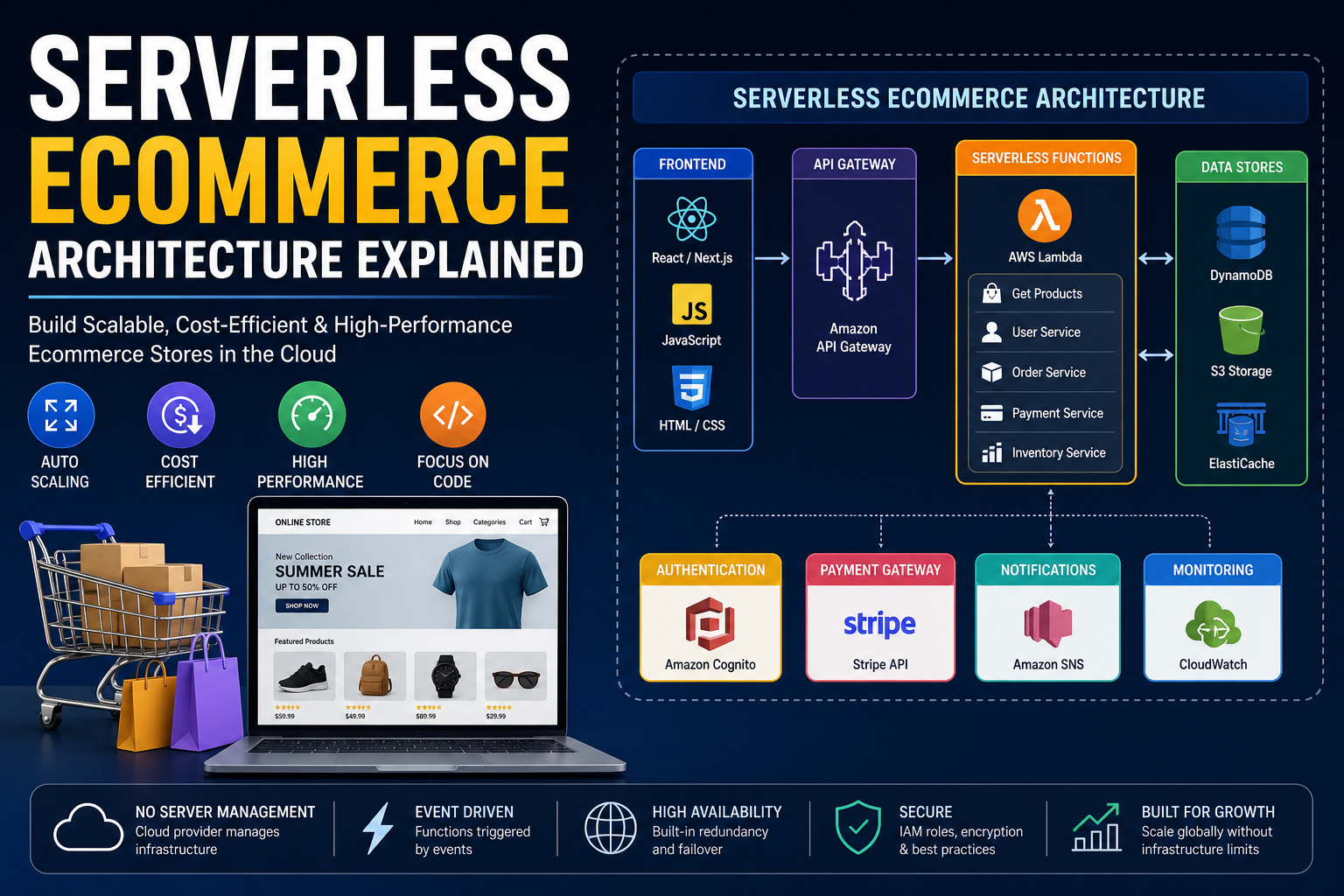
When a user visits an ecommerce website, the frontend (often built using a headless architecture) interacts with backend services through APIs. These APIs trigger serverless functions that handle specific tasks such as retrieving product data, processing orders, or managing payments.
For example, when a customer places an order, an API call triggers a serverless function that processes the order, updates inventory, and initiates payment processing. Each of these tasks can be handled by separate functions, allowing the system to scale efficiently and independently.
🏗️ Core Components of Serverless Ecommerce Architecture
🌐 Frontend (Headless Layer)
The frontend is typically built using modern frameworks such as React or Next.js. It communicates with backend services via APIs and delivers content to users through CDNs for faster performance.
🔗 API Gateway
An API gateway acts as the entry point for all client requests. It routes requests to the appropriate serverless functions and manages authentication, rate limiting, and monitoring.
👉 https://aws.amazon.com/api-gateway/
⚡ Serverless Functions (FaaS)
Serverless functions handle business logic. Each function performs a specific task, such as processing payments or fetching product data.
🗄️ Database Layer
Serverless architectures use managed databases that scale automatically.
☁️ Cloud Providers
Popular platforms include:
- Amazon Web Services → https://aws.amazon.com/serverless/
- Google Cloud Platform → https://cloud.google.com/serverless
- Microsoft Azure → https://azure.microsoft.com/en-in/solutions/serverless/
🔄 How a Serverless Ecommerce Workflow Functions (Detailed Example)
To understand serverless architecture in practice, consider a typical ecommerce transaction.
When a customer browses products, the frontend sends a request to an API gateway. The API gateway triggers a serverless function that retrieves product data from a database and returns it to the frontend.
When the customer adds a product to their cart and proceeds to checkout, another API call triggers a function that validates the order. A separate function processes the payment through a payment gateway, while another updates inventory and generates an order confirmation.
Each of these functions operates independently, ensuring that the system remains efficient and scalable.
🚀 Benefits of Serverless Ecommerce Architecture
⚡ 1. Automatic Scalability
Serverless systems scale automatically based on demand, making them ideal for handling traffic spikes during sales events or peak seasons.
💰 2. Cost Efficiency
Businesses only pay for the resources they use, reducing infrastructure costs.
🚀 3. Faster Development
Developers can focus on building features rather than managing servers.
🔧 4. Reduced Operational Overhead
Cloud providers handle infrastructure management, including updates and maintenance.
🌍 5. Global Performance
Serverless applications can be deployed across multiple regions, improving performance for global users.
⚠️ Challenges of Serverless Ecommerce Architecture
🧠 Complexity
Managing multiple functions and services can be complex.
⏱️ Cold Start Issues
Serverless functions may experience delays when invoked after inactivity.
🔐 Security Concerns
Proper security measures must be implemented to protect APIs and data.
🔐 Security Best Practices
Security is critical in serverless ecommerce systems.
🔒 Authentication & Authorization
Use secure authentication methods such as OAuth.
🔒 Encryption
All data should be encrypted during transmission.
🔒 OWASP Guidelines
Follow best practices from OWASP:
👉 https://owasp.org/www-project-top-ten/
⚡ Performance Optimization Strategies
🚀 Use CDN
Deliver content faster using CDNs.
🚀 Caching
Cache frequently accessed data.
🚀 Optimize Functions
Keep functions lightweight and efficient.
📈 SEO Impact of Serverless Architecture
Serverless architecture can significantly improve SEO performance by:
- Reducing page load times
- Improving uptime
- Enhancing mobile performance
🔮 Future of Serverless Ecommerce
The future of ecommerce is moving toward serverless and API-driven architectures. Businesses are adopting event-driven systems, integrating AI for personalization, and leveraging edge computing for faster performance.
🏁 Conclusion
Serverless ecommerce architecture represents a paradigm shift in how online stores are built and managed. By eliminating infrastructure complexity and enabling automatic scaling, serverless systems allow businesses to focus on innovation and growth.
To build a scalable and high-performance serverless ecommerce platform, partner with Sri Hayavadhana Info Tech and create a future-ready digital commerce solution.