Blog
Local SEO Case Study for Ecommerce

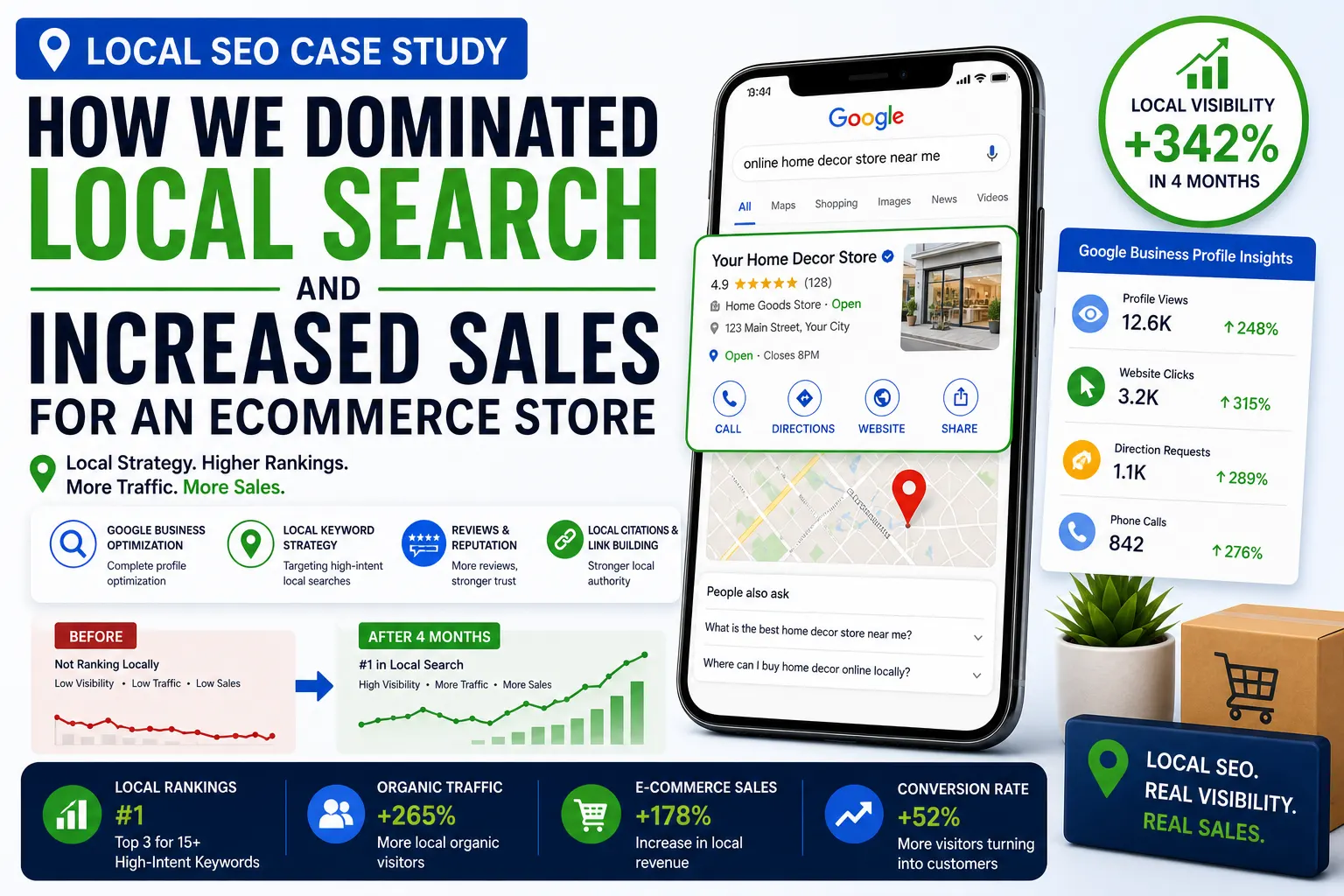
How Strategic Optimization Increased Local Visibility and Sales
Local SEO has become an essential growth strategy for ecommerce businesses that serve specific cities, regions, or local customer markets. While many people associate ecommerce primarily with national or global online selling, a large number of ecommerce businesses generate substantial revenue from local customers searching for nearby products, services, pickup options, or region-specific ecommerce solutions.
Modern customers frequently search using local intent keywords such as:
- Ecommerce store near me
- Online shopping in specific cities
- Same-day delivery products
- Local ecommerce brands
- Pickup and delivery services
- City-based product searches
Businesses that optimize their ecommerce websites for local search visibility can increase targeted traffic, improve conversion rates, strengthen brand trust, and reduce dependence on paid advertising.
This local SEO ecommerce case study explains how a business improved local search visibility and ecommerce sales through a structured local SEO strategy focused on Google Business Profile optimization, local landing pages, technical SEO improvements, location-based content marketing, mobile optimization, customer reviews, and ecommerce conversion enhancements.
The growth achieved was not the result of temporary ranking tricks or short-term campaigns. Instead, the results came from improving local search relevance, strengthening website authority, optimizing user experience, and building trust within local customer markets.
This article explains the challenges faced by the ecommerce business, the optimization process implemented, the local SEO strategies used, and the lessons learned while scaling local ecommerce visibility.
For ecommerce SEO services, local SEO optimization, Shopify development, WooCommerce development, and ecommerce website solutions, visit:
Initial Challenges Faced by the Ecommerce Business
Before implementing the local SEO strategy, the ecommerce business struggled with low local visibility despite serving customers across multiple nearby regions.
Although the business had a functional ecommerce website and quality products, it failed to rank effectively for local commercial keywords.
The ecommerce business depended heavily on paid advertising and repeat customers because local organic traffic remained limited.
Several major challenges affected growth.
Poor Local Search Visibility
The ecommerce website ranked poorly for city-based and location-specific search terms.
The website lacked:
- Local keyword optimization
- Location landing pages
- Google Business Profile optimization
- Local citations
- Local schema markup
- Geo-targeted content
This limited local search discovery.
Weak Google Business Profile Optimization
The business had a basic Google Business Profile setup but lacked proper optimization.
Problems included:
- Incomplete business information
- Limited business categories
- Weak image optimization
- Inconsistent NAP details
- Minimal customer reviews
- Limited local engagement
This reduced local visibility in map results.
Thin Localized Website Content
The ecommerce website contained very little locally targeted content.
The business did not have:
- City-specific pages
- Local buying guides
- Regional landing pages
- Local FAQs
- Area-focused ecommerce content
Competitors with stronger local relevance often ranked higher.
Poor Mobile User Experience
Most local searches occurred through mobile devices.
However, the ecommerce website had:
- Slow mobile loading speed
- Weak navigation
- Poor mobile layouts
- Difficult checkout experience
Mobile usability problems negatively affected conversions.
Weak Local Trust Signals
Customers searching locally often look for trust indicators.
The website lacked:
- Local testimonials
- Area-based customer reviews
- Delivery transparency
- Pickup information
- Local contact visibility
This reduced local customer confidence.
Defining the Local SEO Objectives
Before implementing changes, the business established clear local SEO goals.
The strategy focused on long-term local ecommerce growth instead of short-term traffic spikes.
The primary objectives included:
- Increase local organic traffic
- Improve Google Maps visibility
- Rank for local ecommerce keywords
- Increase local ecommerce conversions
- Improve mobile search performance
- Strengthen local trust signals
- Increase customer reviews
- Improve location-based search visibility
- Reduce local advertising dependency
- Improve local engagement
Clear KPIs helped prioritize the most impactful optimization opportunities.
Step 1: Complete Local SEO Audit
The first stage involved conducting a detailed local SEO audit.
This audit analyzed:
- Google Business Profile performance
- Website technical SEO
- Local keyword rankings
- Citation consistency
- Mobile usability
- Local landing pages
- Customer review signals
- Competitor analysis
- Local backlink opportunities
- Internal linking
The audit identified several ranking and visibility issues.
NAP Consistency Problems
The business had inconsistent name, address, and phone number information across online directories.
Inconsistent NAP details reduced trust and local search authority.
Weak Local Keyword Targeting
The ecommerce website targeted broad national keywords instead of location-based search terms.
The business missed valuable local commercial traffic opportunities.
Limited Local Landing Pages
The website lacked dedicated pages for:
- Individual cities
- Service regions
- Delivery locations
- Regional product availability
This limited local relevance.
Poor Local Content Strategy
The website contained minimal content targeting local customer interests.
Competitors with stronger regional content achieved better rankings.
Step 2: Google Business Profile Optimization
Google Business Profile optimization became a major part of the local SEO strategy.
The goal was improving visibility in:
- Google Maps
- Local search results
- Mobile local searches
- Local pack listings
Improving Business Information
The profile was updated with:
- Accurate business categories
- Optimized descriptions
- Updated business hours
- Better service details
- Consistent contact information
Accurate information improved trust and relevance.
Optimizing Images and Media
The business uploaded:
- High-quality storefront images
- Product photos
- Team photos
- Delivery visuals
- Brand graphics
Visual improvements increased engagement.
Encouraging Customer Reviews
The business implemented a structured review acquisition strategy.
Customers were encouraged to leave reviews after purchases.
The increase in positive reviews improved:
- Local trust
- Map rankings
- Customer confidence
Regular Profile Updates
The Google Business Profile remained active through:
- Regular posts
- Product updates
- Promotional announcements
- Customer engagement
This strengthened local activity signals.
Step 3: Local Ecommerce Landing Page Strategy
Location-focused landing pages became one of the most important local SEO assets.
The ecommerce business created dedicated pages for targeted service areas.
Creating City-Specific Landing Pages
Each local landing page included:
- City-focused keywords
- Local product relevance
- Regional customer information
- Area-specific FAQs
- Delivery details
- Internal linking
The pages were designed to provide real value instead of generic keyword stuffing.
Optimizing Local Search Intent
The landing pages focused heavily on local customer intent.
Content addressed:
- Delivery availability
- Local shopping preferences
- Regional customer needs
- Pickup options
This improved engagement and conversions.
Adding Local Trust Elements
The local pages included:
- Customer testimonials
- Service area information
- Delivery timelines
- Local contact details
Trust-building content improved conversion rates.
For ecommerce website development and location-based SEO optimization:
https://srihayavadhana.com/ecommerce-website-development/
Step 4: Ecommerce Local SEO Keyword Strategy
Keyword research focused heavily on local commercial intent.
The strategy targeted:
- City-based ecommerce searches
- Near-me searches
- Local delivery keywords
- Pickup-related terms
- Product + location combinations
Long-Tail Local Keywords
Long-tail keywords often had lower competition and higher conversion intent.
Examples included:
- Ecommerce delivery in specific cities
- Online shopping with same-day delivery
- Local product availability searches
This improved targeted traffic acquisition.
Local Category Optimization
Category pages were optimized using:
- Location-based modifiers
- Geo-targeted metadata
- Local internal linking
- Regional keyword integration
Category optimization improved broader local rankings.
Product Page Local Optimization
Some product pages included:
- Regional availability information
- Local delivery messaging
- Area-based service details
This improved relevance for local search queries.
Step 5: Technical Local SEO Improvements
Technical SEO strongly influences local search performance.
The ecommerce website implemented several technical improvements.
Mobile Optimization
Mobile usability became a major focus because most local searches occurred on smartphones.
The website improved:
- Mobile loading speed
- Responsive layouts
- Navigation simplicity
- Checkout usability
- CTA visibility
Better mobile experiences improved local conversions.
Website Speed Optimization
Performance optimization included:
- Image compression
- WebP conversion
- Lazy loading
- Script optimization
- Better caching systems
Faster websites improve both SEO and user engagement.
Local Schema Markup
Structured data was implemented for:
- Business details
- Location information
- Products
- Reviews
- FAQs
Schema helped search engines understand local relevance.
Internal Linking Improvements
The website improved internal linking between:
- Location pages
- Product categories
- Blog content
- Service pages
This strengthened local authority distribution.
Step 6: Local Content Marketing Strategy
Content marketing became an important local SEO growth channel.
The business focused on publishing content relevant to local audiences.
Creating Regional Ecommerce Content
The content strategy included:
- Local buying guides
- Regional product trends
- Area-focused shopping tips
- Delivery information
- Seasonal local content
Localized content improved topical relevance.
Building Topical Authority
Content clusters were created around:
- Local ecommerce topics
- Delivery solutions
- Product education
- Shopping trends
This strengthened search engine authority.
Improving Internal Linking Through Content
Blog content linked naturally to:
- Local landing pages
- Product pages
- Category pages
This improved crawlability and engagement.
For ecommerce SEO and local SEO optimization:
https://srihayavadhana.com/ecommerce-seo-services/
Step 7: Ecommerce Conversion Optimization for Local Customers
Local traffic alone does not guarantee sales.
The ecommerce business also improved conversion-focused experiences.
Improving Delivery Transparency
Local customers often want clear delivery information.
The website improved visibility for:
- Delivery timelines
- Local service areas
- Pickup options
- Shipping policies
This reduced customer uncertainty.
Adding Regional Trust Signals
The ecommerce website added:
- Local customer testimonials
- Area-based reviews
- Delivery success stories
- Customer photos
These elements improved trust.
Checkout Optimization
Checkout improvements focused on:
- Mobile usability
- Faster completion
- Simpler forms
- Better payment flexibility
Local conversions improved after reducing checkout friction.
Step 8: Local Citation and Authority Building
Citation consistency became a major local SEO priority.
The business updated information across:
- Business directories
- Local listing platforms
- Ecommerce directories
- Social platforms
Consistent citations improved local authority.
Local Backlink Opportunities
The strategy also focused on:
- Regional partnerships
- Local publications
- Community mentions
- Area-based business references
Relevant local backlinks strengthened local rankings.
Step 9: Tracking Local SEO Performance
Continuous monitoring helped improve long-term local SEO results.
The ecommerce business tracked:
- Local keyword rankings
- Google Maps visibility
- Mobile traffic
- Conversion rates
- Customer reviews
- Organic traffic trends
- Engagement metrics
Data-driven optimization improved performance consistently.
Monitoring Customer Behavior
Analytics revealed:
- High-performing local pages
- Popular regional searches
- Customer drop-off points
- Mobile usability trends
These insights guided future improvements.
Updating Local Content Regularly
The business continuously updated:
- City landing pages
- Local FAQs
- Delivery information
- Regional promotions
Fresh content improved relevance.
The Results: Local SEO Growth Achievements
After implementing the full local SEO strategy, the ecommerce business achieved substantial improvements in visibility and performance.
Key Results Achieved
The ecommerce website experienced:
- Increased local organic traffic
- Improved Google Maps visibility
- Better local keyword rankings
- Increased ecommerce conversions
- Higher mobile engagement
- Improved customer trust
- Stronger local brand authority
- Better regional visibility
- Increased customer reviews
- Reduced dependence on paid advertising
The growth came from combining:
- Local SEO optimization
- Mobile improvements
- Content marketing
- Google Business Profile optimization
- Local trust-building strategies
- Technical SEO enhancements
No single tactic produced the results independently.
Most Important Lessons From the Local SEO Strategy
Several important insights emerged during the campaign.
Local SEO Is Valuable for Ecommerce Businesses
Even ecommerce stores can benefit significantly from local search optimization.
Google Business Profile Optimization Matters
Active and optimized profiles improve local visibility.
Mobile Optimization Strongly Influences Local Conversions
Most local searches happen on mobile devices.
Local Trust Signals Improve Conversions
Customers prefer businesses with visible local credibility.
Content Localization Improves Search Relevance
Localized content strengthens regional authority.
Common Local SEO Mistakes Ecommerce Businesses Should Avoid
Many ecommerce businesses struggle with avoidable local SEO problems.
Inconsistent Business Information
NAP inconsistency reduces local trust and rankings.
Weak Local Landing Pages
Thin or duplicate location pages often perform poorly.
Ignoring Mobile Optimization
Mobile usability strongly affects local search performance.
Lack of Customer Reviews
Reviews influence both rankings and conversions.
Poor Internal Linking
Weak internal linking limits local authority distribution.
Future Trends in Local Ecommerce SEO
Local ecommerce SEO continues evolving rapidly.
Important future trends include:
- Voice search optimization
- AI-powered local personalization
- Hyperlocal targeting
- Mobile-first local commerce
- Visual local search
- Predictive delivery experiences
Businesses investing early in local SEO may gain strong competitive advantages.
Advanced Local SEO Strategies Used for Ecommerce Growth
After the foundational local SEO improvements were implemented, the ecommerce business expanded into more advanced optimization strategies to strengthen local authority and improve long-term scalability.
These advanced techniques helped the business compete more effectively in highly competitive regional search markets.
Hyperlocal Keyword Optimization
Instead of targeting only broad city-level keywords, the strategy expanded into hyperlocal search optimization.
The ecommerce website began targeting:
- Neighborhood-level searches
- Area-specific delivery searches
- District-based product queries
- Micro-location commercial keywords
Hyperlocal targeting improved visibility for highly specific customer intent searches.
Localized Product Availability Messaging
Customers often search for products available in nearby locations.
The ecommerce business added:
- Local delivery availability
- Regional shipping timelines
- Area-based stock information
- Pickup location details
This improved customer trust and local search relevance.
Dynamic Local Landing Page Expansion
The original location pages performed well, so the strategy expanded further.
Additional landing pages were created for:
- Nearby towns
- Regional service zones
- Delivery-specific regions
- Product-focused city searches
Every page included unique content instead of duplicated templates.
This strengthened regional search visibility.
Voice Search Optimization
Voice-based local searches continued increasing through smartphones and smart assistants.
The ecommerce website optimized content for conversational search phrases such as:
- Best ecommerce store near me
- Same-day delivery nearby
- Local online shopping options
- Nearby product delivery searches
Voice search optimization improved long-tail visibility.
Local SEO Content Strategy for Ecommerce Scaling
Content marketing became one of the most effective local SEO growth channels.
Instead of creating generic ecommerce blog posts, the strategy focused on highly localized educational content.
Publishing City-Specific Buying Guides
The ecommerce business published:
- Regional shopping guides
- Local product trend articles
- Seasonal city-based shopping content
- Delivery-focused guides
- Area-specific product recommendations
These articles improved topical authority and regional relevance.
Creating Problem-Solving Content
Local customers often search for practical ecommerce solutions.
The content strategy focused heavily on answering customer questions related to:
- Delivery timelines
- Product availability
- Local purchasing options
- Regional product preferences
- Pickup and return processes
Problem-solving content improved engagement and trust.
Optimizing Blog Internal Linking
Every blog article linked strategically to:
- Local landing pages
- Product categories
- Ecommerce service pages
- Location-focused collections
This improved:
- Crawlability
- Authority distribution
- Session duration
- Product discovery
Building Local Topical Authority
Instead of publishing unrelated articles, the ecommerce website focused on topical relevance.
Content clusters were built around:
- Local ecommerce trends
- Regional delivery solutions
- City-specific product searches
- Location-based shopping behavior
This strengthened local SEO authority significantly.
Mobile-First Local Ecommerce Optimization
Local ecommerce success depends heavily on mobile usability.
Most local searches now happen through smartphones, especially for nearby delivery and same-day shopping intent.
Improving Mobile Navigation
The ecommerce website simplified mobile navigation using:
- Sticky navigation systems
- Simplified menus
- Better product filtering
- Improved category visibility
- Faster product access
Users could browse products more efficiently.
Mobile CTA Optimization
Call-to-action sections were redesigned specifically for mobile devices.
The optimization focused on:
- Larger touch-friendly buttons
- Better spacing
- Improved visibility
- Sticky add-to-cart sections
- Faster interaction pathways
Mobile engagement improved significantly.
Faster Mobile Checkout Experience
The checkout process was optimized heavily for mobile users.
Improvements included:
- Faster loading speed
- Reduced form complexity
- Mobile payment support
- Simplified checkout flow
- Autofill support
Reducing checkout friction improved mobile conversion rates.
Mobile Performance and Core Web Vitals
The ecommerce website improved mobile performance metrics through:
- Image compression
- Script optimization
- Lazy loading
- Better server response times
- Responsive image delivery
Improved mobile performance positively affected:
- User experience
- Bounce rates
- SEO rankings
- Conversion rates
Ecommerce Reputation Management for Local SEO
Customer trust strongly influences local ecommerce performance.
Reputation management became an important part of the growth strategy.
Review Acquisition Strategy
The business implemented automated systems encouraging customers to leave reviews after purchases.
Customers received:
- Post-purchase review requests
- Delivery follow-up emails
- Feedback collection forms
The increase in positive reviews improved:
- Local rankings
- Customer trust
- Conversion rates
Responding to Customer Reviews
The business actively responded to:
- Positive reviews
- Customer concerns
- Delivery feedback
- Product experiences
Active engagement improved local credibility.
Showcasing Regional Customer Experiences
The ecommerce website highlighted:
- Local testimonials
- Area-based customer stories
- Delivery success experiences
- User-generated content
These trust signals improved local conversion performance.
Local SEO Link Building for Ecommerce Websites
Backlink authority remains important for local SEO.
The ecommerce business focused on acquiring relevant local links instead of low-quality mass backlinks.
Building Regional Partnerships
The strategy included partnerships with:
- Local blogs
- Regional directories
- Area-based publications
- Community organizations
These partnerships improved local authority.
Local PR and Brand Mentions
The ecommerce business increased visibility through:
- Local press mentions
- Community sponsorships
- Regional business features
- Industry collaborations
Local mentions strengthened brand trust.
Niche-Relevant Link Building
The backlink strategy focused on relevance instead of quantity.
High-quality industry links improved:
- Domain authority
- Search visibility
- Referral traffic
Conversion Optimization for Local Ecommerce Traffic
Local SEO traffic must convert effectively to generate revenue growth.
The ecommerce business optimized local landing pages for conversions.
Delivery and Pickup Visibility
Customers searching locally often want fast purchasing convenience.
The website improved visibility for:
- Same-day delivery
- Pickup availability
- Local shipping timelines
- Service area coverage
This reduced uncertainty and improved conversions.
Geo-Targeted Promotional Messaging
The ecommerce business introduced:
- Region-specific promotions
- Seasonal local offers
- City-focused campaigns
- Area-based discounts
Localized campaigns improved engagement.
Personalized Product Recommendations
Returning customers received personalized recommendations based on:
- Regional purchase behavior
- Browsing history
- Product preferences
- Local trends
This improved customer retention and average order value.
Measuring Local Ecommerce SEO Success
The ecommerce business continuously tracked local SEO performance using multiple metrics.
Local SEO KPIs Monitored
Important metrics included:
- Google Maps rankings
- Local keyword visibility
- Organic local traffic
- Mobile conversion rates
- Customer review growth
- Bounce rates
- Session duration
- Local landing page performance
- Ecommerce revenue from local traffic
Tracking performance helped identify optimization opportunities.
Geographic Performance Analysis
Analytics revealed:
- High-performing regions
- Strong conversion cities
- Weak engagement areas
- Delivery demand patterns
These insights supported future expansion strategies.
Continuous Landing Page Updates
Local landing pages were updated regularly using:
- Fresh customer reviews
- Regional delivery updates
- Seasonal content
- New FAQs
Updated content maintained local relevance.
Scaling the Local SEO Strategy Across Multiple Locations
After achieving strong results in primary regions, the ecommerce business expanded its local SEO strategy into additional locations.
Creating Scalable Location Templates
The business developed scalable frameworks for:
- City landing pages
- Local SEO metadata
- Internal linking structures
- Regional content sections
This allowed faster expansion while maintaining quality.
Avoiding Duplicate Content Problems
Each location page contained:
- Unique local introductions
- Region-specific customer insights
- Area-focused delivery details
- Distinct FAQs
This prevented duplicate content issues.
Expanding Local Service Coverage
The ecommerce business gradually expanded into:
- Nearby cities
- Secondary markets
- Regional delivery zones
Local SEO scalability increased overall ecommerce growth opportunities.
Why Local SEO Is Important for Modern Ecommerce Businesses
Many ecommerce brands incorrectly assume local SEO only benefits physical stores.
In reality, local SEO provides strong advantages for ecommerce businesses offering:
- Regional delivery
- Same-day shipping
- Pickup services
- City-based targeting
- Local product availability
Local optimization helps ecommerce businesses:
- Increase targeted traffic
- Improve conversion quality
- Build regional trust
- Reduce advertising costs
- Improve customer engagement
Businesses with strong local relevance often outperform larger competitors in regional search markets.
Final Thoughts on Local SEO for Ecommerce
This local SEO ecommerce case study demonstrated how structured local optimization strategies can significantly improve ecommerce visibility and sales.
The growth came from combining:
- Google Business Profile optimization
- Local landing page strategy
- Technical SEO improvements
- Mobile optimization
- Content localization
- Customer trust signals
- Conversion optimization
- Local authority building
Successful local SEO requires ongoing optimization rather than one-time changes.
Businesses that focus on customer experience, regional relevance, mobile usability, and search intent alignment are more likely to achieve sustainable local ecommerce growth.
For ecommerce SEO services, local SEO optimization, Shopify development, WooCommerce development, and ecommerce website solutions, visit: