Blog
Shopify Store Growth Case Study

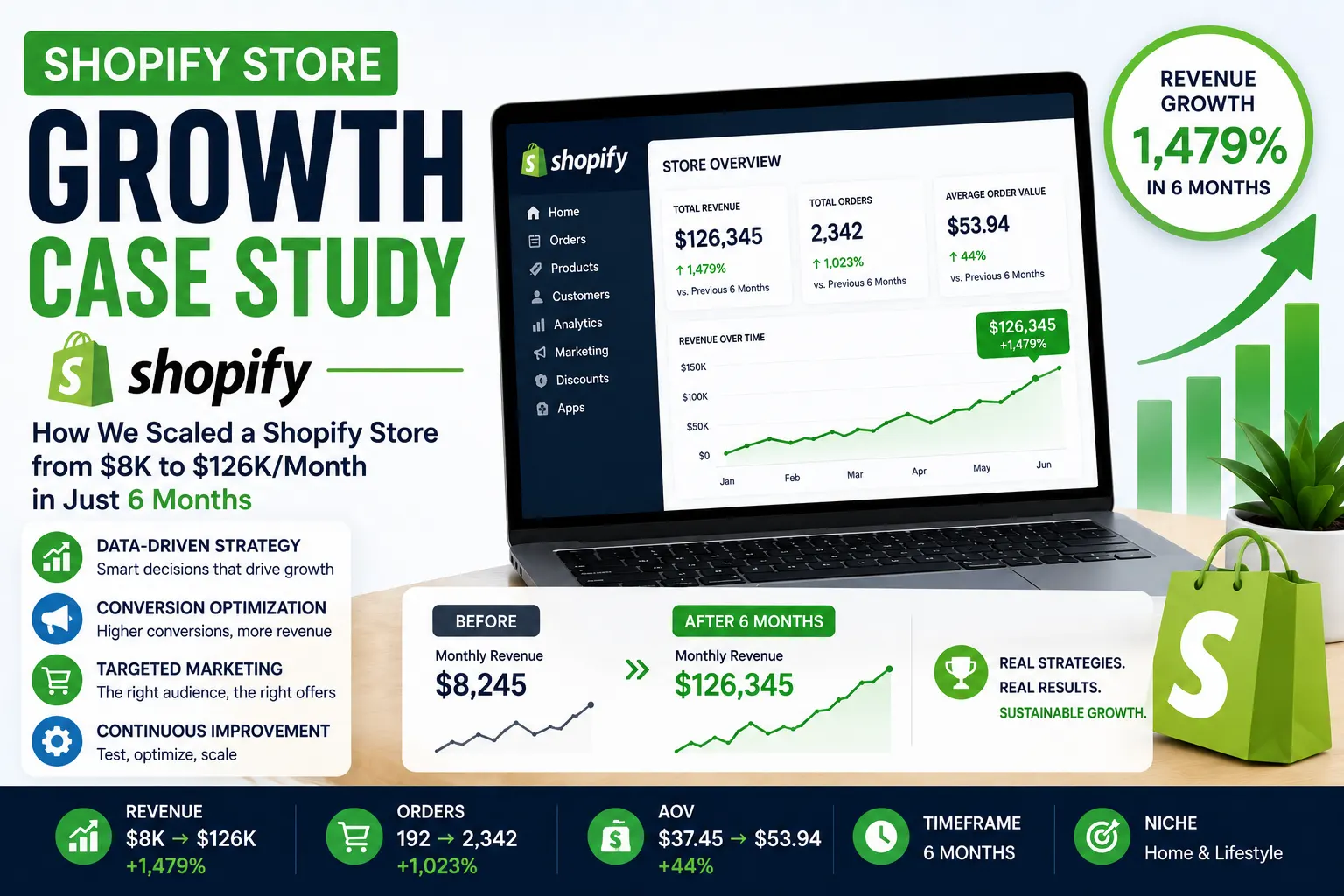
Shopify Store Growth Case Study: How Strategic Optimization Scaled Ecommerce Performance
Shopify has become one of the most popular ecommerce platforms for modern online businesses because of its flexibility, scalability, user-friendly management system, and strong ecosystem of integrations. However, launching a Shopify store alone does not guarantee ecommerce success. Many Shopify businesses struggle with low organic traffic, inconsistent conversions, high cart abandonment rates, weak branding, and rising customer acquisition costs.
Successful Shopify growth usually comes from improving the complete ecommerce ecosystem rather than relying on isolated marketing tactics. A high-performing Shopify store requires strong SEO foundations, conversion-focused design, mobile optimization, customer retention systems, performance marketing strategies, trust-building elements, fast-loading pages, and scalable operational systems.
This Shopify store growth case study explains how an ecommerce business improved overall store performance through a structured digital commerce strategy focused on SEO optimization, Shopify performance improvements, customer experience enhancements, conversion optimization, content marketing, and retention-based ecommerce growth.
The growth achieved was not the result of temporary promotional campaigns or short-term advertising spikes. Instead, the improvements came from consistent optimization across every important stage of the customer journey.
This article explains the challenges faced by the Shopify store, the optimization process implemented, the strategies that improved revenue performance, and the lessons learned while scaling ecommerce growth.
For Shopify development, ecommerce SEO services, WooCommerce development, and ecommerce website optimization, visit:
Initial Challenges Faced by the Shopify Store
Before implementing the growth strategy, the Shopify store experienced several operational and marketing limitations that affected scalability.
Although the business offered quality products and had a visually attractive storefront, the website struggled to convert traffic efficiently and lacked strong organic visibility.
The ecommerce business depended heavily on paid advertising for customer acquisition, which increased marketing costs over time.
Several major challenges affected overall growth.
Low Organic Traffic Performance
The Shopify store received limited traffic from search engines.
Important category pages and product pages ranked poorly for commercial keywords.
The website lacked:
- Strong ecommerce SEO optimization
- Content depth
- Structured keyword targeting
- Internal linking strategy
- Search intent alignment
This reduced sustainable traffic growth opportunities.
High Cart Abandonment Rates
Many visitors added products to their carts but failed to complete purchases.
The checkout process contained friction points that negatively affected conversion rates.
Weak Mobile Shopping Experience
Most traffic came from mobile devices, but the mobile experience was inconsistent.
Problems included:
- Slow-loading pages
- Poor product image optimization
- Complicated navigation
- Weak CTA visibility
- Checkout usability issues
Mobile users abandoned the site frequently.
Poor Product Page Optimization
Product pages lacked persuasive conversion-focused elements.
Several pages contained:
- Thin product descriptions
- Limited product information
- Weak visual presentation
- Minimal trust signals
- Inconsistent layouts
- Poor SEO structure
The product pages did not provide enough information to build customer confidence.
Inconsistent Branding and User Experience
The Shopify store lacked a unified customer experience.
Several pages contained inconsistent:
- Typography
- Layout structures
- Product presentation
- Visual hierarchy
- CTA styles
This affected professionalism and trust.
Rising Advertising Costs
Paid advertising costs increased steadily while conversion efficiency remained inconsistent.
The business needed stronger organic traffic and better conversion optimization to improve profitability.
Defining the Shopify Growth Objectives
Before implementing changes, the ecommerce business defined clear growth objectives.
The strategy focused on sustainable long-term ecommerce growth rather than short-term traffic spikes.
The main goals included:
- Increase Shopify store sales
- Improve conversion rates
- Increase organic traffic
- Improve mobile shopping experience
- Reduce cart abandonment
- Increase customer retention
- Improve average order value
- Strengthen SEO visibility
- Improve customer trust
- Reduce dependency on paid advertising
- Improve website performance
- Increase returning customer purchases
Clear KPIs helped prioritize high-impact optimization opportunities.
Step 1: Shopify Store Audit and Performance Analysis
The first stage involved conducting a complete Shopify store audit.
This audit analyzed:
- Shopify SEO performance
- User experience
- Mobile responsiveness
- Product page optimization
- Conversion pathways
- Website speed
- Navigation structure
- Checkout experience
- Customer behavior
- Analytics data
- Internal linking
- App performance impact
The audit identified several performance bottlenecks affecting growth.
Shopify Theme Performance Issues
The Shopify theme contained unnecessary scripts and poorly optimized design elements.
Problems included:
- Excessive JavaScript
- Large image files
- Slow rendering speed
- Heavy app integrations
These issues negatively affected page speed and user experience.
Weak SEO Foundations
The Shopify store lacked strong technical SEO optimization.
Important issues included:
- Duplicate metadata
- Thin category content
- Weak product descriptions
- Missing schema markup
- Poor internal linking
- Limited blog strategy
Search engine visibility remained limited because the website lacked topical authority.
Conversion Funnel Problems
The customer journey contained several friction points.
Analytics showed users frequently exited during:
- Product comparison stages
- Mobile navigation
- Checkout process
This indicated the need for stronger conversion optimization.
Step 2: Shopify UX and Website Redesign Improvements
The next stage focused heavily on improving the Shopify store user experience.
The redesign strategy prioritized:
- Usability
- Mobile responsiveness
- Conversion efficiency
- Visual consistency
- Customer trust
Simplifying Shopify Navigation
The navigation system was redesigned to improve product discovery.
Improvements included:
- Better category organization
- Simplified menus
- Improved search functionality
- Mobile-friendly navigation
- Cleaner product pathways
Users could find products more efficiently.
Improving Visual Hierarchy
The Shopify store previously lacked clear visual structure.
The redesign improved:
- CTA visibility
- Product focus areas
- Typography consistency
- Spacing and readability
- Layout clarity
This improved engagement and usability.
Mobile-First Shopify Optimization
Because most visitors used smartphones, mobile optimization became critical.
The Shopify store implemented:
- Faster mobile loading speed
- Responsive image optimization
- Better touch interactions
- Simplified mobile layouts
- Larger CTA buttons
- Improved checkout usability
Mobile conversion rates improved significantly.
Enhancing Brand Consistency
The store improved brand presentation using:
- Consistent design elements
- Unified typography
- Better color hierarchy
- Professional imagery
- Structured layouts
A more professional appearance improved trust and credibility.
For Shopify website development and optimization:
https://srihayavadhana.com/shopify-development-company/
Step 3: Shopify SEO Strategy Implementation
SEO became one of the most important long-term growth channels.
Instead of depending entirely on paid advertising, the Shopify business invested in sustainable organic growth.
Ecommerce Keyword Research
The keyword research strategy focused on:
- Transactional keywords
- Product-focused queries
- Category page opportunities
- Long-tail ecommerce searches
- Informational search intent
The strategy targeted keywords with strong commercial intent.
Optimizing Shopify Collection Pages
Collection pages were optimized to improve rankings for category-level search terms.
Improvements included:
- SEO-focused introductory content
- Better metadata
- Structured headings
- Internal linking
- Keyword optimization
Collection pages became major organic traffic drivers.
Shopify Product Page SEO
Product pages were optimized individually.
The strategy included:
- Unique product descriptions
- Optimized alt text
- Better metadata
- Product FAQs
- Structured data implementation
- Search intent optimization
This improved both rankings and conversions.
Content Marketing Strategy
The Shopify business implemented a long-form content strategy.
The blog content included:
- Buying guides
- Product comparison articles
- Educational content
- Ecommerce trend articles
- Customer-focused resources
Long-form content improved:
- Organic traffic
- Topical authority
- Internal linking opportunities
- Customer trust
Technical SEO Improvements
Technical SEO optimization included:
- Sitemap optimization
- Schema markup implementation
- Canonical tag fixes
- Crawlability improvements
- Page speed optimization
These changes strengthened Shopify SEO performance.
For ecommerce SEO services and Shopify optimization:
https://srihayavadhana.com/ecommerce-seo-services/
Step 4: Shopify Conversion Rate Optimization
Traffic growth alone would not maximize revenue.
The Shopify business also required strong conversion optimization.
Product Page Conversion Improvements
Product pages were redesigned using conversion-focused layouts.
Improvements included:
- Better product imagery
- Detailed descriptions
- FAQ integration
- Trust badges
- Customer reviews
- Shipping visibility
- Related product recommendations
These elements improved purchase confidence.
CTA Optimization
Call-to-action sections were redesigned.
The strategy focused on:
- Better visibility
- Action-oriented copy
- Improved button placement
- Mobile optimization
CTA engagement improved significantly.
Trust Signal Integration
Trust-building elements were added throughout the Shopify store.
These included:
- Secure payment badges
- Return policy visibility
- Custom