Blog
UX Case Studies in Ecommerce

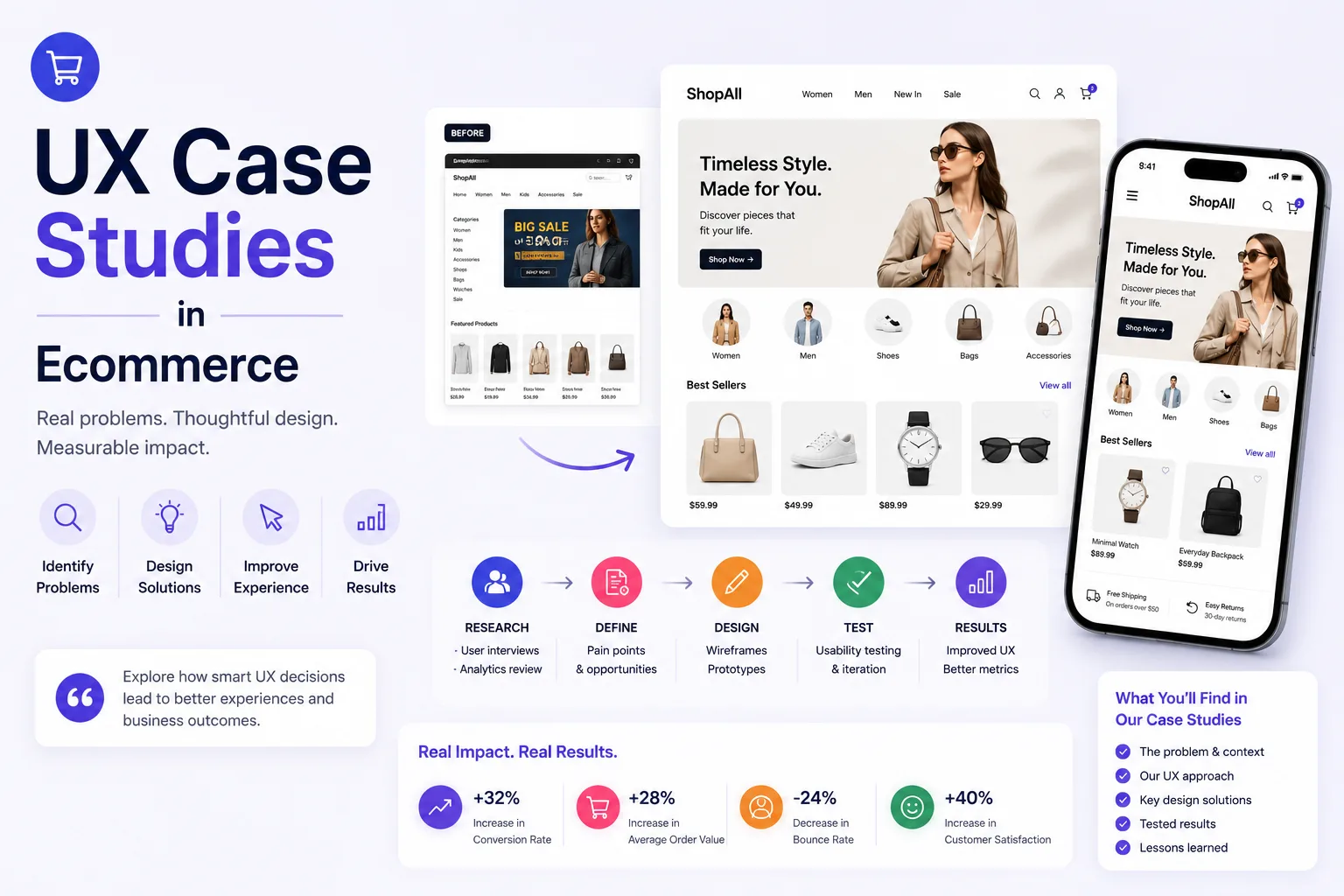
Introduction to UX Case Studies in Ecommerce
User experience has become one of the most important competitive advantages in ecommerce. Modern online shoppers expect ecommerce websites to feel intuitive, fast, visually appealing, mobile-friendly, and effortless to navigate. Customers no longer compare ecommerce businesses only based on product pricing or discounts. Instead, they evaluate entire shopping experiences, including website usability, navigation flow, search functionality, product discovery, mobile responsiveness, checkout simplicity, loading speed, and overall convenience.
As ecommerce competition continues increasing globally, businesses that prioritize user experience consistently outperform competitors in customer retention, conversion optimization, SEO visibility, and long-term revenue growth. UX case studies in ecommerce provide valuable insights into how strategic design improvements can transform customer behavior and dramatically improve business performance.
Studying ecommerce UX case studies helps businesses understand:
- What works in real-world ecommerce environments
- Which UX improvements increase conversions
- How customers behave while shopping online
- Why usability directly affects sales performance
- How design decisions influence customer trust
Successful ecommerce UX combines:
- User-centered design
- Mobile optimization
- Fast-loading interfaces
- Simplified navigation
- Conversion-focused layouts
- Customer psychology
- Accessibility standards
UX case studies reveal how small improvements in usability often create significant increases in ecommerce revenue. In many cases, simplifying navigation, improving search functionality, optimizing mobile experiences, or redesigning checkout systems leads to measurable business growth without increasing advertising budgets.
This comprehensive guide explores UX case studies in ecommerce in depth, covering homepage optimization, navigation design, mobile UX, checkout optimization, search usability, product page improvements, accessibility, personalization, trust-building strategies, and future ecommerce UX trends shaping online retail experiences in 2026 and beyond.
Why UX Matters in Ecommerce
User experience directly influences how customers interact with ecommerce websites. Unlike physical retail stores where customers can touch products and interact with sales representatives, ecommerce businesses rely entirely on digital experiences to build trust and encourage purchases.
Poor UX creates friction throughout the customer journey, leading to:
- Higher bounce rates
- Lower engagement
- Reduced product discovery
- Cart abandonment
- Lower customer retention
Strong UX improves:
- Product exploration
- Conversion rates
- Customer satisfaction
- Brand perception
- Repeat purchases
Modern ecommerce customers expect websites to provide:
- Fast loading speed
- Clear navigation
- Mobile responsiveness
- Simplified checkout
- Intuitive browsing experiences
Businesses that fail to meet these expectations often lose customers quickly to competitors with better UX systems.
UX optimization also affects:
- SEO performance
- Advertising ROI
- Customer trust
- Lifetime customer value
Successful ecommerce businesses treat UX as a strategic growth investment rather than simply a visual design task.
Understanding Ecommerce UX Case Studies
UX case studies analyze real ecommerce usability challenges, customer behavior patterns, and design improvements that produced measurable business results.
Strong ecommerce UX case studies typically examine:
- Existing usability problems
- Customer pain points
- Research insights
- UX redesign strategies
- Conversion improvements
- Customer engagement metrics
Case studies help businesses understand how UX decisions influence ecommerce performance in practical situations.
Unlike theoretical UX discussions, case studies reveal:
- Actual customer behavior
- Measurable business impact
- Real usability improvements
- Conversion optimization strategies
Ecommerce UX case studies often focus on areas such as:
- Homepage redesigns
- Mobile UX optimization
- Navigation improvements
- Checkout simplification
- Product page usability
- Search optimization
Businesses studying ecommerce UX case studies can apply proven usability principles to improve their own websites more effectively.
Case Study: Homepage UX Optimization
One of the most common ecommerce UX challenges involves homepage design and product discovery.
Many ecommerce websites initially struggle because their homepages:
- Feel cluttered
- Lack clear hierarchy
- Overload users with promotions
- Hide important product categories
- Create navigation confusion
In one common ecommerce UX scenario, businesses redesigned homepage layouts by:
- Simplifying hero sections
- Improving navigation visibility
- Highlighting featured categories
- Reducing visual clutter
- Improving mobile responsiveness
These changes often result in:
- Higher session duration
- Increased category exploration
- Improved conversion rates
- Lower bounce rates
Successful homepage UX optimization prioritizes:
- Product visibility
- Clear messaging
- Strong visual hierarchy
- Mobile-first usability
Modern ecommerce homepage strategies often focus heavily on minimalism and faster customer decision-making.
Businesses seeking conversion-focused ecommerce homepage improvements often work with experienced UX and ecommerce development specialists such as Sri Hayavadhana Solutions to create optimized shopping experiences tailored for usability, branding, and SEO performance.
Case Study: Mobile UX Improvements
Mobile ecommerce UX has become one of the most important areas of optimization because smartphones now dominate ecommerce traffic globally.
Many ecommerce stores initially experience:
- High mobile bounce rates
- Poor mobile conversions
- Difficult navigation
- Slow loading speeds
In several ecommerce UX redesign projects, businesses improved mobile performance by:
- Simplifying navigation systems
- Adding sticky CTA buttons
- Optimizing image sizes
- Improving touch interactions
- Reducing mobile clutter
These mobile UX improvements often lead to:
- Higher conversion rates
- Increased mobile revenue
- Better engagement
- Improved SEO visibility
Mobile UX optimization typically focuses on:
- Thumb-friendly interfaces
- Faster loading speeds
- Simplified forms
- Responsive layouts
Case studies repeatedly show that mobile-first UX strategies significantly improve ecommerce business performance.
Case Study: Checkout UX Optimization
Checkout optimization is one of the most impactful areas of ecommerce UX because checkout friction directly affects revenue generation.
Many ecommerce websites lose sales because of:
- Long checkout forms
- Mandatory account creation
- Hidden shipping costs
- Weak payment flexibility
- Poor mobile usability
In many UX case studies, businesses redesigned checkout systems by:
- Reducing form fields
- Enabling guest checkout
- Adding digital wallet support
- Improving mobile payment UX
- Simplifying checkout steps
These improvements often produce:
- Lower cart abandonment
- Faster checkout completion
- Higher conversion rates
- Improved customer satisfaction
Successful checkout UX focuses on:
- Simplicity
- Transparency
- Trust
- Speed
Checkout redesigns frequently deliver some of the highest ROI among ecommerce UX optimization projects.
Case Study: Navigation Redesign
Navigation problems are among the most common usability issues in ecommerce.
Many ecommerce stores initially create overly complex navigation systems that confuse customers and reduce product discovery.
Navigation UX case studies often involve:
- Simplifying menu structures
- Improving category organization
- Enhancing search systems
- Adding mega menus
- Improving mobile navigation
Results frequently include:
- Higher product discovery
- Improved browsing depth
- Better engagement metrics
- Increased sales
Strong navigation UX helps customers:
- Locate products quickly
- Understand website structure
- Browse confidently
Businesses continuously optimizing navigation systems often experience long-term improvements in ecommerce usability and customer retention.
Case Study: Ecommerce Search UX
Search functionality strongly affects ecommerce conversion performance because many customers prefer searching directly instead of browsing categories manually.
Weak ecommerce search systems often create:
- Frustration
- Poor product discovery
- Reduced conversions
UX improvements in ecommerce search systems commonly include:
- Predictive search
- Typo correction
- Product thumbnails
- Search filtering
- AI-powered recommendations
These changes often improve:
- Search engagement
- Product visibility
- Purchase completion
- Average order value
Search UX optimization remains especially important for ecommerce stores with large product catalogs.
Modern ecommerce customers expect search systems to feel fast, intelligent, and highly accurate.
Case Study: Product Page UX Optimization
Product pages are among the most conversion-focused areas of ecommerce websites.
Many ecommerce businesses initially struggle with:
- Weak product imagery
- Poor descriptions
- Cluttered layouts
- Hidden shipping information
- Weak CTA visibility
Product page UX redesigns often focus on:
- Improving image quality
- Adding lifestyle photography
- Simplifying layouts
- Improving review visibility
- Enhancing mobile usability
Successful product page UX improvements typically increase:
- Add-to-cart rates
- Customer trust
- Product engagement
- Conversion performance
Modern ecommerce product pages emphasize:
- Visual storytelling
- Trust-building
- Simplicity
- Mobile responsiveness
UX-focused product page optimization often creates measurable ecommerce growth.
Case Study: Trust-Building UX Improvements
Trust is one of the most important conversion factors in ecommerce because customers cannot physically inspect products before purchasing.
Many ecommerce UX case studies focus on improving customer trust through:
- Professional branding
- Customer reviews
- Secure payment indicators
- Transparent policies
- Shipping clarity
Businesses implementing stronger trust-focused UX often experience:
- Higher conversions
- Lower bounce rates
- Increased repeat purchases
Trust-building UX improvements frequently involve:
- Better homepage messaging
- Improved visual consistency
- Stronger review systems
- More visible guarantees
Trust-focused ecommerce UX helps reduce customer hesitation and improve purchase confidence.
Case Study: Simplifying User Interfaces
Overly complicated ecommerce interfaces often overwhelm customers and reduce usability.
Many UX case studies reveal that simplifying ecommerce layouts improves:
- Product focus
- Navigation clarity
- Mobile usability
- Conversion rates
Common simplification strategies include:
- Reducing unnecessary elements
- Improving whitespace usage
- Simplifying navigation
- Removing distractions
Minimalist UX approaches often perform especially well because they reduce cognitive load and help customers focus on products.
Simplified ecommerce experiences typically feel:
- Faster
- More modern
- More trustworthy
Businesses reducing visual clutter often see measurable UX improvements.
Case Study: Speed Optimization and UX
Website speed strongly affects ecommerce UX because customers expect pages to load almost instantly.
Slow-loading ecommerce websites often experience:
- High bounce rates
- Reduced engagement
- Lower conversions
UX speed optimization projects frequently involve:
- Compressing images
- Reducing scripts
- Using modern image formats
- Implementing caching systems
- Optimizing hosting environments
Performance improvements often produce:
- Better SEO rankings
- Higher conversions
- Increased customer satisfaction
Speed optimization is both a UX improvement and an SEO strategy.
Helpful performance resources:
Case Study: Personalization in Ecommerce UX
Personalization improves ecommerce UX by making shopping experiences more relevant and engaging.
Many ecommerce brands improve UX through:
- Product recommendations
- Personalized promotions
- Dynamic homepage content
- Recently viewed products
AI-powered personalization often increases:
- Product discovery
- Average order value
- Customer retention
- Engagement
UX case studies repeatedly show that personalized shopping experiences improve customer satisfaction significantly.
Personalization is expected to become even more important in future ecommerce UX strategies.
Case Study: Accessibility Improvements
Accessibility improvements often benefit all ecommerce users, not only users with disabilities.
Accessible ecommerce UX improvements commonly include:
- Better contrast ratios
- Improved typography
- Keyboard navigation
- Screen reader support
- Alt text optimization
Accessibility-focused UX redesigns often improve:
- SEO visibility
- User satisfaction
- Website usability
Accessible ecommerce design creates broader customer reach and better compliance standards.
Helpful accessibility resource:
Lessons Learned from Ecommerce UX Case Studies
Across multiple ecommerce UX case studies, several common patterns consistently emerge.
Successful ecommerce UX improvements usually prioritize:
- Simplicity
- Mobile usability
- Fast loading speed
- Clear navigation
- Strong visual hierarchy
- Trust-building
Case studies repeatedly show that:
- Reducing friction improves conversions
- Faster websites increase engagement
- Better navigation improves product discovery
- Mobile optimization boosts revenue
- Simpler interfaces improve usability
UX optimization is rarely about dramatic visual redesigns alone.
Often, small usability improvements create major business impact.
Successful ecommerce businesses continuously test and optimize UX rather than treating design as a one-time project.
Ecommerce UX Metrics Used in Case Studies
UX case studies typically evaluate business impact using measurable performance metrics.
Important ecommerce UX metrics include:
- Bounce rate
- Session duration
- Conversion rate
- Add-to-cart rate
- Checkout completion rate
- Mobile engagement
- Product page views
Heatmaps and customer behavior tools also help businesses analyze:
- Scrolling behavior
- Click patterns
- Navigation flow
- Friction points
Helpful UX analytics resources include:
UX optimization should remain data-driven rather than based purely on visual preferences.
Future Trends in Ecommerce UX
Ecommerce UX continues evolving rapidly as customer expectations and technologies advance.
Future ecommerce UX trends may include:
- AI-driven personalization
- Voice commerce
- Augmented reality shopping
- Predictive product recommendations
- Immersive mobile experiences
- Dynamic interfaces
AI-powered UX systems may eventually personalize:
- Layouts
- Navigation
- Product recommendations
- Color systems
based on customer behavior in real time.
Minimalist and mobile-first UX trends will likely continue growing because customers increasingly prioritize simplicity and convenience.
Businesses adapting early to emerging UX technologies will remain more competitive in future ecommerce markets.
Final Thoughts
UX plays a central role in ecommerce success because it influences customer behavior, trust, usability, engagement, and conversion performance.
Ecommerce UX case studies consistently demonstrate that strategic usability improvements can create significant business growth without increasing advertising budgets.
Successful ecommerce UX combines:
- Mobile-first design
- Fast performance
- Simplified navigation
- Conversion-focused layouts
- Trust-building strategies
- Accessibility optimization
Modern ecommerce customers expect websites to feel intuitive, seamless, and effortless across every device.
Businesses investing in UX optimization often achieve:
- Higher conversion rates
- Better customer retention
- Improved SEO performance
- Stronger engagement
- Increased ecommerce revenue
Whether building Shopify stores, WooCommerce websites, Magento platforms, or custom ecommerce applications, UX strategy should remain a continuous business priority.
The future of ecommerce will increasingly revolve around personalized experiences, AI-driven usability, mobile convenience, and frictionless customer journeys. Businesses that consistently improve UX and customer satisfaction will remain competitive and profitable in the evolving digital commerce industry.