Blog
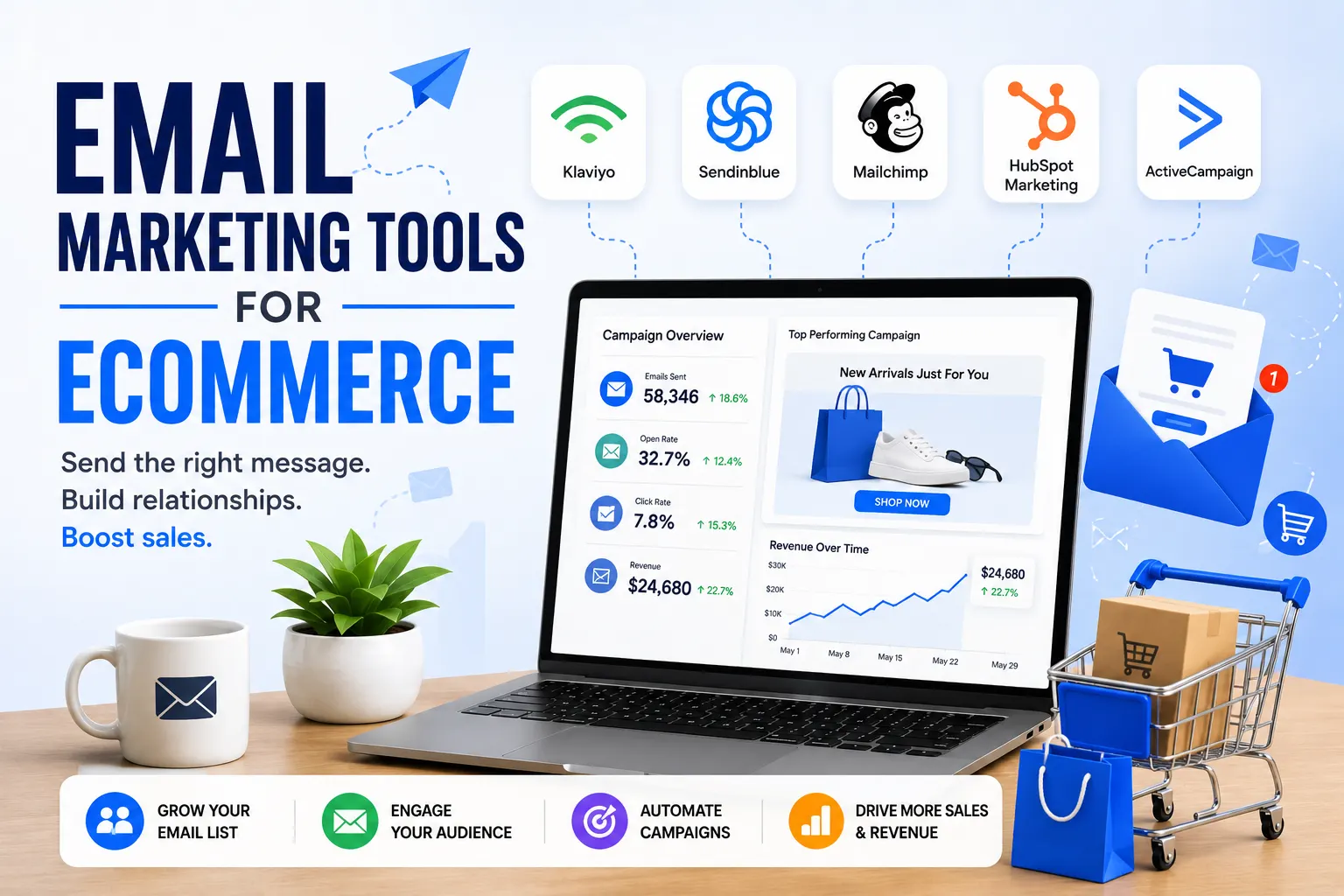
Email Marketing Tools for Ecommerce

rama
Introduction
Email marketing remains one of the highest ROI channels in eCommerce. Despite the rapid growth of social media marketing, influencer campaigns, paid advertising, and AI-driven customer acquisition systems, email marketing continues delivering consistent revenue, strong customer retention, and long-term profitability for online businesses.
Unlike paid advertising platforms where businesses constantly spend money to maintain visibility, email marketing allows brands to build direct relationships with customers through owned communication channels. This makes email one of the most sustainable and scalable marketing assets in modern eCommerce.
Today’s eCommerce customers expect personalized communication throughout the buying journey.
This includes:
- Welcome emails
- Product recommendations
- Cart abandonment reminders
- Post-purchase follow-ups
- Loyalty campaigns
- Re-engagement sequences
- Promotional newsletters
- Subscription notifications
Without effective email systems, businesses often struggle to retain customers, recover abandoned carts, and maximize customer lifetime value.
Modern eCommerce email marketing is no longer limited to sending newsletters manually. Advanced email marketing tools now support:
- Behavioral automation
- AI-driven personalization
- Customer segmentation
- Predictive analytics
- SMS integration
- Omnichannel communication
- Dynamic product recommendations
- Revenue attribution
- Lifecycle marketing
According to industry studies, email marketing consistently generates some of the highest returns among digital marketing channels for eCommerce businesses. Retention-focused email automation significantly improves profitability because repeat customers often spend more and convert faster than first-time buyers. (shopify.com)
However, choosing the right email marketing tool for eCommerce can be challenging because different platforms focus on different capabilities.
Some specialize in:
- Advanced automation
- SMS marketing
- Personalization
- Subscription commerce
- CRM integration
- Enterprise segmentation
- Omnichannel messaging
This comprehensive guide explains the best email marketing tools for eCommerce in 2026, including:
- Email automation platforms
- Customer retention systems
- SMS marketing tools
- AI-powered personalization tools
- Shopify email marketing apps
- WooCommerce email marketing tools
- Lifecycle marketing platforms
- Enterprise email systems
- Omnichannel marketing solutions
The goal is to help businesses build scalable email marketing systems that improve customer engagement, retention, and long-term revenue growth.
Why Email Marketing Matters for Ecommerce Businesses
Many businesses focus heavily on customer acquisition while underestimating the importance of retention marketing.
Acquiring new customers is becoming increasingly expensive due to:
- Rising advertising costs
- Increased competition
- Privacy restrictions
- Platform dependency
Email marketing helps businesses reduce dependency on paid acquisition by improving customer retention and repeat purchases.
Higher ROI
Email marketing often generates stronger ROI compared to many paid advertising channels because communication costs remain relatively low.
Customer Retention
Retention campaigns encourage repeat purchases and improve customer lifetime value.
Cart Recovery
Abandoned cart automation helps recover lost revenue.
Personalized Customer Journeys
Behavioral automation creates more relevant customer experiences.
Ownership of Audience
Unlike social media platforms, email lists are owned assets controlled by the business.
This makes email marketing strategically important for long-term growth.
Key Features to Look for in Ecommerce Email Marketing Tools
Not every email platform is designed specifically for eCommerce workflows.
Businesses should evaluate tools based on operational requirements.
Automation Capabilities
Advanced automation supports:
- Welcome sequences
- Cart abandonment emails
- Post-purchase flows
- Win-back campaigns
- Loyalty automation
Customer Segmentation
Segmentation allows businesses to target customers based on:
- Purchase history
- Location
- Browsing behavior
- Average order value
- Customer lifetime value
SMS Integration
Many platforms now combine:
- Email marketing
- SMS marketing
- Push notifications
Ecommerce Integrations
Strong integrations with:
- Shopify
- WooCommerce
- Magento
- CRM systems
- Analytics tools
improve operational efficiency.
Personalization Features
Modern email marketing increasingly depends on dynamic personalization.
Deliverability
Strong deliverability infrastructure helps ensure emails reach inboxes instead of spam folders.
Best Email Marketing Tools for Ecommerce
Klaviyo
Klaviyo is widely considered one of the best email marketing platforms for eCommerce businesses.
The platform specializes heavily in:
- Email automation
- SMS marketing
- Behavioral segmentation
- Revenue attribution
- Personalized customer journeys
Klaviyo integrates deeply with major eCommerce platforms including:
- Shopify
- WooCommerce
- Magento
- BigCommerce
Key features include:
- Advanced automation flows
- Predictive analytics
- AI-powered segmentation
- Dynamic product recommendations
- Customer lifecycle tracking
- SMS campaigns
Klaviyo is especially effective for businesses focused on customer retention and lifecycle marketing.
The platform’s ability to centralize customer data helps businesses create highly personalized marketing campaigns.
Many high-growth D2C brands rely on Klaviyo because of its scalability and strong automation ecosystem.
Official website: Klaviyo
Omnisend
Omnisend is another powerful email and SMS marketing platform built specifically for eCommerce businesses.
Compared to some enterprise-level systems, Omnisend is more beginner-friendly while still offering advanced automation functionality.
Features include:
- Email campaigns
- SMS marketing
- Push notifications
- Automation workflows
- Product recommendations
- Audience segmentation
Omnisend helps businesses manage omnichannel communication through a centralized interface.
The platform is especially suitable for:
- Small businesses
- Growing Shopify stores
- Mid-sized eCommerce brands
Its visual workflow builder simplifies automation creation for non-technical teams.
Official website: Omnisend
Mailchimp
Mailchimp remains one of the most recognized email marketing platforms globally.
Although it originally focused on general email marketing, the platform has expanded significantly into eCommerce automation.
Features include:
- Email templates
- Audience segmentation
- Marketing automation
- Product recommendations
- Behavioral targeting
- Customer journeys
Mailchimp integrates with major eCommerce platforms and remains especially useful for beginners and smaller businesses.
The platform’s interface is easy to use and widely adopted.
Official website: Mailchimp
Brevo
Brevo, formerly known as Sendinblue, combines:
- Email marketing
- SMS campaigns
- CRM functionality
- Transactional emails
- Marketing automation
Brevo is especially attractive for businesses seeking affordable omnichannel communication systems.
The platform supports:
- Automated workflows
- Segmentation
- Personalization
- Sales CRM integration
Official website: Brevo
ActiveCampaign
ActiveCampaign combines advanced email marketing with CRM automation.
Features include:
- Customer segmentation
- Behavioral automation
- Dynamic content
- CRM workflows
- Lead scoring
The platform is particularly valuable for businesses requiring sophisticated customer journey automation.
Official website: ActiveCampaign
Best SMS and Omnichannel Marketing Tools
Modern customer communication increasingly extends beyond email alone.
Attentive
Attentive focuses heavily on SMS marketing for eCommerce.
Features include:
- SMS campaigns
- Behavioral targeting
- Personalized messaging
- Mobile engagement
The platform integrates closely with Shopify and other eCommerce systems.
Official website: Attentive
Postscript
Postscript specializes in SMS marketing for Shopify businesses.
It supports:
- Cart recovery
- Promotional campaigns
- Subscriber segmentation
- Automated SMS flows
SMS marketing continues growing rapidly because of high open rates and mobile-first customer behavior.
Official website: Postscript
Best Shopify Email Marketing Tools
Shopify businesses often require platform-specific integrations.
Popular Shopify email tools include:
- Klaviyo
- Omnisend
- Shopify Email
- Postscript
- Attentive
Shopify Email
Shopify Email provides built-in email marketing functionality directly within the Shopify ecosystem.
Features include:
- Product-based templates
- Customer segmentation
- Campaign analytics
The platform is suitable for smaller businesses seeking simplified workflows.
Official website: Shopify Email
Professional Shopify optimization can further improve email automation performance and customer lifecycle marketing.
Businesses can explore Shopify development services at Sri Hayavadhana Solutions
Best WooCommerce Email Marketing Tools
WooCommerce businesses require WordPress-compatible email systems.
Popular WooCommerce email tools include:
- Mailchimp
- Klaviyo
- Brevo
- ActiveCampaign
- FluentCRM
FluentCRM
FluentCRM is a WordPress-native CRM and email marketing platform.
It supports:
- Automation
- Email campaigns
- Funnel creation
- Customer segmentation
WooCommerce businesses often prefer FluentCRM for deeper WordPress integration.
Official website: FluentCRM
Best AI-Powered Email Marketing Tools
Artificial intelligence increasingly shapes eCommerce email strategies.
Seventh Sense
Seventh Sense uses AI to optimize email send times based on customer behavior.
This improves:
- Open rates
- Engagement
- Deliverability
Official website: Seventh Sense
Phrasee
Phrasee focuses on AI-generated marketing copy optimization.
It helps businesses improve:
- Subject lines
- Email engagement
- Conversion performance
Official website: Phrasee
Essential Ecommerce Email Automations
Successful eCommerce brands rely heavily on automated workflows.
Welcome Email Series
Introduces new subscribers to the brand.
Cart Abandonment Emails
Recover incomplete purchases.
Browse Abandonment Emails
Re-engage visitors who viewed products without purchasing.
Post-Purchase Sequences
Improve retention and customer satisfaction.
Win-Back Campaigns
Re-engage inactive customers.
Loyalty Campaigns
Encourage repeat purchases.
Automation significantly improves marketing efficiency and customer retention.
Ecommerce Email Segmentation Strategies
Segmentation is critical for personalization.
Businesses commonly segment customers based on:
Purchase History
Different products require different messaging strategies.
Customer Lifetime Value
High-value customers may receive exclusive campaigns.
Engagement Behavior
Inactive subscribers require re-engagement strategies.
Geographic Location
Regional promotions improve relevance.
Device Usage
Mobile-first communication improves engagement.
Advanced segmentation increases email relevance and conversion performance.
Deliverability and Inbox Placement
Deliverability directly affects campaign success.
Even strong campaigns fail if emails land in spam folders.
Important deliverability factors include:
- Domain reputation
- Email authentication
- Subscriber engagement
- List hygiene
- Spam compliance
Businesses should prioritize tools with strong infrastructure and deliverability support.
Common Ecommerce Email Marketing Mistakes
Sending Too Many Emails
Excessive frequency increases unsubscribe rates.
Poor Mobile Optimization
Most customers read emails on mobile devices.
Weak Segmentation
Generic campaigns reduce engagement.
Ignoring Deliverability
Poor domain practices hurt inbox placement.
Weak Automation Strategy
Manual campaigns limit scalability.
Overly Promotional Messaging
Balanced content improves long-term engagement.
Best Metrics to Track in Ecommerce Email Marketing
Businesses should monitor:
Open Rate
Measures subject line effectiveness.
Click-Through Rate
Measures engagement quality.
Conversion Rate
Tracks sales performance.
Revenue Per Email
Evaluates campaign profitability.
Unsubscribe Rate
Measures audience dissatisfaction.
Customer Lifetime Value
Evaluates long-term retention performance.
Email Marketing and Customer Retention
Retention is one of the most profitable aspects of eCommerce growth.
Email marketing supports retention through:
- Personalized communication
- Loyalty rewards
- Educational content
- Product recommendations
- Subscription reminders
Repeat customers often generate significantly higher profitability compared to first-time buyers.
Email Marketing and SEO: The Hidden Relationship
Although email marketing does not directly improve search rankings, it indirectly supports SEO through:
- Increased brand searches
- Higher repeat traffic
- Improved customer engagement
- Content distribution
- Returning visitors
Businesses combining email marketing with SEO strategies often build stronger long-term digital ecosystems.
For advanced eCommerce SEO implementation, businesses can explore Sri Hayavadhana Solutions
The Future of Ecommerce Email Marketing
Several trends are shaping the future of email marketing.
AI-Powered Personalization
Campaigns will become increasingly individualized.
Predictive Customer Journeys
AI systems will anticipate customer needs.
Omnichannel Automation
Email, SMS, push notifications, and social messaging will integrate more deeply.
Privacy-Focused Marketing
First-party data collection will become increasingly important.
Interactive Emails
Future campaigns may support richer interactive experiences.
Why Professional Ecommerce Development Matters for Email Marketing
Email marketing systems work best when integrated properly into the eCommerce ecosystem.
Professional development improves:
- Tracking accuracy
- Customer segmentation
- Checkout integration
- Event automation
- Mobile optimization
Weak implementation limits automation quality and reporting accuracy.
Businesses planning long-term growth often combine advanced email marketing systems with professional eCommerce development.
Custom eCommerce development services are available at Sri Hayavadhana Solutions
Building the Ideal Ecommerce Email Marketing Stack
Beginner Stack
- Mailchimp
- Shopify Email
- Brevo
Intermediate Stack
- Klaviyo
- Omnisend
- Postscript
Enterprise Stack
- Klaviyo
- ActiveCampaign
- Attentive
- AI personalization systems
The right stack depends on business size, complexity, and customer lifecycle requirements.
Final Thoughts
Email marketing remains one of the most important growth channels for eCommerce businesses.
The best email marketing tools for eCommerce help businesses:
- Improve customer retention
- Increase repeat purchases
- Recover abandoned carts
- Personalize customer journeys
- Improve lifetime value
- Scale omnichannel communication
Platforms such as Klaviyo, Omnisend, Mailchimp, ActiveCampaign, Brevo, Postscript, and Attentive each offer different strengths for different business models.
Successful eCommerce brands increasingly rely on automated, personalized, data-driven communication systems instead of generic mass-email campaigns.
As AI, automation, and customer personalization continue evolving, businesses that invest in advanced email marketing infrastructure will gain stronger competitive advantages through better retention, higher customer loyalty, and improved long-term profitability.
Combining email marketing systems with strong SEO, analytics, CRO, and professional eCommerce development creates a scalable foundation for sustainable online growth in 2026 and beyond.