Blog
AI Tools for Ecommerce Growth

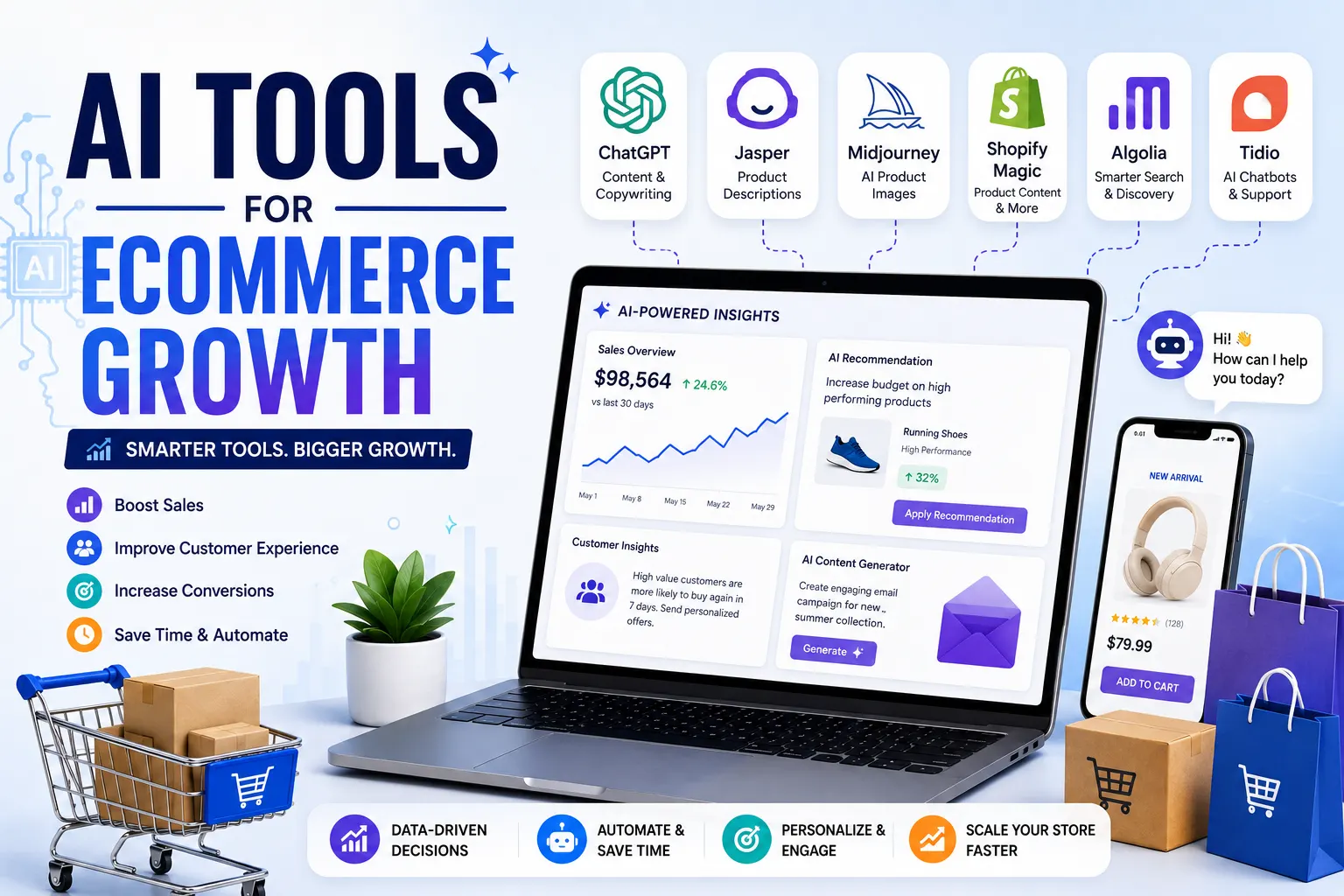
The Complete Ecommerce AI Strategy Guide for Modern Online Stores
Artificial intelligence is transforming ecommerce faster than almost any other technology shift in digital business history. Online stores are no longer competing only on pricing, product variety, or shipping speed. Today, ecommerce growth depends heavily on personalization, automation, customer experience, predictive analytics, intelligent marketing, and operational efficiency. AI tools help ecommerce businesses improve all of these areas while reducing manual work and improving scalability.
From small Shopify startups to enterprise-level ecommerce brands, businesses are increasingly using artificial intelligence to improve conversions, automate customer support, optimize SEO, personalize shopping journeys, forecast inventory demand, and increase customer retention. AI-powered ecommerce strategies are becoming essential for sustainable long-term growth.
Many ecommerce businesses face similar challenges. They struggle with abandoned carts, rising advertising costs, slow customer support, inconsistent content production, inventory forecasting issues, low organic traffic, and declining customer engagement. AI tools help solve these problems by analyzing data, automating workflows, and delivering intelligent recommendations based on customer behavior.
Artificial intelligence is no longer limited to large technology companies with massive budgets. Today, affordable AI tools are available for startups, DTC brands, WooCommerce websites, Shopify stores, B2B ecommerce businesses, and multivendor marketplaces. Businesses of every size can now use AI to improve efficiency, create better customer experiences, and increase revenue.
This comprehensive guide explores how AI tools support ecommerce growth, the most important AI technologies used in online stores, the benefits of AI automation, and how ecommerce businesses can implement AI effectively. The article also covers AI tools for SEO, marketing, customer support, inventory management, personalization, product recommendations, and conversion optimization.
For ecommerce website development, Shopify development, WooCommerce development, SEO optimization, and ecommerce growth solutions, visit:
What Are AI Tools in Ecommerce?
AI tools in ecommerce are software platforms and intelligent systems that use artificial intelligence technologies such as machine learning, predictive analytics, automation, computer vision, and natural language processing to improve ecommerce operations and customer experiences.
Traditional ecommerce systems often require large amounts of manual effort. Teams must manually create product descriptions, respond to customer support tickets, optimize ad campaigns, manage inventory, analyze reports, and improve SEO. AI tools automate many of these tasks while improving accuracy and efficiency.
Artificial intelligence systems learn from data patterns. Ecommerce AI tools analyze customer behavior, browsing activity, purchasing trends, engagement signals, search intent, and operational data to make intelligent recommendations and automate repetitive processes.
For example, AI recommendation engines can suggest products based on customer browsing history. AI chatbots can answer customer questions instantly. AI SEO tools can identify ranking opportunities and optimize ecommerce content for search engines.
The primary goal of AI in ecommerce is to improve business performance while enhancing customer experiences. Businesses using AI effectively often see improvements in:
- Conversion rates
- Customer retention
- Organic traffic
- Marketing ROI
- Inventory accuracy
- Operational efficiency
- Average order value
- Customer satisfaction
- Revenue growth
As ecommerce competition continues increasing globally, AI is becoming a critical competitive advantage for digital businesses.
Why AI Is Important for Ecommerce Growth
The ecommerce industry is evolving rapidly. Customers expect fast-loading websites, personalized product recommendations, quick customer support, seamless mobile experiences, and highly relevant marketing messages. Businesses that fail to meet these expectations often struggle to retain customers.
AI tools help ecommerce companies meet modern customer expectations while improving internal operations.
One of the biggest reasons AI matters in ecommerce is scalability. As ecommerce businesses grow, manual workflows become difficult to manage efficiently. AI automation helps businesses handle larger product catalogs, increased traffic, higher order volumes, and more customer interactions without requiring proportional increases in staffing.
AI also improves business intelligence. Instead of relying on assumptions, ecommerce businesses can make data-driven decisions based on customer behavior and predictive analytics.
For example, AI systems can identify:
- Which products customers are most likely to purchase
- Which visitors are most likely to abandon carts
- Which marketing campaigns generate the highest ROI
- Which products may go out of stock soon
- Which customer segments have the highest lifetime value
This level of insight helps ecommerce businesses improve profitability and efficiency.
AI also supports personalization at scale. Modern shoppers expect online stores to provide relevant recommendations and tailored experiences. AI-powered personalization improves customer engagement while increasing conversion rates.
Businesses that adopt AI early often gain competitive advantages because they can operate more efficiently and respond faster to changing customer behaviors.
Major Benefits of AI Tools for Ecommerce Businesses
Artificial intelligence offers numerous advantages for ecommerce businesses across marketing, operations, customer experience, and analytics.
Improved Customer Experience
Customer experience plays a major role in ecommerce success. AI tools help businesses deliver faster, more personalized, and more efficient shopping experiences.
AI-powered recommendation systems help customers discover relevant products quickly. AI chatbots provide instant support without requiring customers to wait for human agents. Personalized email campaigns improve engagement by showing products and offers tailored to customer preferences.
Better customer experiences often lead to:
- Higher conversion rates
- Increased customer loyalty
- Better retention
- Improved customer satisfaction
- Stronger brand reputation
Increased Operational Efficiency
AI automates repetitive tasks that normally require manual work.
Examples include:
- Content generation
- Customer support automation
- Product tagging
- Inventory forecasting
- Email automation
- Data analysis
- Fraud detection
Automation helps ecommerce businesses save time while reducing operational costs.
Better Marketing Performance
AI marketing tools improve targeting accuracy and campaign optimization.
Businesses can use AI to:
- Improve audience segmentation
- Optimize ad spending
- Generate personalized campaigns
- Improve retargeting performance
- Analyze customer behavior
This often results in higher return on investment from digital marketing campaigns.
Smarter Inventory Management
Inventory forecasting is a major challenge for ecommerce businesses.
AI systems analyze:
- Historical sales data
- Seasonal demand
- Market trends
- Customer behavior
- Advertising activity
This helps businesses maintain better inventory levels while reducing overstocking and stock shortages.
Enhanced Ecommerce SEO
AI-powered SEO tools help ecommerce businesses improve organic visibility.
AI systems assist with:
- Keyword research
- Content optimization
- Internal linking
- Product description generation
- Technical SEO audits
- Search intent analysis
SEO remains one of the most sustainable customer acquisition channels for ecommerce growth.
Learn more about ecommerce SEO services:
https://srihayavadhana.com/ecommerce-seo-services/
Types of AI Tools Used in Ecommerce
Different AI tools solve different ecommerce challenges. Understanding these categories helps businesses choose the right solutions.
AI Chatbots and Customer Support Tools
Customer support strongly influences customer satisfaction and retention.
AI chatbots help ecommerce businesses provide instant assistance 24 hours a day.
These systems can:
- Answer frequently asked questions
- Track orders
- Recommend products
- Help customers during checkout
- Process return requests
- Resolve common support issues
Unlike traditional support systems, AI chatbots can handle thousands of conversations simultaneously.
Advanced chatbot systems use natural language processing to understand customer intent and respond conversationally.
Popular ecommerce chatbot platforms include:
- Tidio
- Intercom
- Drift
- Zendesk AI
- Freshchat
AI chatbots reduce support costs while improving response speed.
AI Product Recommendation Engines
Product recommendation systems are among the most valuable AI technologies in ecommerce.
These systems analyze customer behavior and recommend products based on:
- Browsing history
- Purchase history
- Customer preferences
- Similar customer behavior
- Product relationships
Recommendation engines help increase:
- Average order value
- Cross-selling opportunities
- Upselling opportunities
- Customer engagement
- Product discovery
Large ecommerce companies like Amazon have demonstrated how effective recommendation systems can significantly increase sales.
Today, smaller ecommerce businesses can also implement advanced recommendation systems through SaaS platforms.
Popular recommendation tools include:
- Nosto
- Dynamic Yield
- LimeSpot
- Clerk.io
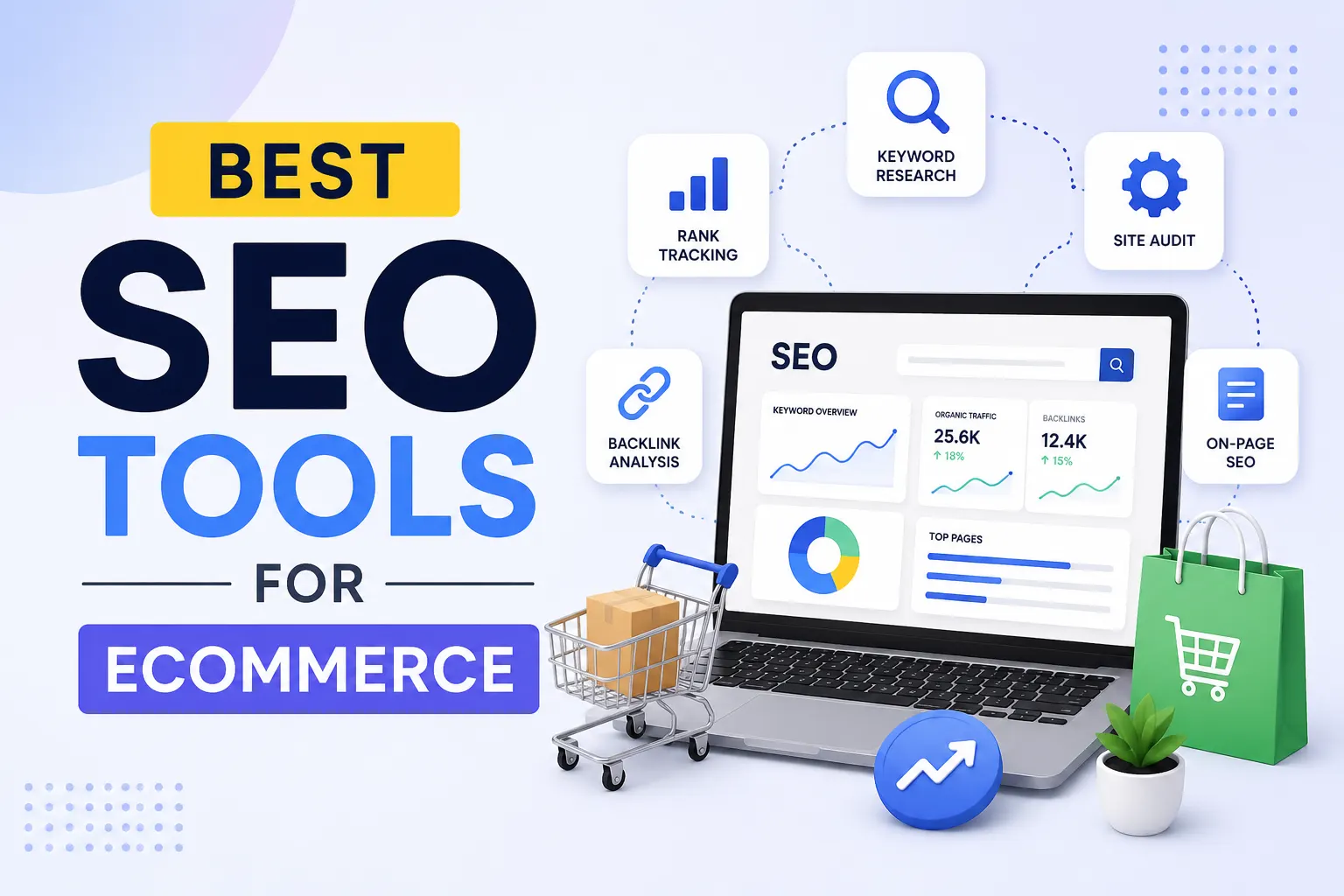
AI SEO Tools for Ecommerce Websites
Search engine optimization is essential for long-term ecommerce growth.
Organic traffic often provides one of the highest ROI acquisition channels because businesses are not paying for every click.
AI SEO tools help ecommerce businesses:
- Identify keyword opportunities
- Optimize content
- Improve readability
- Generate product descriptions
- Detect SEO errors
- Improve internal linking
- Analyze competitors
AI-powered SEO platforms analyze large amounts of search data quickly.
Popular ecommerce SEO tools include:
- Surfer SEO
- Frase
- Semrush AI tools
- Ahrefs AI features
- Clearscope
AI-generated insights help businesses create content aligned with search intent