Blog
CRO Case Study

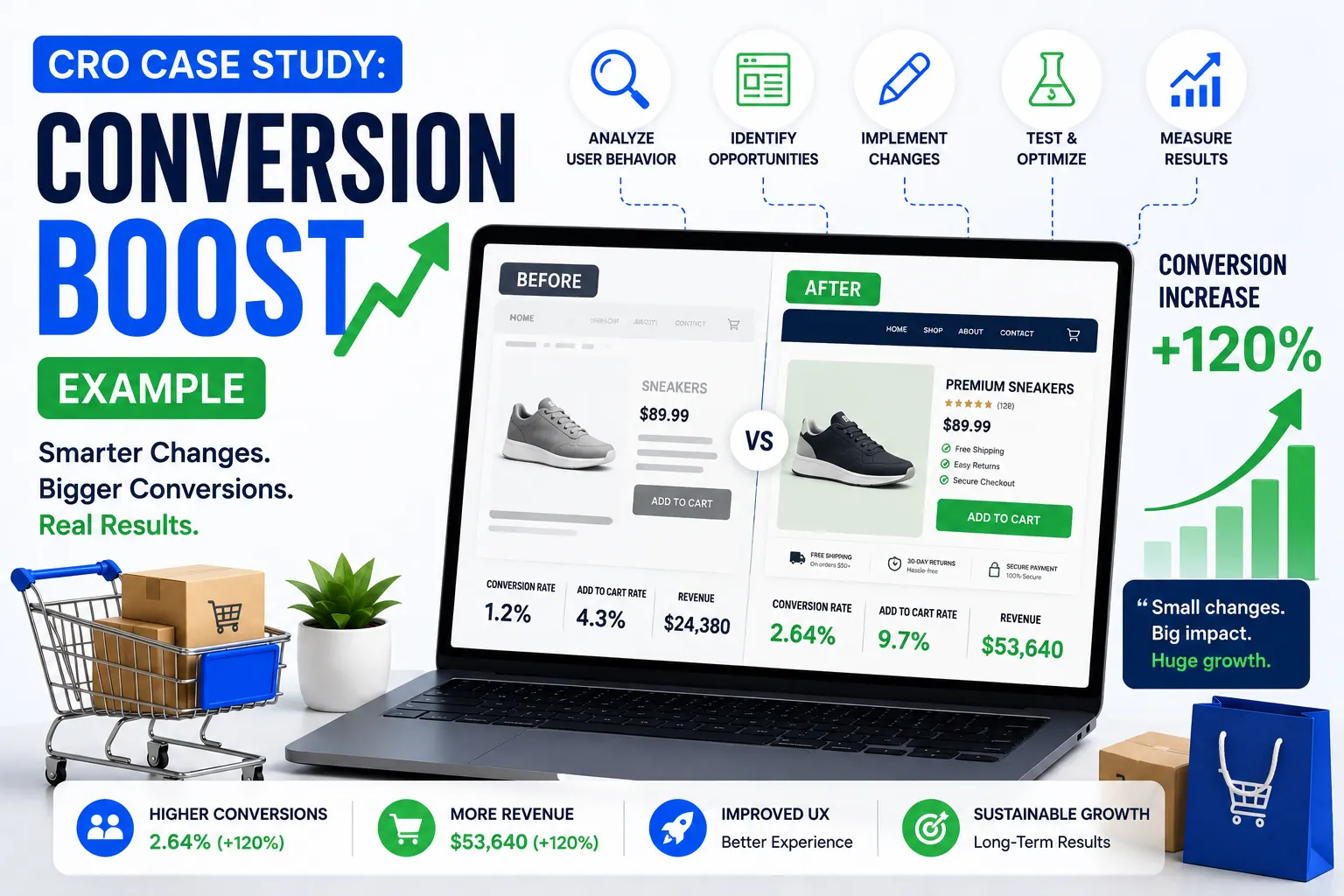
CRO Case Study: Conversion Boost Example for Ecommerce Growth
Conversion rate optimization is one of the most important strategies for ecommerce growth. Many businesses focus heavily on increasing website traffic but fail to improve the percentage of visitors who actually convert into paying customers. Without strong conversion optimization, even high traffic volumes may produce weak revenue performance.
A successful ecommerce business requires more than attractive website design or paid advertising campaigns. Online stores need optimized user journeys, trust-building experiences, mobile-friendly layouts, persuasive product pages, efficient checkout systems, and data-driven testing strategies.
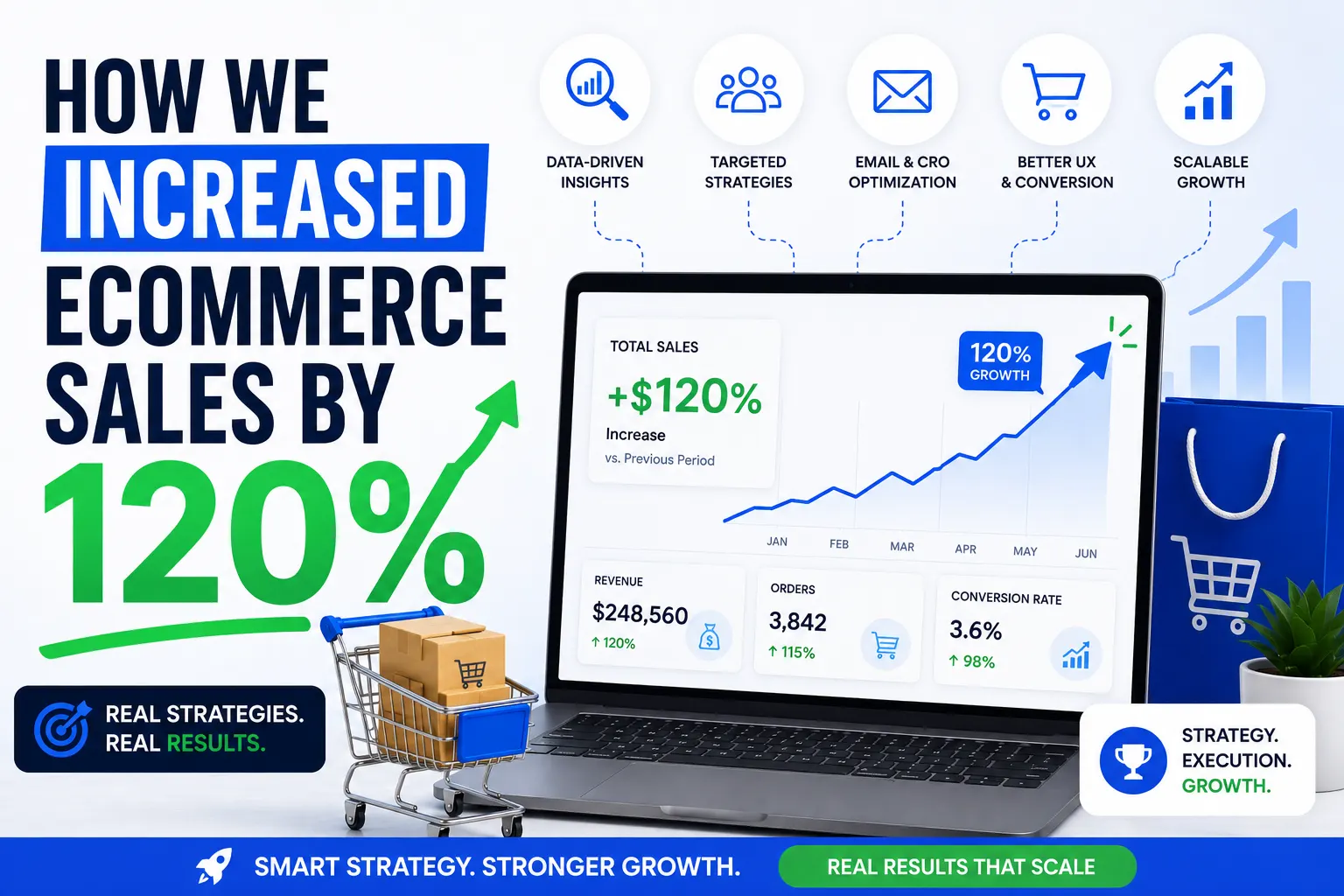
This CRO case study explains how an ecommerce business improved conversions significantly through a structured optimization strategy focused on user behavior analysis, checkout improvements, product page redesign, mobile optimization, trust signals, and customer experience enhancements.
The conversion improvements were achieved through continuous testing and optimization rather than quick design changes alone. Every improvement was based on analytics, user behavior insights, and ecommerce best practices.
This article explains the challenges faced by the ecommerce business, the optimization process used, the conversion-focused strategies implemented, and the lessons learned while scaling ecommerce performance.
For ecommerce website development, conversion optimization, Shopify development, WooCommerce development, and ecommerce SEO services, visit:
Understanding the Initial Ecommerce Conversion Challenges
Before implementing the CRO strategy, the ecommerce business struggled with inconsistent sales performance despite receiving a reasonable amount of website traffic.
The business generated traffic through:
- Organic search
- Paid advertising
- Social media campaigns
- Email marketing
- Referral traffic
However, the website failed to convert visitors efficiently.
Several key problems affected conversions.
High Cart Abandonment Rates
Many users added products to their carts but failed to complete purchases.
Checkout abandonment became one of the biggest revenue loss areas.
Weak Mobile Conversion Performance
Most traffic came from mobile users, but the mobile shopping experience was poor.
Problems included:
- Slow-loading pages
- Difficult navigation
- Small CTA buttons
- Complicated checkout forms
- Poor spacing and layout issues
Mobile users frequently abandoned sessions before completing purchases.
Poor Product Page Engagement
Product pages lacked persuasive structure and important conversion-focused elements.
The pages contained:
- Thin product descriptions
- Weak product imagery
- Limited trust signals
- Minimal customer reviews
- Poor CTA placement
- Inconsistent layouts
Users often left product pages without taking action.
Lack of Trust and Credibility Signals
The website did not communicate enough trust indicators.
Important elements such as:
- Secure payment badges
- Return policies
- Shipping information
- Customer reviews
- Business credibility indicators
were either missing or difficult to find.
Slow Website Performance
Website speed negatively affected both user experience and conversions.
Several pages loaded slowly because of:
- Large image files
- Unoptimized scripts
- Heavy third-party integrations
- Weak caching systems
Slow performance increased bounce rates.
Setting the CRO Goals and KPIs
Before making changes, the business established clear conversion optimization goals.
The objective was not only to increase sales but also to improve the complete customer journey.
The main goals included:
- Increase conversion rates
- Reduce cart abandonment
- Improve mobile conversions
- Increase average order value
- Improve user engagement
- Reduce bounce rates
- Increase returning customer purchases
- Improve checkout completion rates
- Strengthen customer trust
- Improve session duration
Tracking measurable KPIs helped prioritize optimization efforts effectively.
Step 1: User Behavior Analysis and CRO Audit
The first stage involved conducting a detailed CRO audit.
This audit analyzed:
- User behavior
- Navigation patterns
- Checkout performance
- Product page engagement
- Mobile usability
- Session recordings
- Heatmaps
- Click tracking
- Bounce patterns
The goal was identifying friction points preventing conversions.
Heatmap Analysis
Heatmaps revealed how users interacted with the website.
The analysis showed:
- Important CTAs were ignored
- Users scrolled inconsistently
- Product details lacked visibility
- Navigation created confusion
These insights helped redesign important sections.
Session Recordings
Session recordings identified:
- Checkout confusion
- Navigation difficulties
- Product comparison issues
- Form abandonment behavior
Real user interactions provided valuable optimization insights.
Funnel Analysis
The sales funnel analysis identified major drop-off points.
The highest abandonment rates occurred during:
- Cart review stage
- Shipping information step
- Mobile checkout process
This became a major optimization priority.
Step 2: Improving Ecommerce Website User Experience
The next stage focused on improving the overall ecommerce user experience.
The redesign strategy prioritized usability, clarity, simplicity, and conversion efficiency.
Simplifying Website Navigation
The original navigation structure was cluttered and difficult to use.
Improvements included:
- Cleaner menu structures
- Better category organization
- Improved search functionality
- Simplified mobile navigation
- Clear product pathways
These changes improved product discovery.
Mobile-First Optimization
Because most users visited through mobile devices, mobile usability became critical.
The ecommerce website implemented:
- Faster mobile loading speed
- Responsive design improvements
- Larger buttons
- Better touch interactions
- Simplified layouts
- Mobile-friendly forms
The improved mobile experience reduced friction significantly.
Enhancing Website Readability
Many pages previously contained poor content formatting.
The content structure was improved using:
- Better spacing
- Clear headings
- Bullet points
- Scannable layouts
- Improved typography
Readable content improved engagement and comprehension.
For ecommerce website optimization and UI/UX improvements:
https://srihayavadhana.com/ecommerce-website-development/
Step 3: Product Page Conversion Optimization
Product pages play a major role in ecommerce conversions.
The product page redesign focused on improving customer confidence and reducing hesitation.
Improving Product Imagery
Product visuals strongly influence purchasing decisions.
The ecommerce website upgraded:
- Product image quality
- Zoom functionality
- Lifestyle photography
- Product angle variety
- Mobile image responsiveness
High-quality visuals improved engagement.
Expanding Product Descriptions
The original product descriptions were short and generic.
The new descriptions included:
- Product benefits
- Usage information
- Material details
- Feature highlights
- FAQs
- Customer-focused explanations
Detailed descriptions improved both SEO and conversions.
Strengthening Call-to-Action Sections
CTA sections were redesigned to improve visibility and engagement.
Improvements included:
- Better CTA positioning
- Stronger action-oriented copy
- Improved button design
- Better spacing
- Mobile optimization
CTA visibility improved click-through rates significantly.
Adding Social Proof
Customers often rely on social validation before purchasing.
The ecommerce website added:
- Customer reviews
- Ratings
- Testimonials
- User-generated content
- Product popularity indicators
Social proof improved trust and reduced uncertainty.
Step 4: Checkout Optimization Strategy
Checkout optimization became one of the highest-impact CRO improvements.
The original checkout process created unnecessary friction.
Simplifying Checkout Forms
The previous checkout contained too many fields.
The optimization strategy reduced:
- Unnecessary form inputs
- Redundant information requests
- Complex steps
Shorter forms improved completion rates.
Enabling Guest Checkout
Many users abandoned the checkout because account creation was required.
Guest checkout functionality reduced friction significantly.
Improving Payment Trust Signals
Payment security concerns often reduce conversions.
The checkout process added:
- Secure payment badges
- SSL indicators
- Trusted payment methods
- Refund policies
Trust indicators improved customer confidence.
Optimizing Checkout Speed
Slow-loading checkout pages were optimized through:
- Script reduction
- Better caching
- Faster payment processing
- Mobile optimization
Faster checkout improved conversions.
Step 5: Website Speed and Performance Optimization
Website speed directly affects ecommerce conversion rates.
Slow websites often lead to:
- Higher bounce rates
- Lower engagement
- Increased cart abandonment
- Reduced search rankings
Image Optimization
Large image sizes previously slowed the website significantly.
The optimization included:
- WebP conversion
- Lazy loading
- Compression optimization
- Responsive image sizing
This improved page speed.
Script and Code Optimization
Several unnecessary scripts were removed.
CSS and JavaScript files were optimized to reduce rendering delays.
CDN and Caching Improvements
Caching systems and CDN integration improved:
- Global loading speed
- Mobile performance
- Server response times
Core Web Vitals Improvements
The optimization focused heavily on:
- Largest Contentful Paint
- Interaction responsiveness
- Visual stability
Improved Core Web Vitals positively affected both UX and SEO.
Step 6: Building Customer Trust and Credibility
Trust strongly influences ecommerce conversions.
Customers are more likely to purchase when websites appear secure and reliable.
Improving Trust Signals Across the Website
The ecommerce store added:
- Customer reviews
- Security badges
- Business contact details
- Shipping transparency
- Return policies
- Product guarantees
These elements reduced customer hesitation.
Strengthening Brand Presentation
The website improved branding consistency through:
- Better design alignment
- Consistent typography
- Professional visuals
- Clear messaging