Blog
Profit Margin Optimization in Ecommerce

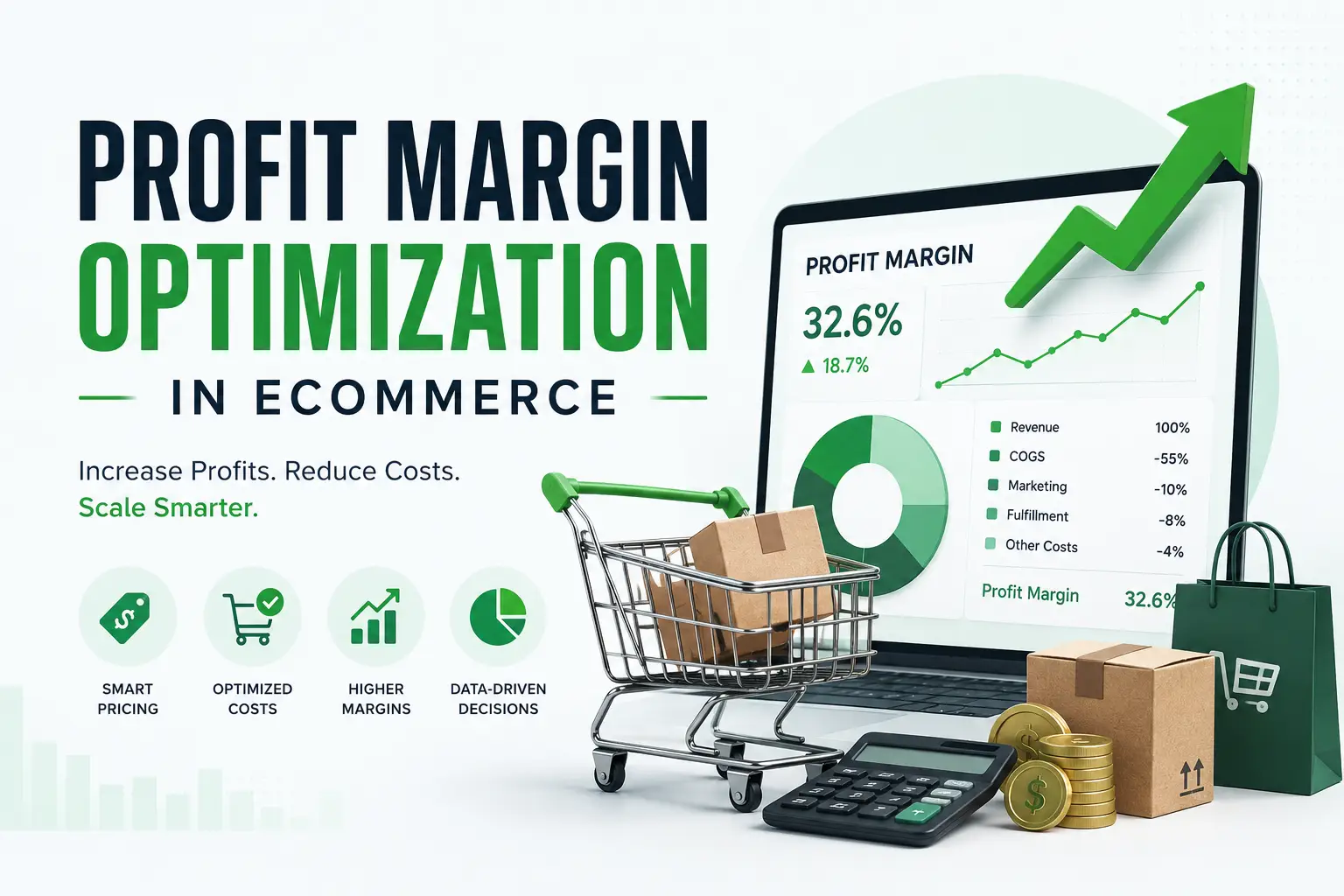
Introduction to Profit Margin Optimization in Ecommerce
Ecommerce businesses often focus heavily on increasing traffic, improving conversion rates, and scaling advertising campaigns. While these areas are important, many online stores overlook one of the most powerful drivers of long-term business success: profit margin optimization. Revenue growth without healthy profit margins can create the illusion of success while silently damaging cash flow, operational sustainability, and business valuation.
In modern ecommerce, competition is intense, customer acquisition costs continue to rise, advertising platforms become more expensive every year, and consumers expect faster delivery with better shopping experiences. In this environment, businesses that survive and scale are not always the ones generating the highest sales volume. Instead, the most sustainable ecommerce brands are those that optimize profitability at every stage of operations.
Profit margin optimization is the process of improving the percentage of profit retained from every sale by strategically managing pricing, sourcing, marketing efficiency, operational costs, customer retention, logistics, technology, and conversion performance. It is not simply about increasing prices. True optimization involves building a lean, scalable ecommerce ecosystem where every department contributes toward maximizing profitability.
For ecommerce entrepreneurs, D2C brands, marketplace sellers, Shopify store owners, WooCommerce businesses, and enterprise ecommerce companies, understanding margin optimization can transform business performance dramatically. Even a small increase in net profit margin can produce substantial long-term gains in cash reserves, reinvestment capability, inventory expansion, and business stability.
This comprehensive guide explores ecommerce profit margin optimization in detail, covering strategies, calculations, operational improvements, pricing systems, customer retention methods, technology decisions, logistics optimization, and future trends that help online businesses achieve sustainable profitability.
Understanding Ecommerce Profit Margins
Before optimizing margins, businesses must understand what profit margins actually represent in ecommerce operations.
Profit margin refers to the percentage of revenue remaining after expenses are deducted. Different types of profit margins provide insight into different areas of business performance.
Gross Profit Margin
Gross profit margin measures profitability after deducting the cost of goods sold (COGS). This includes manufacturing, sourcing, packaging, and direct product costs.
The formula is:
Gross Profit Margin=Revenue – COGSRevenue×100\text{Gross Profit Margin} = \frac{\text{Revenue – COGS}}{\text{Revenue}} \times 100
Gross Profit Margin=Revenue−COGSRevenue×100\text{Gross Profit Margin}=\frac{\text{Revenue}-\text{COGS}}{\text{Revenue}}\times100
For example, if a store sells a product for ₹5,000 and the product cost is ₹2,500, the gross margin is 50%.
Gross margin is one of the most important metrics because it determines how much money remains available for operational expenses such as advertising, salaries, software, warehousing, and customer support.
Operating Profit Margin
Operating profit margin accounts for operating expenses such as salaries, rent, software subscriptions, logistics, and marketing expenses.
This metric reflects how efficiently a business operates beyond simple product sourcing.
Net Profit Margin
Net profit margin measures the final profitability after all expenses, taxes, refunds, transaction fees, and operational costs are deducted.
This is the most accurate indicator of true business health.
Many ecommerce businesses generate high revenues but struggle with low net margins because operational inefficiencies consume profits silently.
Why Profit Margin Optimization Matters in Ecommerce
Ecommerce is fundamentally different from traditional retail. Online businesses face unique cost structures including:
- Paid advertising expenses
- Marketplace commissions
- Payment gateway charges
- Shipping costs
- Return management
- Packaging costs
- Technology subscriptions
- Influencer marketing fees
- Warehousing expenses
- Customer acquisition costs
As competition increases, these expenses rise continuously. Businesses that fail to optimize margins often experience growth without profitability.
A store generating ₹1 crore in monthly sales with a 3% net margin earns only ₹3 lakhs in profit. Another store generating ₹60 lakhs monthly with a 15% margin earns ₹9 lakhs profit despite lower revenue.
This demonstrates why margin optimization is more important than vanity metrics such as traffic volume or gross revenue.
Strong profit margins provide several business advantages:
Better Cash Flow Stability
Healthy margins create stronger cash reserves, enabling businesses to manage inventory cycles, seasonal fluctuations, and market uncertainties more effectively.
Improved Scalability
Businesses with optimized margins can reinvest profits into growth initiatives such as SEO, inventory expansion, product development, and customer retention.
Reduced Dependence on External Funding
Highly profitable ecommerce businesses require less dependency on loans or investor capital.
Increased Business Valuation
Potential investors and buyers evaluate ecommerce businesses heavily based on profitability metrics rather than revenue alone.
Greater Marketing Flexibility
Businesses with strong margins can outcompete rivals in advertising because they can afford higher acquisition costs while remaining profitable.
Calculating Ecommerce Profitability Correctly
Many ecommerce businesses calculate profitability incorrectly by ignoring hidden operational expenses.
A realistic ecommerce profitability calculation should include:
- Product sourcing costs
- Shipping charges
- Packaging expenses
- Advertising spend
- Platform fees
- Payment gateway charges
- Return costs
- Refund losses
- Employee salaries
- Warehouse costs
- Software subscriptions
- Customer support expenses
- Taxes
- Discount campaigns
Without comprehensive calculations, businesses may believe products are profitable when they are actually generating losses.
Contribution Margin Analysis
Contribution margin analysis helps identify how much each product contributes toward fixed business expenses and profit generation.
The formula is:
Contribution Margin=Selling Price−Variable Costs\text{Contribution Margin} = \text{Selling Price} – \text{Variable Costs}
Contribution Margin=Selling Price−Variable Costs\text{Contribution Margin}=\text{Selling Price}-\text{Variable Costs}
This analysis is essential for product-level optimization.
Pricing Strategy Optimization
Pricing strategy is one of the most influential factors in ecommerce profitability.
Many businesses underprice products due to fear of competition. However, competing solely on price often destroys margins and creates unsustainable operations.
Effective ecommerce pricing involves balancing:
- Customer perception
- Brand positioning
- Competitor pricing
- Product value
- Market demand
- Profitability targets
Value-Based Pricing
Value-based pricing focuses on perceived customer value rather than cost alone.
Premium brands often achieve significantly higher margins because they position products around:
- Quality
- Experience
- Exclusivity
- Branding
- Emotional appeal
- Customer trust
Consumers are willing to pay more when brands create strong perceived value.
Psychological Pricing
Psychological pricing strategies influence buying behavior effectively.
Examples include:
- ₹999 instead of ₹1,000
- Tiered pricing
- Bundle pricing
- Anchor pricing
- Premium option positioning
These strategies can improve conversion rates while maintaining healthy margins.
Dynamic Pricing
Dynamic pricing adjusts prices based on demand, inventory levels, competition, and customer behavior.
Advanced ecommerce brands use AI-driven pricing systems to maximize profitability automatically.
Dynamic pricing is especially useful during:
- Seasonal demand spikes
- Low inventory situations
- High-conversion periods
- Marketplace competition changes
Bundle Pricing
Product bundling increases average order value while improving profitability.
Bundles reduce:
- Packaging cost per item
- Shipping cost per item
- Customer acquisition cost per order
Bundles also increase perceived customer value.
Reducing Customer Acquisition Costs
Customer acquisition cost (CAC) is one of the largest expenses in ecommerce.
Many online stores become unprofitable because advertising costs rise faster than revenue.
CAC optimization is essential for sustainable margins.
SEO as a Long-Term Margin Strategy
Search engine optimization is one of the most profitable customer acquisition channels for ecommerce businesses because it reduces dependency on paid ads.
Unlike paid advertising, SEO traffic compounds over time.
Businesses investing in content marketing, technical SEO, category optimization, and organic visibility often achieve significantly better margins over the long term.
Professional ecommerce SEO services from <a href=”https://srihayavadhana.com”>Sri Hayavadhana</a> can help businesses build sustainable organic traffic systems that improve profitability while reducing paid acquisition dependency.
Email Marketing Profitability
Email marketing consistently delivers one of the highest ROI channels in ecommerce.
Effective email automation includes:
- Abandoned cart recovery
- Welcome sequences
- Re-engagement campaigns
- Product recommendations
- Upsell sequences
- Post-purchase nurturing
Retention-focused email marketing increases repeat purchases while lowering acquisition costs.
Conversion Rate Optimization
Improving conversion rates directly enhances profit margins because more revenue is generated from existing traffic.
Conversion optimization strategies include:
- Faster page speed
- Better product descriptions
- Improved checkout flow
- Trust signals
- Social proof
- Mobile optimization
- High-quality visuals
- Simplified navigation
A small conversion increase can substantially improve profitability.
Organic Social Media
Organic brand building through platforms like Instagram, LinkedIn, YouTube, and Pinterest helps reduce long-term customer acquisition expenses.
Educational content, community engagement, and authority positioning improve brand trust and customer retention.
Inventory Management and Margin Protection
Inventory mismanagement is a major profit killer in ecommerce.
Common inventory problems include:
- Overstocking
- Dead stock accumulation
- Understocking
- Inventory aging
- Excess storage costs
- High return rates
Efficient inventory management protects margins significantly.
Demand Forecasting
Forecasting helps businesses align inventory with expected demand.
Accurate forecasting reduces:
- Storage costs
- Unsold inventory
- Emergency procurement expenses
- Stockout losses
Advanced forecasting systems use:
- Historical sales data
- Seasonal trends
- Market demand analysis
- Promotional performance data
ABC Inventory Analysis
ABC analysis categorizes products based on profitability and sales contribution.
- A products generate highest profits
- B products generate moderate profits
- C products contribute minimal profitability
This helps businesses prioritize high-margin products strategically.
Inventory Turnover Optimization
Inventory turnover measures how quickly stock sells and gets replenished.
Higher turnover generally improves cash flow and profitability.
Slow-moving inventory ties up capital and increases warehousing costs.
Supplier Negotiation Strategies
Supplier relationships directly affect ecommerce margins.
Businesses that negotiate effectively can improve profitability substantially without increasing sales.
Bulk Purchasing Advantages
Larger purchase quantities often reduce unit costs significantly.
However, businesses must balance bulk purchasing with inventory risk.
Multiple Supplier Strategy
Depending entirely on one supplier creates pricing vulnerability.
Working with multiple suppliers improves negotiation leverage and reduces operational risk.
Long-Term Supplier Partnerships
Reliable long-term partnerships can provide:
- Better pricing
- Priority manufacturing
- Flexible payment terms
- Faster production
- Improved quality control
Strong supplier relationships become competitive advantages.
Private Labeling for Better Margins
Private label products often generate significantly higher margins than reselling third-party brands.
Benefits include:
- Pricing control
- Brand ownership
- Reduced direct competition
- Improved customer loyalty
- Higher perceived value
Many successful ecommerce brands transition from reselling to private labeling to improve margins.
Shipping Cost Optimization
Shipping expenses have become one of the largest ecommerce operational costs.
Customers expect fast and affordable delivery, creating pressure on profit margins.
Shipping Zone Optimization
Using strategically located warehouses reduces delivery costs and transit times.
Regional fulfillment centers improve efficiency for large ecommerce operations.
Packaging Optimization
Oversized packaging increases shipping expenses unnecessarily.
Optimized packaging reduces:
- Dimensional weight charges
- Material costs
- Storage space
- Damage rates
Negotiating Courier Rates
High-volume ecommerce businesses can negotiate discounted shipping rates with logistics providers.
Even small shipping reductions significantly improve margins at scale.
Free Shipping Strategy
Free shipping can increase conversions, but it must be structured carefully.
Effective approaches include:
- Minimum order thresholds
- Partial shipping subsidies
- Built-in shipping costs
- Membership programs
Businesses should never offer unsustainable free shipping.
Reducing Ecommerce Return Rates
Returns can severely impact profitability.
Return-related expenses include:
- Reverse logistics
- Damaged products
- Restocking labor
- Refund processing
- Customer support
- Lost inventory value
Reducing returns improves margins dramatically.
Better Product Descriptions
Accurate product descriptions reduce customer dissatisfaction.
Detailed descriptions should include:
- Dimensions
- Materials
- Usage guidance
- Compatibility details
- Care instructions
High-Quality Product Images
Clear product visuals reduce uncertainty and improve purchase confidence.
Professional product photography reduces return rates significantly.
Customer Reviews and User Content
User-generated content provides realistic purchase expectations.
Customer reviews help buyers make informed decisions.
Size Guides and Compatibility Tools
For fashion and technical products, detailed sizing and compatibility systems reduce costly returns.
Increasing Average Order Value
Average order value (AOV) optimization is one of the most effective profitability strategies.
Higher AOV reduces:
- Acquisition cost per revenue unit
- Packaging cost percentage
- Shipping cost ratio
Upselling Techniques
Upselling encourages customers to purchase premium versions of products.
Examples include:
- Better features
- Larger quantities
- Extended warranties
- Premium materials
Cross-Selling
Cross-selling recommends complementary products.
Examples include:
- Accessories
- Add-ons
- Maintenance products
- Bundled solutions
Cart Threshold Incentives
Offering incentives above certain cart values encourages higher spending.
Examples include:
- Free shipping thresholds
- Free gifts
- Discount unlocks
Technology Stack Optimization
Many ecommerce businesses overspend on software tools.
Technology expenses can quietly erode profit margins.
Evaluating Software ROI
Businesses should regularly evaluate whether tools actually contribute measurable value.
Common areas of waste include:
- Redundant subscriptions
- Underused apps
- Expensive automation tools
- Inefficient integrations
Platform Selection
Choosing the right ecommerce platform impacts profitability significantly.
Platforms such as Shopify, WooCommerce, Magento, and custom ecommerce systems each have different cost structures.
Businesses should choose platforms based on:
- Scalability
- Operational efficiency
- Maintenance costs
- Flexibility
- Performance requirements
Custom ecommerce development solutions from <a href=”https://srihayavadhana.com”>https://srihayavadhana.com</a> can help businesses create optimized ecommerce ecosystems tailored for long-term profitability.
Automation Systems
Automation reduces manual operational costs.
Automation areas include:
- Order processing
- Inventory updates
- Customer emails
- Reporting
- CRM workflows
- Customer support tickets
Efficient automation improves scalability while reducing labor expenses.
Improving Ecommerce Website Performance
Website performance directly affects both conversions and profitability.
Slow websites increase bounce rates and reduce sales.
Page Speed Optimization
Faster websites improve:
- Conversion rates
- User experience
- SEO rankings
- Mobile engagement
Optimization techniques include:
- Image compression
- CDN implementation
- Code minification
- Lazy loading
- Server optimization
Mobile Commerce Optimization
Mobile traffic dominates ecommerce globally.
Poor mobile experiences significantly reduce profitability.
Mobile optimization should include:
- Fast loading
- Easy navigation
- Simplified checkout
- Thumb-friendly interfaces
- Mobile payment systems
Checkout Optimization
Checkout friction reduces conversions and increases cart abandonment.
Effective checkout optimization includes:
- Guest checkout
- Multiple payment options
- Minimal form fields
- Transparent pricing
- Secure payment trust signals
Profit Margin Optimization Through SEO
SEO is not only a traffic strategy but also a profitability strategy.
Organic traffic reduces long-term acquisition expenses and improves overall marketing efficiency.
Category Page SEO
Optimized category pages drive high-intent traffic.
Effective category optimization includes:
- Keyword targeting
- Structured navigation
- Internal linking
- Informative content
- Filter optimization
Product Page SEO
Product pages should target transactional keywords while improving conversion rates.
Important optimization elements include:
- Unique product descriptions
- Schema markup
- Optimized images
- Customer reviews
- FAQ sections
Informational Content Marketing
Educational articles attract top-of-funnel users and build authority.
Examples include:
- Buying guides
- Product comparisons
- Industry trends
- Tutorials
- Problem-solving content
Long-form content builds sustainable organic visibility.
Technical SEO
Technical SEO improvements help search engines crawl and rank ecommerce sites efficiently.
Key areas include:
- Site architecture
- Indexation management
- Canonicalization
- Core Web Vitals
- Structured data
- XML sitemaps
Businesses seeking ecommerce SEO improvements can explore solutions from <a href=”https://srihayavadhana.com”>https://srihayavadhana.com</a>.
Marketplace Margin Optimization
Selling on marketplaces such as Amazon and Flipkart presents unique profitability challenges.
Marketplace fees can significantly reduce margins.
Sponsored Ad Efficiency
Marketplace advertising should focus on:
- High-converting keywords
- Negative keyword filtering
- ROAS monitoring
- Bid optimization
Poorly managed ads destroy profitability quickly.
Marketplace Listing Optimization
Optimized listings improve organic rankings and reduce paid advertising dependency.
Important elements include:
- Keyword-rich titles
- Strong images
- Conversion-focused descriptions
- Customer reviews
Multi-Channel Selling
Depending solely on marketplaces increases vulnerability.
Diversifying into:
- D2C websites
- Social commerce
- Retail partnerships
- B2B sales
helps stabilize margins.
Customer Retention and Lifetime Value
Retention is one of the most powerful ecommerce profitability drivers.
Acquiring new customers is far more expensive than retaining existing ones.
Customer Lifetime Value
Customer lifetime value (CLV) measures the total revenue generated from a customer over time.
The formula is:
CLV=Average Order Value×Purchase Frequency×Customer Lifespan\text{CLV} = \text{Average Order Value} \times \text{Purchase Frequency} \times \text{Customer Lifespan}
CLV=Average Order Value×Purchase Frequency×Customer Lifespan\text{CLV}=\text{Average Order Value}\times\text{Purchase Frequency}\times\text{Customer Lifespan}
Increasing CLV improves profitability dramatically.
Loyalty Programs
Loyalty systems encourage repeat purchases.
Examples include:
- Reward points
- Exclusive discounts
- VIP memberships
- Early product access
Personalized Marketing
Personalization improves engagement and repeat purchase behavior.
AI-powered recommendation systems enhance profitability through targeted suggestions.
Subscription Models
Subscription commerce improves predictable revenue and customer retention.
Examples include:
- Consumable products
- Membership clubs
- Replenishment systems
Subscription businesses often achieve stronger margins due to recurring revenue.
Data Analytics for Profit Optimization
Data-driven decision-making is essential for ecommerce profitability.
Businesses should monitor:
- Gross margin
- Net margin
- CAC
- CLV
- ROAS
- Conversion rate
- AOV
- Refund rate
- Inventory turnover
Profitability Dashboards
Centralized dashboards improve operational visibility.
Businesses should analyze profitability at:
- Product level
- Channel level
- Campaign level
- Customer segment level
Cohort Analysis
Cohort analysis reveals long-term customer behavior patterns.
Understanding retention trends helps optimize marketing investments.
Attribution Modeling
Attribution analysis identifies which marketing channels contribute real profitability.
Not all traffic sources produce equal margins.
Reducing Operational Waste
Operational inefficiencies reduce margins silently over time.
Workflow Optimization
Businesses should identify repetitive manual tasks suitable for automation.
Team Productivity
Efficient team structures reduce unnecessary labor costs.
Clear SOPs improve operational consistency.
Warehouse Efficiency
Warehouse optimization reduces:
- Picking errors
- Labor costs
- Processing delays
- Inventory mismanagement
Energy and Infrastructure Savings
For larger ecommerce operations, infrastructure efficiency contributes meaningfully to profitability.
Financial Planning for Ecommerce Profitability
Financial planning is essential for sustainable margin optimization.
Budget Allocation
Businesses should allocate budgets strategically across:
- Marketing
- Inventory
- Technology
- Staffing
- Branding
Cash Flow Forecasting
Cash flow management prevents operational disruptions.
Scenario Planning
Businesses should prepare for:
- Seasonal downturns
- Supply chain disruptions
- Advertising cost spikes
- Economic slowdowns
Scenario planning improves resilience.
Profit Margin Optimization for Different Ecommerce Models
Different ecommerce models require different optimization approaches.
D2C Ecommerce
D2C brands focus heavily on:
- Branding
- Customer retention
- Subscription systems
- Community building
Margins are typically stronger due to direct customer relationships.
Dropshipping
Dropshipping often struggles with lower margins because of:
- Supplier dependency
- High competition
- Limited differentiation
Success requires strong branding and niche targeting.
Wholesale Ecommerce
Wholesale businesses focus on:
- Bulk order efficiency
- Relationship management
- Operational scale
Margins may be lower but volumes are higher.
Luxury Ecommerce
Luxury brands achieve high margins through:
- Exclusivity
- Brand perception
- Premium customer experience
AI and Automation in Margin Optimization
Artificial intelligence is transforming ecommerce profitability strategies.
AI Pricing Engines
AI systems optimize pricing dynamically based on market conditions.
Predictive Inventory Systems
Predictive analytics improves inventory efficiency and reduces wastage.
AI Customer Support
AI chatbots reduce support costs while improving customer service scalability.
Personalized Recommendations
Recommendation engines increase AOV and customer retention.
International Ecommerce and Margin Considerations
Global ecommerce expansion introduces additional profitability challenges.
Currency Exchange Risks
Currency fluctuations affect international margins.
International Shipping Costs
Cross-border logistics require careful planning.
Tax and Compliance
International tax structures impact profitability significantly.
Localization Strategies
Localized content and payment methods improve international conversions.
Common Profit Margin Mistakes in Ecommerce
Many ecommerce businesses unintentionally damage profitability.
Excessive Discounting
Frequent discounts train customers to wait for promotions.
Scaling Ads Too Quickly
Rapid ad scaling without profitability analysis can create losses.
Ignoring Small Operational Costs
Minor recurring costs accumulate significantly over time.
Overexpansion
Expanding product lines too aggressively increases complexity and operational costs.
Chasing Revenue Instead of Profit
Revenue without profitability creates unstable business foundations.
Building a High-Margin Ecommerce Brand
Strong brands consistently achieve better margins than generic stores.
Brand Positioning
Clear positioning differentiates businesses from price-based competition.
Storytelling
Brand storytelling creates emotional customer connections.
Premium Customer Experience
Exceptional customer experiences justify premium pricing.
Community Building
Communities improve retention and customer advocacy.
Ecommerce Profit Margin Benchmarks
Profit margins vary across industries.
Typical ranges include:
- Fashion: 5%–20%
- Electronics: 2%–10%
- Beauty: 10%–30%
- Luxury goods: 20%–40%
- Digital products: 50%–90%
Businesses should benchmark performance against industry standards while focusing on sustainable growth.
Future Trends in Ecommerce Profitability
The future of ecommerce margin optimization will increasingly depend on:
- AI automation
- First-party customer data
- Supply chain resilience
- Personalization
- Sustainable operations
- Omnichannel integration
Businesses adapting early will gain significant competitive advantages.
Privacy Changes and First-Party Data
Advertising platform privacy restrictions make customer retention and owned audience building more important.
Sustainable Ecommerce
Consumers increasingly value environmentally responsible brands.
Sustainable operations can improve long-term profitability through customer loyalty.
Hyper-Personalization
Advanced personalization systems improve conversions and retention simultaneously.
Final Thoughts on Profit Margin Optimization in Ecommerce
Profit margin optimization is not a one-time activity. It is an ongoing strategic process that affects every aspect of ecommerce operations. Businesses that prioritize profitability create stronger foundations for sustainable growth, operational stability, and long-term success.
The most successful ecommerce brands understand that profitability is built through hundreds of small improvements across pricing, inventory management, customer retention, SEO, logistics, technology, and operational efficiency.
Rather than focusing only on increasing sales volume, ecommerce businesses should continuously analyze where profits are gained and lost. Even small improvements in margin percentages can produce major financial impact over time.
Modern ecommerce success depends on balancing growth with operational intelligence. Businesses that combine efficient systems, strong branding, optimized marketing, and customer-focused experiences are best positioned to achieve sustainable profitability in an increasingly competitive digital marketplace.
Whether operating a small Shopify store, a growing D2C brand, or a large-scale ecommerce enterprise, profit margin optimization should remain a central business priority. Companies that master this discipline will not only survive future market challenges but also build scalable, resilient, and highly valuable ecommerce businesses for years to come.