Blog
Multi-Channel Selling Strategy

Introduction to Multi-Channel Selling Strategy
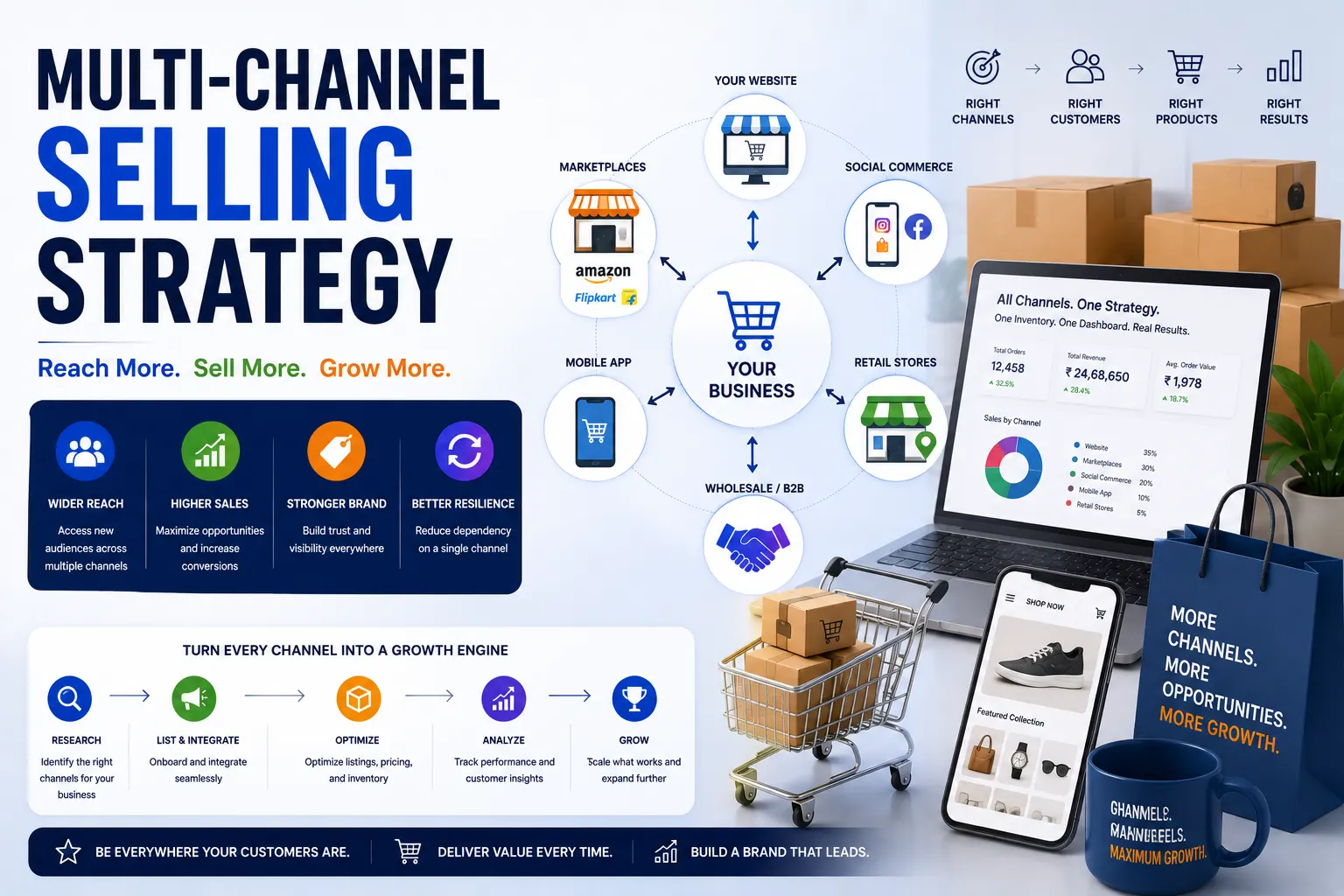
Multi-channel selling has become one of the most important growth strategies in ecommerce and digital commerce. Modern customers no longer purchase products through a single platform or channel. Instead, they discover brands, compare products, engage with content, and complete purchases across multiple digital and offline touchpoints. Customers may first see a product on Instagram, search for reviews on Google, compare prices on marketplaces, visit the brand website, and finally complete the purchase through a mobile app or ecommerce store.
Because customer journeys are increasingly fragmented, ecommerce businesses must build strong multi-channel selling systems that provide consistent customer experiences across every sales platform. Businesses relying only on a single marketplace, website, or social media platform often face serious growth limitations and operational risks. Multi-channel selling helps ecommerce businesses:
- Expand customer reach
- Diversify revenue streams
- Increase brand visibility
- Improve customer convenience
- Reduce platform dependency
- Increase sales opportunities
In 2026, multi-channel commerce is no longer optional for serious ecommerce businesses. Customers expect brands to be accessible across:
- Ecommerce websites
- Marketplaces
- Social media platforms
- Mobile apps
- Search engines
- Messaging platforms
Successful multi-channel selling requires much more than listing products across multiple websites. Businesses must create coordinated systems that maintain:
- Pricing consistency
- Inventory synchronization
- Branding alignment
- Customer experience quality
- Logistics efficiency
- Marketing integration
Poorly managed multi-channel operations often create:
- Inventory confusion
- Pricing inconsistencies
- Customer dissatisfaction
- Operational inefficiencies
- Brand dilution
Strong multi-channel strategies help ecommerce businesses build scalable and resilient digital commerce ecosystems capable of long-term growth.
This comprehensive guide explores multi-channel selling strategy in depth, including ecommerce websites, marketplace selling, social commerce, omnichannel customer experience, inventory management, branding consistency, SEO integration, paid advertising, logistics optimization, customer retention, mobile commerce, automation systems, and future trends shaping multi-channel ecommerce growth globally.
Understanding Multi-Channel Selling
Multi-channel selling refers to selling products through multiple online and offline channels simultaneously.
These channels may include:
- Ecommerce websites
- Amazon
- Flipkart
- Meesho
- Instagram Shops
- Facebook Shops
- WhatsApp Commerce
- Mobile apps
- Offline retail stores
The goal of multi-channel selling is to maximize customer accessibility and revenue opportunities.
Customers today shop differently depending on:
- Product category
- Device usage
- Convenience preferences
- Platform familiarity
- Purchase urgency
Some customers prefer marketplaces because of:
- Faster delivery
- Reviews
- Familiarity
Others prefer direct brand websites because of:
- Better branding
- Exclusive products
- Personalized experiences
Multi-channel selling allows businesses to meet customers wherever they prefer to shop.
Successful multi-channel ecommerce strategies focus on creating connected customer experiences across every platform.
Why Multi-Channel Selling Matters
Customer behavior has changed dramatically in recent years.
Modern shoppers frequently interact with multiple channels before purchasing products.
For example:
- A customer sees a product on Instagram.
- They search for reviews on Google.
- They compare pricing on Amazon.
- They visit the official website.
- They complete the purchase later through mobile.
Because customer journeys are non-linear, businesses relying on only one channel may lose potential customers during various stages of the decision-making process.
Multi-channel selling improves:
- Brand visibility
- Customer trust
- Revenue diversification
- Customer acquisition opportunities
It also reduces business risk because businesses become less dependent on a single platform algorithm or marketplace policy.
Businesses operating across multiple channels often achieve:
- Higher total sales volume
- Better customer reach
- Improved retention
- Stronger brand authority
Difference Between Multi-Channel and Omnichannel Selling
Many people confuse multi-channel and omnichannel commerce.
Multi-Channel Selling
Multi-channel selling means businesses sell products across multiple platforms.
However, channels may operate independently.
For example:
- Website inventory may differ from marketplace inventory
- Customer support may vary by channel
Omnichannel Selling
Omnichannel commerce focuses on creating a seamless and connected customer experience across all channels.
Examples include:
- Unified inventory
- Shared customer profiles
- Consistent branding
- Cross-channel order management
Omnichannel strategies prioritize customer experience continuity.
Modern ecommerce businesses increasingly move toward omnichannel systems because customers expect integrated experiences.
Ecommerce Website as the Central Sales Channel
Even with multiple sales channels, ecommerce websites should remain the core brand hub.
A branded ecommerce website provides:
- Full control
- Better branding opportunities
- Higher margins
- Customer data ownership
Unlike marketplaces, ecommerce websites allow businesses to control:
- UX design
- Product presentation
- SEO strategy
- Customer experience
- Retention systems
Strong ecommerce websites improve:
- Brand authority
- Customer trust
- Organic traffic growth
Businesses developing scalable multi-channel ecommerce ecosystems often work with professional ecommerce strategy and UX specialists such as Sri Hayavadhana Solutions to create optimized ecommerce websites designed for SEO visibility, mobile UX, branding consistency, and conversion optimization.
Marketplace Selling Strategy
Marketplaces remain extremely important for ecommerce growth because they provide immediate access to large customer bases.
Popular marketplaces include:
- Amazon
- Flipkart
- Meesho
- Etsy
Marketplace advantages include:
- Existing traffic
- Customer trust
- Faster visibility
- Simplified logistics options
However, marketplaces also involve:
- High competition
- Platform commissions
- Limited branding control
Successful marketplace strategies focus on:
- Product optimization
- Review generation
- Competitive pricing
- Sponsored advertising
Many ecommerce businesses use marketplaces primarily for:
- Customer acquisition
- Product visibility
- Revenue diversification
while encouraging repeat customers to purchase directly through brand websites.
Social Commerce Strategy
Social commerce is growing rapidly as customers increasingly shop directly through social media platforms.
Popular social commerce channels include:
- Instagram Shops
- Facebook Shops
- TikTok commerce
- WhatsApp Business
Social commerce helps businesses:
- Showcase products visually
- Build communities
- Increase engagement
- Generate impulse purchases
Visual content strongly influences social commerce performance.
Successful social commerce strategies include:
- Influencer collaborations
- User-generated content
- Video marketing
- Live selling
Social platforms are becoming increasingly important discovery channels for ecommerce brands.
Mobile Commerce in Multi-Channel Selling
Mobile commerce dominates ecommerce traffic globally.
Businesses must optimize every sales channel for mobile users because customers increasingly browse and shop using smartphones.
Mobile optimization includes:
- Responsive design
- Fast loading speed
- Mobile-friendly checkout
- Touch-friendly navigation
Poor mobile experiences reduce:
- Conversions
- Engagement
- Customer retention
Mobile-first multi-channel strategies improve:
- Customer accessibility
- SEO performance
- Revenue growth
Modern ecommerce customers expect smooth mobile experiences across:
- Websites
- Apps
- Marketplaces
- Social platforms
Branding Consistency Across Channels
Consistent branding is essential in multi-channel commerce.
Customers should experience:
- Similar messaging
- Visual identity
- Product quality
- Tone of communication
across every channel.
Brand consistency improves:
- Recognition
- Trust
- Professionalism
Important branding areas include:
- Logos
- Product imagery
- Packaging
- Social media visuals
- Product descriptions
Inconsistent branding creates confusion and weakens customer trust.
Strong multi-channel brands maintain unified identity across:
- Websites
- Marketplaces
- Social platforms
- Email campaigns
Inventory Management in Multi-Channel Selling
Inventory synchronization is one of the biggest operational challenges in multi-channel commerce.
Poor inventory management may create:
- Overselling
- Stockouts
- Customer dissatisfaction
Businesses should use centralized inventory systems that update stock levels automatically across:
- Websites
- Marketplaces
- Retail stores
Inventory automation improves:
- Operational efficiency
- Fulfillment accuracy
- Customer satisfaction
As businesses scale, inventory complexity increases significantly.
Efficient inventory systems become essential for sustainable growth.
Logistics and Fulfillment Strategy
Multi-channel selling increases logistics complexity because businesses may fulfill orders from:
- Multiple marketplaces
- Ecommerce websites
- Social commerce platforms
Strong logistics systems improve:
- Delivery speed
- Customer satisfaction
- Operational efficiency
Businesses should optimize:
- Shipping workflows
- Packaging systems
- Return management
- Tracking communication
Fast and reliable delivery strongly affects customer retention and brand perception.
Many ecommerce businesses work with:
- Third-party logistics providers
- Fulfillment centers
- Marketplace fulfillment programs
to improve scalability.
Customer Experience in Multi-Channel Ecommerce
Customer experience should remain consistent regardless of the sales channel.
Customers expect:
- Fast support
- Reliable delivery
- Smooth checkout
- Clear communication
across every platform.
Strong customer experience improves:
- Retention
- Reviews
- Brand loyalty
Important customer experience areas include:
- Support quality
- Packaging
- Delivery reliability
- Website usability
- Return processes
Businesses should ensure customer interactions feel cohesive across channels.
SEO Strategy for Multi-Channel Selling
SEO remains one of the most profitable long-term ecommerce growth channels.
Strong ecommerce SEO improves:
- Organic traffic
- Brand visibility
- Customer acquisition
SEO strategies should focus heavily on:
- Ecommerce websites
- Category pages
- Product pages
- Content marketing
Helpful SEO resources:
SEO supports multi-channel selling by:
- Increasing brand discovery
- Driving direct traffic
- Reducing advertising dependency
Content marketing also helps strengthen brand authority and search visibility.
Paid Advertising Across Multiple Channels
Paid advertising helps businesses drive traffic and conversions across multiple ecommerce platforms.
Important advertising channels include:
- Google Ads
- Meta Ads
- Marketplace ads
- YouTube Ads
Multi-channel advertising strategies should remain coordinated to maintain:
- Brand consistency
- Audience targeting accuracy
- Marketing efficiency
Retargeting campaigns are especially effective because customers often interact with multiple channels before purchasing.
Businesses should continuously monitor:
- Return on ad spend
- Conversion rates
- Customer acquisition costs
to maintain profitability.
Customer Retention in Multi-Channel Commerce
Retention becomes increasingly important as customer acquisition costs rise.
Strong retention strategies improve:
- Customer lifetime value
- Brand loyalty
- Revenue stability
Retention-focused strategies include:
- Email marketing
- Loyalty programs
- Personalized recommendations
- WhatsApp communication
- Exclusive offers
Customers who trust brands often purchase through multiple channels over time.
Retention optimization helps ecommerce businesses scale more profitably.
Data Analytics and Performance Tracking
Multi-channel selling generates large amounts of customer and operational data.
Businesses should monitor:
- Sales performance
- Channel profitability
- Customer behavior
- Conversion rates
- Inventory turnover
Helpful analytics resources include:
Data-driven decision-making improves:
- Marketing efficiency
- Inventory planning
- Customer retention
- Operational scalability
Businesses should evaluate which channels produce:
- Highest profitability
- Best customer retention
- Strongest ROI
rather than focusing only on revenue volume.
Automation in Multi-Channel Selling
Automation is essential for scaling multi-channel ecommerce operations efficiently.
Important automation areas include:
- Inventory synchronization
- Order processing
- Shipping updates
- Customer communication
- Marketing workflows
Automation improves:
- Operational speed
- Accuracy
- Scalability
Businesses should reduce manual workflows wherever possible to improve efficiency.
Automation allows teams to focus more on:
- Growth
- Branding
- Customer relationships
rather than repetitive operational tasks.
Common Multi-Channel Selling Mistakes
Many ecommerce businesses struggle with multi-channel commerce because of operational and strategic mistakes.
Common mistakes include:
- Inconsistent pricing
- Weak branding
- Poor inventory synchronization
- Ignoring mobile UX
- Over-reliance on marketplaces
- Slow customer support
Another major issue is expanding across too many channels too quickly without operational readiness.
Businesses should prioritize:
- Channel quality
- Customer experience
- Operational efficiency
before aggressive expansion.
Future Trends in Multi-Channel Ecommerce
Multi-channel commerce continues evolving rapidly.
Future trends may include:
- AI-powered personalization
- Unified omnichannel systems
- Voice commerce
- Social commerce growth
- AR shopping experiences
- Hyperlocal delivery
Customers increasingly expect seamless transitions between:
- Online browsing
- Social discovery
- Mobile purchasing
- Offline fulfillment
AI-driven systems may eventually personalize:
- Product recommendations
- Pricing
- Marketing campaigns
- Customer experiences
across channels dynamically.
Businesses adapting early to emerging multi-channel trends will remain more competitive.
Final Thoughts
Multi-channel selling is one of the most important ecommerce growth strategies in modern digital commerce.
Successful multi-channel ecommerce businesses combine:
- Strong branding
- Mobile-first UX
- Inventory synchronization
- SEO optimization
- Customer retention
- Operational efficiency
Modern ecommerce customers expect shopping experiences to feel:
- Convenient
- Fast
- Personalized
- Consistent
- Mobile-friendly
Businesses that strategically optimize customer experience across multiple channels often achieve:
- Higher revenue diversification
- Better customer reach
- Stronger retention
- Increased brand authority
Whether selling through ecommerce websites, marketplaces, social platforms, mobile apps, or offline retail systems, businesses should prioritize consistency and operational scalability.
The future of multi-channel ecommerce will increasingly revolve around omnichannel integration, AI-driven personalization, mobile convenience, and frictionless customer journeys. Businesses that continuously improve customer experience and operational coordination across channels will remain competitive and profitable in the evolving ecommerce industry.