Blog
Progressive Web Apps (PWA) for Ecommerce: Benefits & Implementation (Complete 2026 Guide)

📘 Introduction: Why PWAs Are Transforming Ecommerce Experiences
Ecommerce has reached a point where user expectations are higher than ever. Customers demand lightning-fast loading speeds, seamless navigation, app-like interactions, and uninterrupted browsing—even in low network conditions. Traditional websites and even native mobile apps often struggle to meet all these expectations simultaneously. Native apps require downloads and updates, while standard websites may lack performance and offline capabilities.
This is where Progressive Web Apps (PWAs) emerge as a powerful solution.
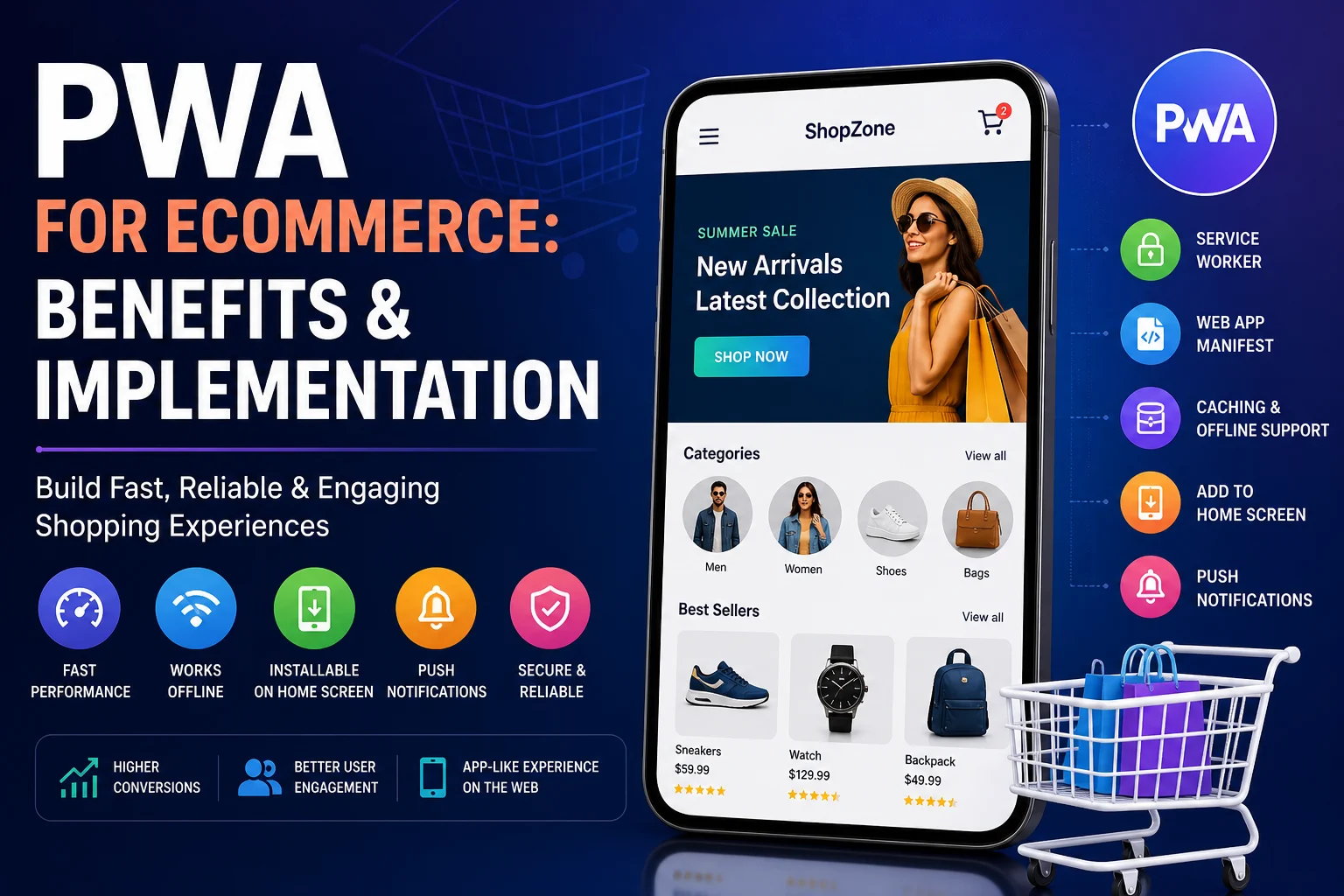
PWAs combine the best of both worlds: the reach of the web and the performance of mobile applications. They are designed to deliver fast, reliable, and engaging experiences directly through the browser, eliminating the need for app store downloads while still offering features such as offline access, push notifications, and home screen installation.
For ecommerce businesses, PWAs are not just a technical upgrade—they represent a strategic advantage that can significantly improve conversion rates, customer engagement, and overall user experience. In this comprehensive guide, we will explore PWAs in depth, including how they work, their benefits, implementation strategies, and future trends.
🧠 What is a Progressive Web App (PWA)? (Deep Explanation)
A Progressive Web App is a web application that uses modern web technologies to deliver an app-like experience in the browser. PWAs are built using standard web technologies such as HTML, CSS, and JavaScript but are enhanced with advanced capabilities like service workers, web app manifests, and caching strategies.
Unlike traditional websites, PWAs are designed to be:
- Fast and responsive
- Reliable even in poor network conditions
- Installable on devices without app stores
- Capable of sending push notifications
The key idea behind PWAs is progressive enhancement, meaning they work on any browser but provide enhanced features on modern devices.
👉 Learn more about PWAs:
https://web.dev/progressive-web-apps/
⚙️ How PWAs Work (Technical Deep Dive)
PWAs rely on a combination of technologies that work together to deliver enhanced performance and functionality.
🔧 Service Workers
Service workers are JavaScript files that run in the background, separate from the main browser thread. They enable features such as offline access, caching, and background synchronization.
When a user visits a PWA, the service worker caches important resources such as images, scripts, and data. This allows the app to load instantly on subsequent visits and function even without an internet connection.
📄 Web App Manifest
The web app manifest is a JSON file that defines how the PWA appears when installed on a user’s device. It includes information such as the app name, icons, theme colors, and display mode.
⚡ Caching Strategies
PWAs use advanced caching techniques to improve performance. Instead of fetching data from the server every time, cached resources are served instantly, reducing load times and improving user experience.
🚀 Benefits of PWAs for Ecommerce (Deep Analysis)
⚡ 1. Faster Load Times
Speed is critical in ecommerce. Studies show that even a one-second delay in page load time can significantly reduce conversions. PWAs use caching and efficient resource loading to deliver near-instant page loads.
👉 https://developers.google.com/speed/docs/insights/v5/about
📱 2. App-Like Experience
PWAs provide smooth navigation, animations, and interactions similar to native apps. This enhances user engagement and makes browsing more enjoyable.
📶 3. Offline Functionality
One of the most powerful features of PWAs is their ability to work offline or in low network conditions. Customers can continue browsing products even without an active internet connection.
🔔 4. Push Notifications
PWAs can send push notifications to users, enabling businesses to re-engage customers with promotions, updates, and reminders.
💰 5. Higher Conversion Rates
Improved performance and user experience lead to higher conversion rates. Many ecommerce businesses have reported significant increases in sales after adopting PWAs.
📦 6. Reduced Development Costs
Unlike native apps, PWAs do not require separate development for different platforms. A single PWA can work across all devices, reducing development and maintenance costs.
🏗️ PWA Architecture for Ecommerce
A typical PWA architecture consists of:
🌐 Frontend Layer
Built using frameworks like React, Vue, or Angular, the frontend handles user interactions and displays content.
🔗 API Layer
APIs connect the frontend with backend services, enabling data exchange.
⚙️ Backend System
The backend manages business logic, including product data, orders, and payments.
☁️ Cloud Infrastructure
PWAs are often hosted on cloud platforms for scalability.
Popular Platforms:
- Amazon Web Services → https://aws.amazon.com/
- Google Cloud Platform → https://cloud.google.com/
🔄 Step-by-Step Guide to Building a PWA for Ecommerce
🧩 Step 1: Choose Technology Stack
Select frontend frameworks and backend systems.
🧩 Step 2: Create Responsive Design
Ensure your website works across all devices.
🧩 Step 3: Implement Service Worker
Enable caching and offline functionality.
🧩 Step 4: Add Web App Manifest
Configure installable features.
🧩 Step 5: Optimize Performance
Use caching and CDNs.
🧩 Step 6: Enable Push Notifications
Implement notification systems.
🧩 Step 7: Test Across Devices
Ensure compatibility and performance.
🔐 Security Considerations
PWAs must be served over HTTPS to ensure secure data transmission.
Developers should follow best practices from OWASP:
👉 https://owasp.org/www-project-top-ten/
📈 SEO Benefits of PWAs
PWAs can significantly improve SEO by:
- Enhancing page speed
- Reducing bounce rates
- Improving mobile usability
Search engines favor fast and responsive websites, making PWAs a valuable asset for SEO.
⚡ Performance Optimization Strategies
🚀 Lazy Loading
Load images and content only when needed.
🚀 Code Splitting
Reduce initial load time by splitting code.
🚀 CDN Usage
Deliver content faster globally.
🔮 Future of PWAs in Ecommerce
PWAs are becoming increasingly popular as businesses look for cost-effective ways to deliver high-quality user experiences. With advancements in web technologies, PWAs are expected to become even more powerful, offering features traditionally reserved for native apps.
🏁 Conclusion
Progressive Web Apps represent a significant advancement in ecommerce technology. By combining the strengths of web and mobile applications, PWAs provide fast, reliable, and engaging experiences that meet modern user expectations.
For ecommerce businesses, adopting PWAs is not just about improving performance—it is about staying competitive in an increasingly digital marketplace.
To build a high-performance PWA for your ecommerce business, partner with Sri Hayavadhana Info Tech and create a future-ready digital commerce experience.