Blog
CRM & ERP Integration for Ecommerce Businesses (Complete 2026 Guide to Scalable Growth)

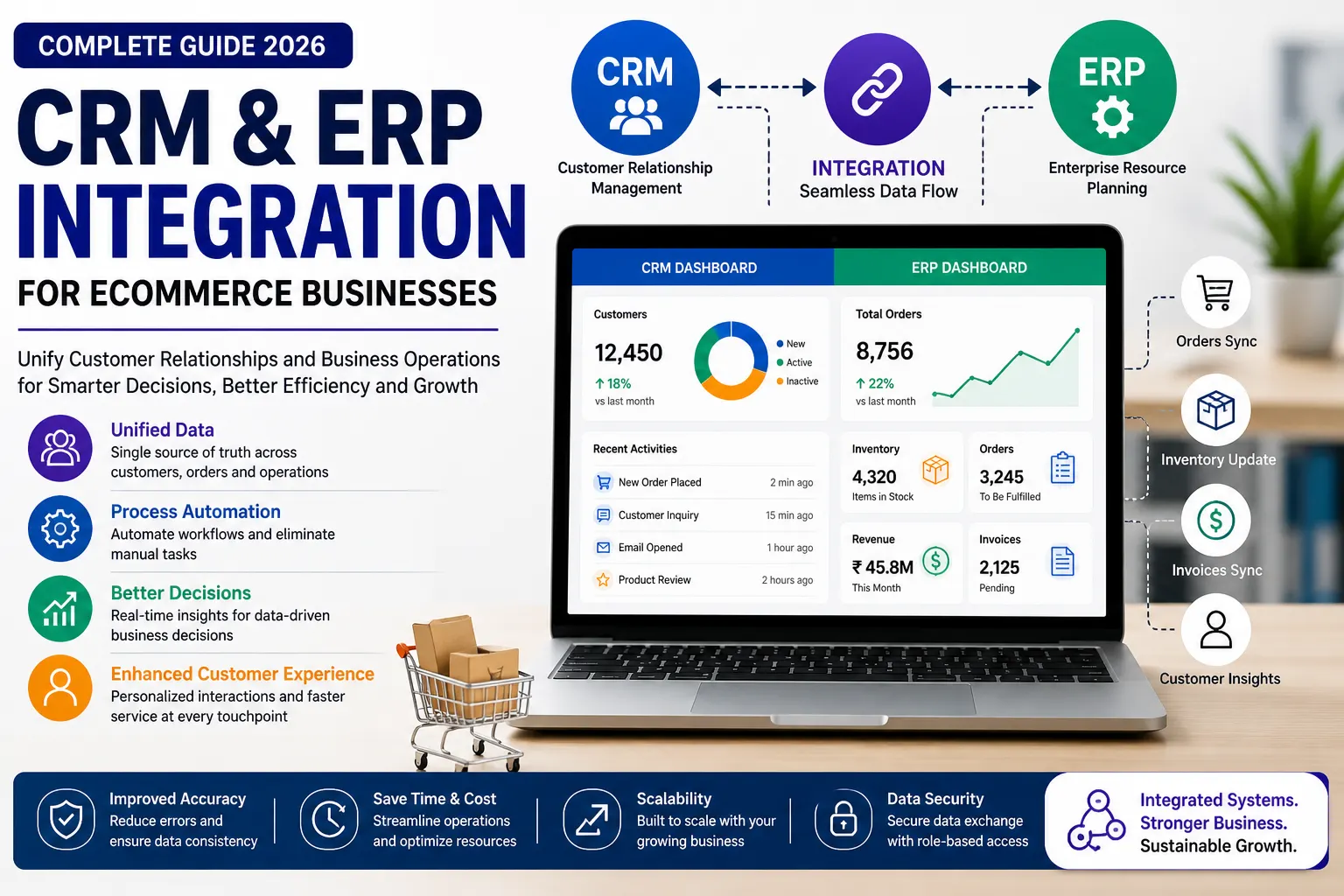
📘 Introduction: Why Integration is the Real Competitive Advantage in Ecommerce
Ecommerce success is no longer driven only by traffic, product quality, or pricing. As businesses scale, operational complexity becomes the biggest challenge. Orders increase, customer interactions multiply, inventory becomes harder to manage, and financial processes grow more complicated. Without a structured system to manage these moving parts, even high-growth ecommerce businesses can struggle with inefficiencies, delays, and poor customer experiences.
This is where CRM and ERP integration becomes a game-changing strategy.
A Customer Relationship Management (CRM) system focuses on managing customer data, interactions, and engagement. An Enterprise Resource Planning (ERP) system manages internal business processes such as inventory, finance, procurement, and operations. Individually, both systems provide value—but when integrated, they create a unified ecosystem that enables real-time data flow across the entire business.
This integration allows ecommerce businesses to eliminate silos, automate workflows, improve decision-making, and deliver seamless customer experiences. In this comprehensive guide, we will explore CRM and ERP integration in depth, including how it works, why it matters, implementation strategies, challenges, and future trends.
🧠 Understanding CRM and ERP Systems in Ecommerce
Before diving into integration, it is essential to understand the roles of CRM and ERP systems individually.
👥 What is a CRM System?
A CRM system is designed to manage all customer-related data and interactions. It helps businesses track customer behavior, store contact information, monitor purchase history, and automate marketing and support processes.
In ecommerce, CRM systems play a critical role in:
- Managing customer profiles
- Tracking customer journeys
- Personalizing marketing campaigns
- Handling customer support interactions
Popular CRM platforms include Salesforce, HubSpot, and Zoho CRM.
👉 Learn more about CRM fundamentals:
https://www.salesforce.com/in/crm/what-is-crm/
🏢 What is an ERP System?
An ERP system is a centralized platform that manages core business processes such as inventory, finance, order management, and supply chain operations.
In ecommerce, ERP systems handle:
- Inventory tracking
- Order processing
- Financial management
- Supplier coordination
Popular ERP solutions include SAP, Oracle, and Microsoft Dynamics.
👉 Learn more about ERP systems:
https://www.oracle.com/erp/what-is-erp/
🔗 What is CRM & ERP Integration? (Deep Explanation)
CRM and ERP integration refers to the process of connecting these two systems so that they can share data and work together seamlessly. Instead of operating as separate platforms, the integrated system ensures that customer data and business operations are aligned in real time.
For example, when a customer places an order, the CRM captures customer details and interaction history, while the ERP updates inventory levels, processes the order, and handles billing. Integration ensures that both systems have access to the same data, eliminating duplication and inconsistencies.
This unified approach enables businesses to create a single source of truth, where all departments can access accurate and up-to-date information.
⚙️ How CRM & ERP Integration Works (Step-by-Step Flow)
The integration process involves multiple stages and systems working together.
When a customer interacts with your ecommerce platform, the CRM system records their activity, including browsing behavior, cart actions, and purchase history. Once an order is placed, this information is sent to the ERP system, which processes the order, updates inventory, and generates invoices.
At the same time, the ERP system sends updates back to the CRM, ensuring that customer records reflect the latest transactions and interactions. This continuous exchange of data enables both systems to stay synchronized.
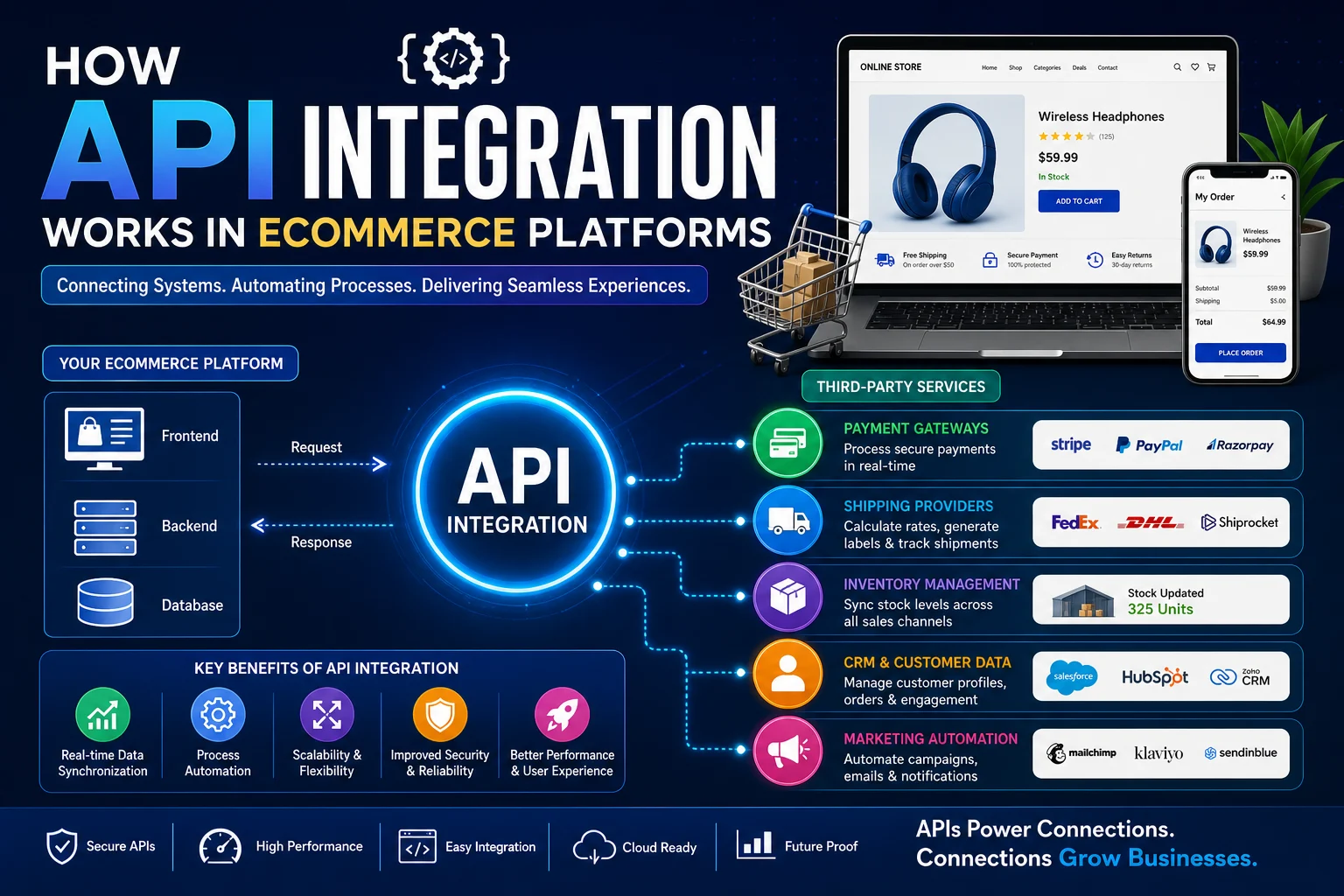
Integration is typically achieved using APIs, middleware, or integration platforms that facilitate communication between systems.
👉 Learn more about API integration:
https://developer.mozilla.org/en-US/docs/Learn/JavaScript/Client-side_web_APIs/Introduction
🚀 Key Benefits of CRM & ERP Integration for Ecommerce
📊 1. Unified Data and Improved Visibility
One of the biggest advantages of integration is the creation of a unified data ecosystem. Businesses can access customer data, order details, inventory levels, and financial information from a single platform, improving visibility and decision-making.
⚡ 2. Operational Efficiency
Integration eliminates manual data entry and reduces errors. Processes such as order fulfillment, inventory updates, and invoicing can be automated, saving time and resources.
🎯 3. Enhanced Customer Experience
With access to complete customer data, businesses can deliver personalized experiences, faster support, and more relevant marketing campaigns.
📈 4. Scalability
As ecommerce businesses grow, integrated systems can handle increased complexity without requiring additional manual effort.
🧩 Real-World Use Case: End-to-End Workflow
To understand the practical impact of integration, consider a typical ecommerce workflow.
A customer visits your website and browses products. The CRM system tracks their behavior and preferences. When they place an order, the CRM sends this information to the ERP system. The ERP processes the order, updates inventory, and generates an invoice.
Once the order is shipped, the ERP updates the CRM with delivery details, allowing the business to send notifications and follow-up emails. This seamless flow ensures that every department has access to accurate information.
🏗️ Integration Methods (Technical Deep Dive)
🔹 API-Based Integration
APIs are the most common method for integrating CRM and ERP systems. They allow real-time communication between systems and provide flexibility for customization.
🔹 Middleware Integration
Middleware acts as a bridge between systems, managing data flow and transformations. This approach is useful for complex integrations involving multiple systems.
🔹 iPaaS (Integration Platform as a Service)
Cloud-based integration platforms simplify the integration process by providing pre-built connectors and automation tools.
⚡ Performance Optimization in Integration
To ensure smooth operation, integration systems must be optimized for performance.
🚀 Caching
Caching frequently accessed data reduces system load.
🚀 Data Synchronization Strategies
Businesses can choose between real-time synchronization and batch processing depending on their requirements.
🔐 Security Considerations
Integration involves sensitive data, making security a top priority.
🔒 Authentication
Secure authentication methods such as OAuth ensure that only authorized systems can access data.
🔒 Data Encryption
All data transfers must be encrypted to prevent unauthorized access.
🔒 Compliance
Businesses must comply with data protection regulations such as GDPR.
📈 SEO & Business Impact
Although CRM and ERP integration is primarily operational, it indirectly impacts SEO by improving:
- Site performance
- Order accuracy
- Customer satisfaction
These factors contribute to better user engagement and higher search rankings.
☁️ Cloud-Based CRM & ERP Integration
Cloud platforms enable scalable and flexible integration.
Platforms:
- Amazon Web Services → https://aws.amazon.com/enterprise-applications/
- Google Cloud Platform → https://cloud.google.com/solutions/erp
🔮 Future Trends in CRM & ERP Integration
The future of integration is driven by emerging technologies such as AI, machine learning, and automation.
Businesses are moving towards:
- Real-time analytics
- Predictive customer insights
- Automated decision-making
🏁 Conclusion
CRM and ERP integration is essential for ecommerce businesses that want to scale efficiently and deliver exceptional customer experiences. By connecting customer data with business operations, businesses can streamline processes, improve accuracy, and gain a competitive advantage.
To implement advanced CRM and ERP integration for your ecommerce business, partner with Sri Hayavadhana Info Tech and build a scalable, future-ready digital commerce platform.