Blog
Homepage Design for Ecommerce (What Works)

Introduction to Homepage Design for Ecommerce (What Works)
The homepage is one of the most critical elements of any ecommerce website. It serves as the digital storefront, the brand introduction, the navigation hub, and often the first interaction a customer has with an online business. In ecommerce, first impressions happen instantly. Visitors begin evaluating trust, professionalism, usability, product quality, pricing expectations, and overall credibility within seconds of landing on the homepage. Because of this, homepage design directly influences customer engagement, bounce rates, product discovery, and ultimately ecommerce conversions.
Modern ecommerce homepage design is no longer only about aesthetics. Successful ecommerce homepages combine user experience principles, conversion optimization strategies, SEO structure, mobile responsiveness, branding consistency, visual storytelling, speed optimization, and customer psychology. Every section on the homepage should serve a clear strategic purpose while helping guide visitors naturally through the shopping journey.
As ecommerce competition continues intensifying in 2026, businesses can no longer rely on outdated homepage layouts or generic themes. Customers expect fast-loading, intuitive, mobile-friendly ecommerce experiences that help them discover products quickly and shop confidently. Ecommerce websites that fail to provide seamless homepage experiences often lose potential customers to competitors within moments.
A high-performing ecommerce homepage should accomplish several goals simultaneously:
- Introduce the brand clearly
- Communicate value propositions
- Build customer trust
- Improve product discovery
- Support mobile usability
- Increase conversions
- Enhance SEO visibility
- Encourage deeper browsing
This comprehensive guide explores what works in ecommerce homepage design, including homepage structure, navigation systems, visual hierarchy, mobile optimization, trust-building techniques, product presentation strategies, SEO considerations, conversion optimization principles, personalization, branding, and future homepage design trends shaping ecommerce growth.
Why Homepage Design Matters in Ecommerce
The homepage acts as the foundation of the ecommerce experience. Even though many visitors now enter ecommerce websites through search engines, advertisements, product pages, or social media campaigns, the homepage still plays a central role in shaping customer perception and influencing user behavior.
A professionally designed ecommerce homepage helps customers immediately understand:
- What the business sells
- Who the products are designed for
- Why the brand is trustworthy
- What makes the store different from competitors
Customers form opinions about ecommerce websites extremely quickly. A homepage that appears cluttered, outdated, confusing, or slow can instantly reduce customer confidence. On the other hand, a polished and intuitive homepage creates emotional reassurance and encourages users to continue exploring products.
Homepage design directly affects:
- Customer engagement
- Session duration
- Bounce rates
- Product exploration
- Conversion rates
- Customer retention
- SEO performance
Businesses investing in ecommerce homepage optimization often see measurable improvements in both customer experience and revenue generation.
The homepage also serves as a strategic internal linking hub that helps distribute traffic toward category pages, featured collections, product listings, and informational content. Because of this, homepage structure influences both usability and search engine crawlability.
In modern ecommerce, homepage design is not simply about visual presentation. It is a business growth tool that supports branding, marketing, customer acquisition, and conversion optimization simultaneously.
Understanding Customer Behavior on Ecommerce Homepages
Effective homepage design begins with understanding how users behave when they first land on ecommerce websites.
Most customers do not carefully read every line of content. Instead, users scan pages rapidly while searching for:
- Relevant products
- Clear navigation
- Pricing indicators
- Trust signals
- Product categories
- Search functionality
- Promotions
This scanning behavior means ecommerce homepages must prioritize clarity and visual hierarchy rather than overwhelming users with excessive information.
Modern ecommerce users expect:
- Fast loading times
- Simple interfaces
- Mobile responsiveness
- Clear value propositions
- Intuitive navigation
Visitors should immediately understand:
- What products are available
- Why they should trust the brand
- How to begin shopping
If customers cannot quickly identify these answers, bounce rates increase dramatically.
User behavior also differs across devices. Mobile users typically:
- Browse more quickly
- Scroll more frequently
- Interact using thumbs
- Have shorter attention spans
Desktop users often explore products in greater depth, while mobile users prioritize speed and convenience.
Understanding these behavioral patterns helps businesses design ecommerce homepages that align with customer expectations and improve conversion performance.
The Importance of First Impressions in Ecommerce
First impressions strongly influence ecommerce purchasing behavior because customers cannot physically interact with products before buying them online.
When visitors arrive on an ecommerce homepage, they subconsciously evaluate:
- Brand professionalism
- Product quality
- Website trustworthiness
- Ease of navigation
- Visual appeal
- Security perception
These impressions form within seconds and heavily influence whether users continue browsing or leave immediately.
Professional ecommerce homepage design creates positive emotional signals through:
- Clean layouts
- Consistent branding
- High-quality imagery
- Smooth interactions
- Readable typography
- Fast-loading content
Poor homepage design often creates uncertainty and distrust. Customers may question:
- Product authenticity
- Payment security
- Delivery reliability
- Customer support quality
Visual consistency plays an especially important role in ecommerce trust building. Inconsistent colors, typography, layouts, or imagery can make websites feel unprofessional and unreliable.
Modern ecommerce businesses must treat homepage design as a core trust-building mechanism rather than purely a visual design exercise.
Structuring a High-Converting Ecommerce Homepage
Homepage structure directly affects usability, engagement, and conversion rates.
A high-converting ecommerce homepage should guide visitors naturally through a logical shopping journey while minimizing friction and distractions.
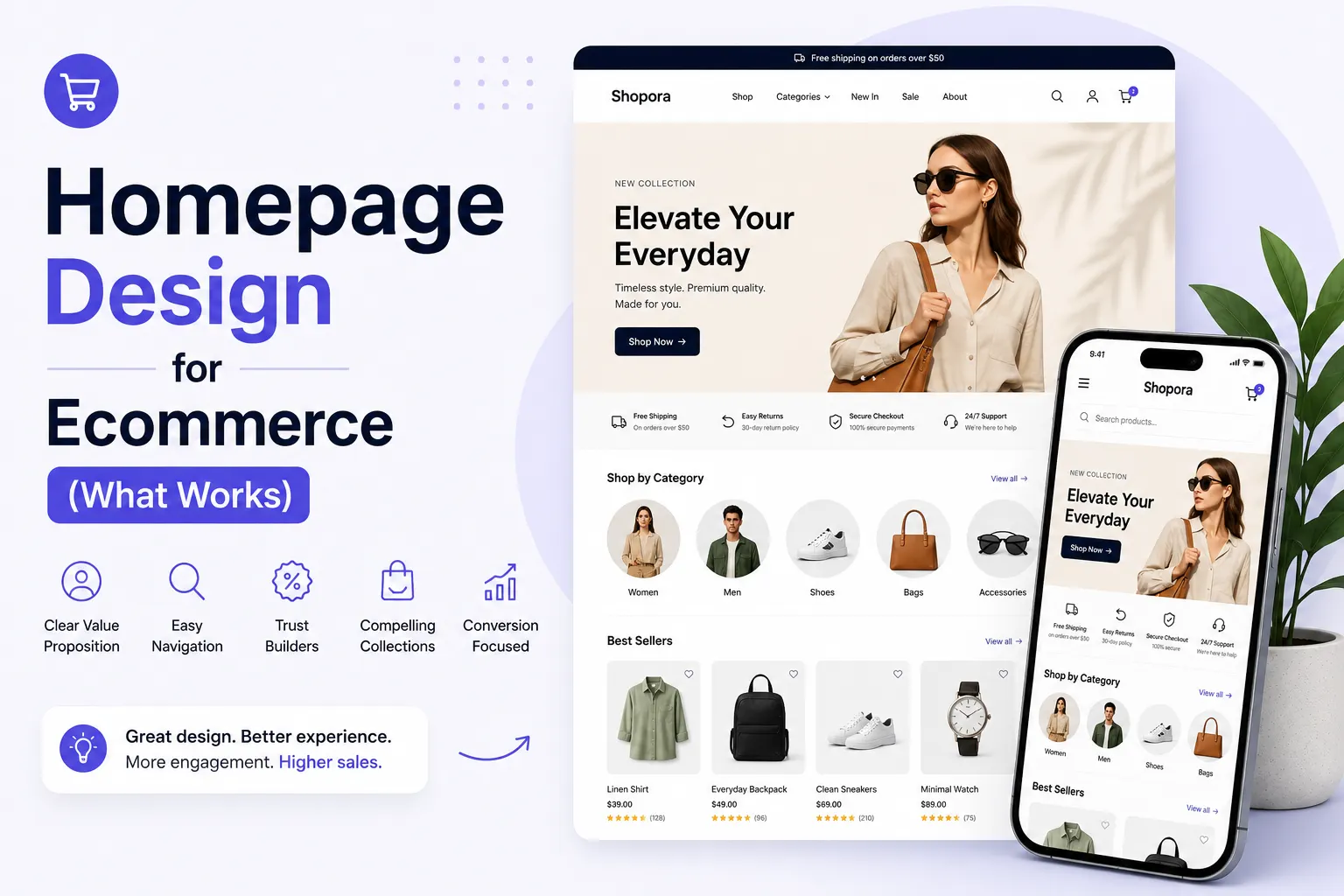
Most effective ecommerce homepages include:
- Hero section
- Navigation menu
- Featured categories
- Product collections
- Best-selling products
- Trust signals
- Customer reviews
- Brand storytelling
- Footer navigation
Each section should have a clear purpose while supporting overall conversion goals.
The homepage should avoid clutter and excessive content density. Overwhelming visitors with too many competing messages creates confusion and decision fatigue.
Strong homepage structure prioritizes:
- Simplicity
- Visual hierarchy
- Product discoverability
- Mobile usability
- Conversion-focused layouts
Content placement should align with customer intent and browsing behavior.
For businesses seeking professionally optimized ecommerce homepage design and conversion-focused web development, Sri Hayavadhana Solutions offers ecommerce website development, UX optimization, and SEO-driven design services tailored for modern online stores.
Designing Effective Hero Sections
The hero section is often the first visual area users see when landing on an ecommerce homepage.
A strong hero section should immediately communicate:
- Brand identity
- Product focus
- Unique value proposition
- Primary CTA
Many ecommerce websites misuse hero sections by prioritizing oversized banners or excessive animations without providing clear messaging.
High-performing hero sections typically include:
- Professional imagery
- Clear headlines
- Persuasive subheadings
- Conversion-focused CTA buttons
The messaging should quickly answer:
- What does the store sell?
- Why should customers shop here?
- What action should users take next?
Static hero designs often outperform rotating sliders because users rarely wait for multiple slides to load or change.
Mobile optimization is especially important because hero sections consume significant screen space on smartphones.
Effective mobile hero sections prioritize:
- Concise messaging
- Fast-loading images
- Clear CTAs
- Minimal distractions
Optimized hero sections improve both engagement and conversion rates significantly.
Ecommerce Navigation Design Best Practices
Navigation design directly influences how efficiently customers can discover products and browse ecommerce websites.
Poor navigation creates confusion, frustration, and higher bounce rates.
Strong ecommerce navigation systems prioritize:
- Simplicity
- Accessibility
- Clarity
- Product discoverability
Main navigation menus should contain logical product categories that align with customer expectations and shopping behavior.
Examples include:
- Electronics
- Clothing
- Accessories
- Home Decor
- Beauty Products
- Dry Fruits
Mega menus often improve usability for larger ecommerce stores because they organize extensive product catalogs more efficiently.
Search functionality is equally important because many users prefer searching directly rather than manually browsing categories.
Advanced ecommerce search systems should support:
- Predictive search
- Auto-suggestions
- Typo correction
- Product thumbnails
- Smart filters
Sticky headers improve usability by keeping:
- Search bars
- Cart access
- Menu systems
visible while users scroll through pages.
Mobile navigation requires additional optimization because smaller screens create unique usability challenges.
Touch-friendly mobile navigation systems improve both customer experience and conversion performance.
Visual Hierarchy and Customer Attention Flow
Visual hierarchy helps guide user attention strategically throughout the homepage.
Without strong visual hierarchy, ecommerce homepages feel chaotic and difficult to navigate.
Effective visual hierarchy uses:
- Typography sizing
- Spacing
- Contrast
- Positioning
- Color emphasis
to prioritize important information.
The customer journey on the homepage should flow naturally from:
- Brand introduction
- Product discovery
- Trust building
- Conversion actions
Important CTAs should stand out visually without appearing overwhelming or aggressive.
Whitespace is equally important because it improves readability and prevents visual clutter.
Minimalist ecommerce homepage designs often perform better because they help users focus attention on products and shopping actions rather than distractions.
Strong visual hierarchy improves:
- User engagement
- Product visibility
- Mobile usability
- Conversion optimization
Every homepage section should support a clear attention flow that encourages deeper browsing.
Product Presentation Strategies That Increase Engagement
Product visibility is one of the primary goals of ecommerce homepage design.
Homepage product sections help customers begin exploring products immediately without requiring excessive navigation.
Common homepage product sections include:
- Best sellers
- Trending products
- Featured collections
- New arrivals
- Seasonal products
- Recommended items
Best-selling products often perform particularly well because customers trust products that appear popular among other shoppers.
Homepage product displays should remain visually organized and easy to scan.
Important product details should include:
- Product images
- Pricing
- Discounts
- Ratings
- CTA buttons
Product imagery quality significantly affects perceived product value.
High-quality product visuals improve:
- Customer confidence
- Engagement
- Conversion rates
Homepage product sections should balance product visibility with simplicity to avoid overwhelming users.
Curated product collections generally perform better than cluttered product grids containing excessive options.
Building Trust Through Homepage Design
Trust is one of the most important factors influencing ecommerce conversions.
Since customers cannot physically inspect products before purchasing, ecommerce websites must establish trust digitally.
Homepage trust signals help reassure visitors early in the customer journey.
Important trust-building elements include:
- Customer reviews
- Star ratings
- Secure payment badges
- Shipping guarantees
- Return policies
- Money-back guarantees
- Trusted brand partnerships
Social proof strongly influences ecommerce behavior because customers trust peer experiences more than promotional messaging alone.
Displaying reviews and ratings prominently can significantly improve customer confidence.
Professional branding consistency also contributes to trust perception. Websites that appear polished and cohesive feel more reliable.
Transparency is equally important. Customers prefer businesses that clearly communicate:
- Shipping timelines
- Pricing
- Return policies
- Customer support availability
Strong trust-building strategies improve:
- Conversion rates
- Customer retention
- Brand credibility
Mobile Homepage Design for Ecommerce
Mobile optimization is essential because most ecommerce traffic now comes from smartphones.
Mobile homepage design should prioritize:
- Speed
- Simplicity
- Touch-friendly interactions
- Readability
- Efficient navigation
Desktop-style homepage layouts often perform poorly on mobile devices because they create clutter and reduce usability.
Mobile users expect quick access to:
- Search functionality
- Product categories
- Featured collections
- Cart systems
Hero sections should remain concise and optimized for smaller screens.
Buttons and navigation systems should feel natural for thumb-based interactions.
Mobile ecommerce homepages should avoid:
- Excessive animations
- Heavy scripts
- Intrusive popups
- Tiny tap targets
Optimized mobile experiences improve:
- Customer satisfaction
- Conversion rates
- SEO visibility
- Session duration
Businesses that prioritize mobile UX often outperform competitors significantly in ecommerce performance.
Homepage Speed Optimization for Ecommerce Websites
Homepage speed directly affects ecommerce usability and conversions.
Modern customers expect ecommerce websites to load almost instantly, especially on mobile devices.
Slow-loading homepages increase:
- Bounce rates
- Customer frustration
- Cart abandonment
Fast-loading ecommerce homepages improve:
- Engagement
- Product exploration
- Conversion rates
- SEO performance
Common causes of slow homepage performance include:
- Large images
- Excessive scripts
- Heavy animations
- Too many plugins
- Poor hosting
Homepage speed optimization techniques include:
- Image compression
- WebP and AVIF formats
- CDN integration
- Browser caching
- Code minification
- Lazy loading
Google measures user experience using Core Web Vitals metrics, making performance optimization important for both SEO and usability.
Helpful resources:
Businesses continuously optimizing homepage speed often achieve stronger ecommerce growth.
Ecommerce Homepage SEO Best Practices
Homepage SEO helps improve ecommerce visibility in search engines.
An SEO-friendly ecommerce homepage supports:
- Organic traffic growth
- Brand discovery
- Internal linking
- Crawlability
Homepage title tags and meta descriptions should clearly communicate:
- Brand identity
- Product focus
- Value proposition
Homepage content should naturally include relevant ecommerce keywords without excessive keyword stuffing.
Internal linking from the homepage helps distribute authority toward:
- Category pages
- Product collections
- Informational content
Structured data markup can further improve search engine understanding of ecommerce content.
Fast-loading, mobile-friendly homepages also support stronger search rankings because user experience signals influence SEO performance.
SEO and homepage UX should work together rather than being treated separately.
Ecommerce Branding Through Homepage Design
The homepage plays a major role in shaping ecommerce brand identity.
Strong branding helps businesses differentiate themselves in highly competitive ecommerce markets.
Branding elements include:
- Color systems
- Typography
- Photography style
- Messaging tone
- Layout consistency
Consistent branding improves:
- Recognition
- Customer trust
- Emotional connection
- Long-term loyalty
Homepage storytelling can further strengthen customer relationships.
Successful ecommerce brands often communicate:
- Company mission
- Sustainability efforts
- Product sourcing
- Craftsmanship
- Brand values
through homepage content.
Storytelling helps customers connect emotionally with businesses beyond pricing alone.
Strong branding contributes significantly to long-term ecommerce growth and customer retention.
Personalization on Ecommerce Homepages
Personalization improves ecommerce engagement by making homepage experiences more relevant for individual users.
Modern ecommerce platforms increasingly personalize:
- Product recommendations
- Homepage banners
- Featured collections
- Promotions
based on browsing behavior and customer data.
Personalized homepage experiences improve:
- Product discovery
- Average order value
- Customer retention
- Conversion rates
AI-powered recommendation systems help customers discover products more efficiently.
Examples include:
- Recently viewed products
- Frequently bought together
- Personalized recommendations
Personalization is expected to become even more important as ecommerce competition continues increasing.
Using Customer Reviews and Social Proof Effectively
Customer reviews are among the most powerful conversion tools in ecommerce.
Homepage social proof helps reassure visitors that other customers trust the brand and purchase products successfully.
Social proof elements include:
- Product ratings
- Customer testimonials
- User-generated content
- Video reviews
- Customer photos
Authentic reviews improve:
- Trust
- Purchase confidence
- Engagement
- Conversion rates
User-generated content often performs especially well because it feels relatable and genuine.
Businesses should avoid overly generic or obviously fake testimonials because customers quickly recognize inauthentic reviews.
Strong social proof strategies improve both customer trust and long-term brand credibility.
Accessibility in Ecommerce Homepage Design
Accessibility ensures ecommerce websites remain usable for all customers, including users with disabilities.
Accessible homepage design improves:
- User experience
- SEO performance
- Compliance
- Customer reach
Important accessibility considerations include:
- Alt text for images
- Keyboard navigation
- Readable typography
- Proper contrast ratios
- Screen reader compatibility
Accessible ecommerce websites benefit all users, not only customers with disabilities.
Accessibility should remain integrated into homepage design strategy from the beginning rather than added later.
Helpful accessibility resource:
Common Ecommerce Homepage Design Mistakes
Many ecommerce businesses unintentionally reduce conversions because of poor homepage design decisions.
One major issue is excessive clutter. Too many banners, popups, promotions, and competing messages overwhelm users and reduce focus.
Weak navigation systems also hurt product discovery and usability.
Slow-loading homepages significantly increase bounce rates and reduce engagement.
Poor mobile optimization remains another common problem despite mobile traffic dominance.
Lack of clear CTAs can confuse customers and reduce conversion opportunities.
Weak trust signals reduce customer confidence and increase hesitation.
Businesses that continuously audit homepage UX and optimize customer journeys often achieve stronger ecommerce performance.
Future Trends in Ecommerce Homepage Design
Ecommerce homepage design continues evolving rapidly as customer expectations and technology capabilities change.
AI-driven personalization will become increasingly sophisticated, allowing homepages to adapt dynamically based on user behavior.
Minimalist and speed-focused layouts will continue growing because customers prefer clean and efficient browsing experiences.
Video content and interactive product visualization technologies are expected to become more common.
Voice search integration and conversational interfaces may also influence future homepage design structures.
Augmented reality product previews could eventually become integrated directly into homepage experiences.
Businesses adapting early to emerging ecommerce homepage trends will remain more competitive in future digital commerce environments.
Final Thoughts
Homepage design plays a central role in ecommerce success because it shapes customer first impressions, supports product discovery, builds trust, and guides visitors through the shopping journey.
Successful ecommerce homepages combine:
- Conversion optimization
- Mobile responsiveness
- Fast loading speed
- Strong branding
- Clear navigation
- Trust-building strategies
- Personalized experiences
Modern customers expect ecommerce websites to feel intuitive, fast, visually appealing, and easy to use across every device.
Businesses investing in homepage optimization often achieve:
- Higher conversion rates
- Improved customer retention
- Better SEO visibility
- Stronger engagement
- Increased ecommerce revenue
Whether building Shopify stores, WooCommerce websites, Magento platforms, or custom ecommerce applications, homepage design should remain a continuous strategic priority.
The future of ecommerce will increasingly revolve around experience quality, personalization, mobile convenience, and frictionless interactions. Businesses that consistently improve homepage UX and customer satisfaction will remain competitive and profitable in the evolving ecommerce landscape.