Blog
Ecommerce Navigation Best Practices

Introduction to Ecommerce Navigation Best Practices
Ecommerce navigation is one of the most important elements of a successful online store. No matter how visually attractive an ecommerce website looks or how high-quality the products are, customers will struggle to complete purchases if they cannot navigate the website easily. Navigation acts as the roadmap that guides users through product categories, collections, search systems, filters, product pages, and checkout experiences. A well-structured ecommerce navigation system improves customer satisfaction, increases product discovery, supports SEO performance, and significantly boosts conversion rates.
Modern ecommerce customers expect websites to feel intuitive and effortless. They want to locate products quickly, browse categories naturally, compare options efficiently, and complete purchases without confusion or frustration. As ecommerce competition continues increasing in 2026, businesses can no longer rely on outdated navigation systems or cluttered menu structures. Ecommerce navigation must now support mobile-first usability, fast product discovery, search optimization, conversion-focused UX, and scalable category architecture.
Navigation design affects nearly every aspect of ecommerce performance, including:
- User experience
- Bounce rates
- Product visibility
- Conversion rates
- SEO crawlability
- Mobile usability
- Session duration
- Customer retention
A poorly designed navigation system increases friction and creates confusion, often causing customers to leave the website before completing purchases. On the other hand, optimized ecommerce navigation systems create smooth shopping journeys that encourage deeper browsing and stronger customer engagement.
This comprehensive guide explores ecommerce navigation best practices in depth, including information architecture, category organization, mobile navigation, mega menus, search functionality, filtering systems, SEO optimization, accessibility, conversion optimization, and future ecommerce navigation trends shaping modern online stores.
Why Ecommerce Navigation Matters
Navigation determines how efficiently users can move through an ecommerce website and discover products. Even highly attractive ecommerce websites can fail if users struggle to locate items or understand how the store is organized.
Customers visiting ecommerce websites generally have one of two goals:
- Find a specific product quickly
- Explore products for inspiration or comparison
In both situations, navigation plays a central role in shaping the shopping experience.
Strong ecommerce navigation helps customers:
- Locate products faster
- Understand category structures
- Browse collections confidently
- Discover related products
- Complete purchases efficiently
Poor navigation creates several negative outcomes:
- Increased bounce rates
- Reduced product discovery
- Lower conversions
- Customer frustration
- Weak SEO performance
Navigation also affects search engines because internal linking structures help search engines understand website hierarchy and page relationships.
Businesses that invest in navigation optimization often achieve:
- Higher conversion rates
- Better customer retention
- Improved SEO rankings
- Stronger user engagement
Navigation should never be treated as a secondary design element. It is one of the core foundations of ecommerce usability and business growth.
Understanding Ecommerce User Behavior
Effective ecommerce navigation begins with understanding how users behave while shopping online.
Most ecommerce visitors do not browse websites in perfectly predictable ways. Instead, users move between:
- Search bars
- Category pages
- Product filters
- Recommendations
- Product pages
- Promotional sections
Some users arrive with high purchase intent, while others browse casually for inspiration.
Modern ecommerce users expect:
- Fast navigation
- Clear category organization
- Efficient search functionality
- Mobile-friendly usability
- Predictable browsing experiences
Users prefer websites that feel intuitive immediately without requiring extra learning.
Mobile users behave differently from desktop users. Smartphone shoppers often:
- Scroll quickly
- Use search more frequently
- Prefer simplified menus
- Browse in shorter sessions
- Interact using thumbs
Desktop users may spend more time comparing products and browsing deeply.
Understanding these behavioral differences helps ecommerce businesses design navigation systems optimized for both desktop and mobile customer journeys.
Ecommerce Information Architecture Best Practices
Information architecture refers to how products, categories, pages, and content are organized within the ecommerce website.
Strong information architecture creates logical relationships between:
- Categories
- Subcategories
- Product pages
- Collections
- Informational content
Poor architecture creates confusion and reduces product discoverability.
Effective ecommerce information architecture prioritizes:
- Simplicity
- Scalability
- Clarity
- Searchability
Category structures should align with how customers naturally search and browse products rather than internal inventory structures.
For example, fashion ecommerce customers typically expect categories such as:
- Men
- Women
- Kids
- Accessories
- Footwear
rather than technical inventory classifications.
Well-structured ecommerce architecture improves:
- Navigation usability
- SEO crawlability
- Customer experience
- Conversion performance
Businesses building scalable ecommerce stores often work with professional ecommerce web design agencies such as Sri Hayavadhana Solutions to create conversion-focused website structures optimized for usability and search visibility.
Main Navigation Menu Best Practices
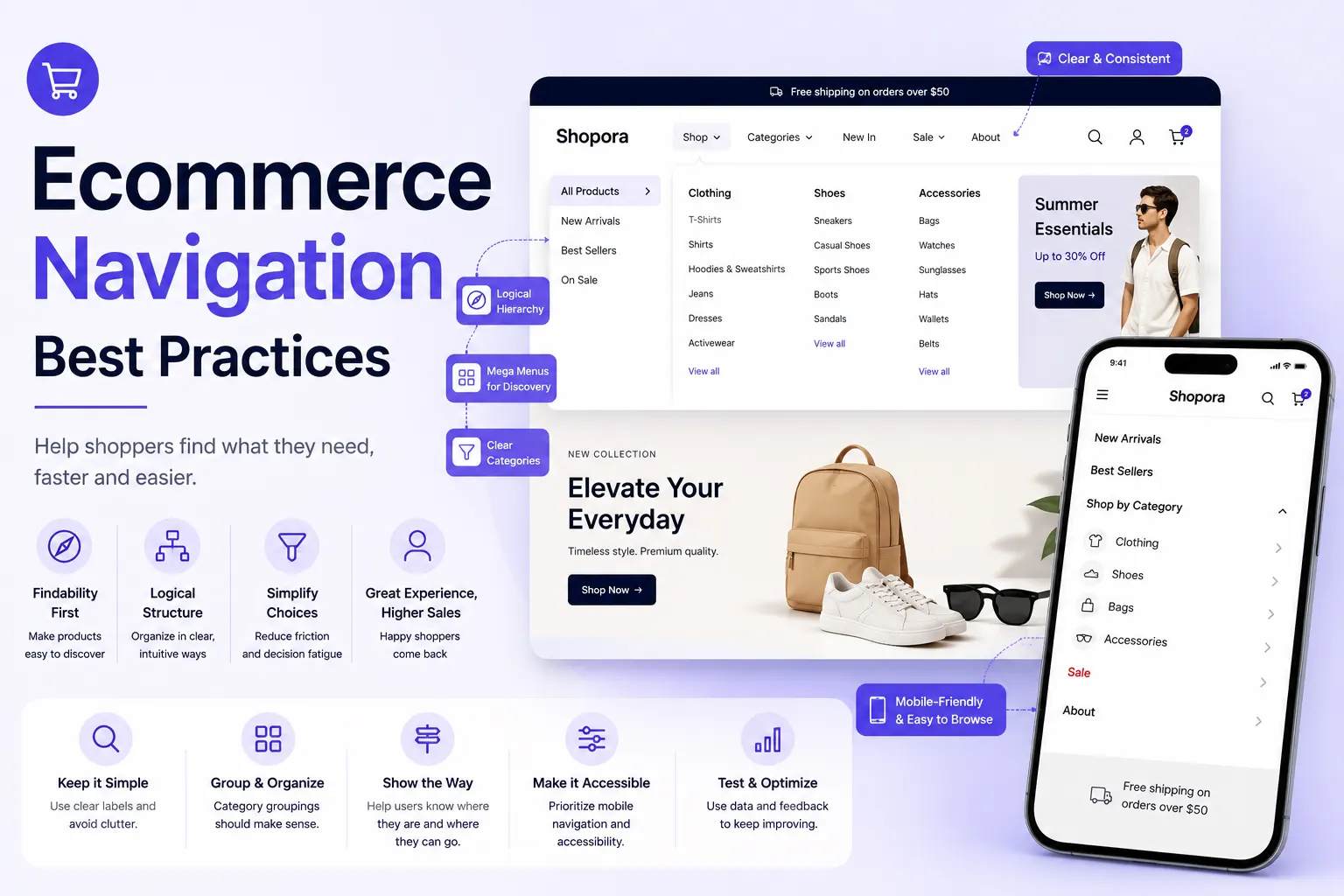
The main navigation menu is one of the most visible elements on an ecommerce website because it acts as the primary gateway to product exploration.
Strong navigation menus prioritize:
- Simplicity
- Readability
- Accessibility
- Product discoverability
Main navigation should include logical categories that match customer expectations.
Examples include:
- New Arrivals
- Best Sellers
- Electronics
- Clothing
- Accessories
- Sale
Navigation labels should remain:
- Clear
- Familiar
- Descriptive
Avoid confusing or overly creative terminology that customers may not immediately understand.
Too many top-level menu items can overwhelm users and reduce usability.
Sticky navigation headers often improve UX by keeping:
- Search functionality
- Menu systems
- Cart access
visible while users scroll through pages.
Main navigation systems should support both browsing-focused users and customers searching for specific products quickly.
Mega Menu Best Practices for Ecommerce Stores
Mega menus are large dropdown navigation systems that organize extensive product catalogs into structured sections.
Mega menus are especially useful for large ecommerce websites because they improve:
- Product discoverability
- Internal linking
- Category visibility
- Browsing efficiency
Strong mega menus maintain:
- Clear visual hierarchy
- Organized layouts
- Readability
- Mobile responsiveness
Mega menus may include:
- Product categories
- Featured collections
- Best sellers
- Promotional banners
- Trending products
Visual elements such as icons or thumbnails can improve scanability.
However, mega menus should avoid excessive complexity because overloaded dropdowns can overwhelm users.
Mega menus should remain:
- Conversion-focused
- Easy to scan
- Fast-loading
- Mobile-friendly
Well-designed mega menus significantly improve ecommerce usability for stores with large inventories.
Ecommerce Search Functionality Best Practices
Search functionality is one of the most important ecommerce navigation tools because many users prefer searching directly instead of browsing categories manually.
Search users often demonstrate stronger purchase intent because they already know what they are looking for.
Strong ecommerce search systems improve:
- Product discovery
- User satisfaction
- Conversion rates
- Average order value
Modern ecommerce search systems should support:
- Predictive search
- Auto-suggestions
- Typo correction
- Product thumbnails
- Popular searches
- Search history
Autocomplete systems improve usability by helping customers locate products faster.
Advanced ecommerce search may also include:
- Voice search
- AI-powered recommendations
- Visual search
Search result pages should remain:
- Fast-loading
- Well-organized
- Filter-friendly
Weak search experiences create frustration and significantly reduce conversions.
Businesses prioritizing ecommerce search optimization often see major improvements in revenue and customer engagement.
Category Page Navigation Best Practices
Category pages help customers browse products efficiently without feeling overwhelmed.
Strong category navigation systems improve:
- Product visibility
- Filtering usability
- Browsing efficiency
- SEO performance
Category names should align with customer expectations and keyword behavior.
Examples include:
- Running Shoes
- Wireless Earbuds
- Organic Dry Fruits
- Gaming Accessories
Subcategories help narrow browsing experiences and improve product discovery.
Category pages should include:
- Filters
- Sorting systems
- Breadcrumb navigation
- Product recommendations
Category layouts should remain visually clean and easy to scan.
SEO-friendly category structures improve:
- Organic visibility
- Crawlability
- Commercial keyword rankings
Well-optimized category navigation improves both usability and ecommerce sales performance.
Breadcrumb Navigation for Ecommerce UX
Breadcrumb navigation helps users understand their location within the ecommerce website structure.
Example breadcrumb path:
Home > Electronics > Smartphones > Android Phones
Breadcrumbs improve:
- Navigation clarity
- User orientation
- Internal linking
- SEO structure
Breadcrumbs are especially useful for ecommerce stores with deep category hierarchies.
Benefits of breadcrumb navigation include:
- Easier backtracking
- Better usability
- Reduced frustration
- Improved crawlability
Google also uses breadcrumb structured data to improve search result presentation.
Breadcrumb navigation supports both customer experience and SEO optimization simultaneously.
Mobile Ecommerce Navigation Best Practices
Mobile navigation requires specialized optimization because smartphone browsing behavior differs significantly from desktop browsing behavior.
Mobile users expect:
- Simplified interfaces
- Fast access
- Thumb-friendly interactions
- Efficient scrolling
Desktop-style navigation systems often perform poorly on smartphones because smaller screens reduce available space.
Hamburger menus remain popular because they help organize navigation efficiently without consuming excessive screen space.
Strong mobile navigation includes:
- Sticky headers
- Search accessibility
- Large tap targets
- Simplified category structures
- Touch-friendly interactions
Mobile navigation should minimize friction and reduce the number of taps required to reach products.
Search functionality becomes even more important on mobile devices because many users prefer searching directly rather than browsing categories.
Businesses optimizing mobile navigation often achieve:
- Higher conversions
- Better engagement
- Improved customer satisfaction
Mobile-first navigation design is now essential for ecommerce success.
Ecommerce Filtering and Sorting Best Practices
Filtering systems help customers narrow product selections quickly and efficiently.
Strong filtering systems improve:
- Product discovery
- Browsing efficiency
- Conversion rates
Useful ecommerce filters may include:
- Price
- Brand
- Color
- Size
- Ratings
- Material
- Availability
Filters should remain:
- Easy to use
- Mobile-friendly
- Fast-loading
Sorting systems help customers organize products according to preferences.
Common sorting options include:
- Best Sellers
- New Arrivals
- Price Low to High
- Price High to Low
- Highest Rated
Advanced filtering systems are especially important for large ecommerce inventories.
Poor filtering UX creates frustration and reduces customer engagement significantly.
Navigation SEO Best Practices
Navigation structure strongly affects ecommerce SEO because search engines rely on internal linking systems to crawl and understand websites.
SEO-friendly navigation improves:
- Crawlability
- Indexing efficiency
- Internal linking
- Organic visibility
Important navigation SEO practices include:
- Logical hierarchy
- Descriptive anchor text
- Crawlable menus
- Consistent linking structures
Category pages often rank for valuable commercial keywords, making navigation especially important for ecommerce SEO.
Businesses should avoid:
- Broken links
- Excessively deep structures
- Duplicate categories
- Orphan pages
Helpful SEO resources include:
Strong navigation architecture improves both SEO performance and customer usability.
Homepage Navigation Strategies
The homepage acts as the primary navigation gateway for ecommerce websites.
Homepage navigation should guide users naturally toward:
- Product categories
- Featured collections
- Best sellers
- Promotional sections
Strong homepage navigation prioritizes:
- Product visibility
- Search accessibility
- Simplicity
- Mobile responsiveness
Homepage layouts should avoid overwhelming users with too many competing messages or excessive visual clutter.
Visual hierarchy helps guide customer attention strategically through the homepage.
Featured collections and trending products improve product discovery and encourage deeper browsing behavior.
Homepage navigation strongly influences first impressions and overall ecommerce usability.
Footer Navigation Best Practices
Footer navigation plays an important role in usability and internal linking.
Footers help users access:
- Customer support pages
- Policies
- Contact information
- Informational resources
- Category links
Well-structured footers improve:
- SEO crawlability
- Customer trust
- Website usability
Important footer links may include:
- Shipping Policy
- Return Policy
- Privacy Policy
- FAQs
- About Us
Footer layouts should remain:
- Organized
- Readable
- Easy to scan
Cluttered footer designs reduce usability and create visual confusion.
Navigation Design and Ecommerce Conversion Optimization
Navigation design directly influences ecommerce conversion rates because it affects how easily users can locate products and complete purchases.
Strong navigation UX improves:
- Product discovery
- Session duration
- Cart additions
- Checkout completion
Conversion-focused navigation prioritizes:
- Fast browsing
- Simplified search
- Clear categories
- Efficient filtering
Reducing navigation friction improves customer satisfaction and increases ecommerce revenue opportunities.
Navigation should support purchasing behavior naturally without distracting users unnecessarily.
Businesses continuously optimizing navigation UX often outperform competitors significantly.
Accessibility in Ecommerce Navigation
Accessible navigation ensures ecommerce websites remain usable for all customers, including users with disabilities.
Accessibility improvements also support:
- SEO performance
- Customer inclusivity
- Usability standards
Important accessibility considerations include:
- Keyboard navigation
- Screen reader compatibility
- Proper menu labeling
- Sufficient contrast ratios
- Focus indicators
Navigation systems should remain usable without relying entirely on mouse interactions.
Accessibility should remain integrated into ecommerce navigation strategy from the beginning.
Helpful accessibility resource:
Common Ecommerce Navigation Mistakes
Many ecommerce businesses unintentionally reduce usability through poor navigation design decisions.
One major issue is excessive complexity. Overloaded menus and confusing category structures overwhelm users quickly.
Other common navigation mistakes include:
- Weak search functionality
- Hidden navigation elements
- Tiny mobile tap targets
- Broken internal links
- Inconsistent category naming
- Slow-loading menus
Poor mobile navigation remains another major ecommerce usability issue.
Businesses should continuously audit customer behavior and optimize navigation systems regularly.
Navigation optimization should remain an ongoing process rather than a one-time design task.
Future Trends in Ecommerce Navigation
Ecommerce navigation continues evolving rapidly as customer expectations and technologies change.
AI-powered navigation systems will become increasingly advanced, allowing ecommerce websites to personalize browsing experiences dynamically.
Voice search integration is expected to grow significantly as voice assistants become more integrated into ecommerce ecosystems.
Visual search technology may also become more common, allowing customers to discover products using uploaded images.
Predictive navigation powered by AI could help customers locate products faster based on browsing patterns and purchase behavior.
Minimalist and mobile-first navigation systems will continue growing because customers increasingly prioritize speed and simplicity.
Businesses adapting early to emerging navigation technologies will remain more competitive in future ecommerce markets.
Final Thoughts
Ecommerce navigation is one of the most important factors influencing user experience, SEO performance, product discoverability, and conversion optimization.
Successful navigation systems combine:
- Strong information architecture
- Mobile-first usability
- Efficient search functionality
- SEO-friendly structures
- Clear visual hierarchy
- Conversion-focused UX
Modern ecommerce customers expect websites to feel intuitive, fast, and effortless across every device.
Businesses investing in navigation optimization often achieve:
- Higher conversion rates
- Better customer retention
- Improved SEO rankings
- Stronger engagement
- Increased ecommerce revenue
Whether developing Shopify stores, WooCommerce websites, Magento platforms, or custom ecommerce solutions, navigation strategy should remain a continuous priority.
The future of ecommerce will increasingly revolve around personalized browsing experiences, AI-powered product discovery, mobile convenience, and frictionless navigation systems. Businesses that consistently improve navigation usability and customer experience will remain competitive and profitable in the evolving ecommerce landscape.
Helpful Resources
- Sri Hayavadhana Solutions
- Google Search Central
- BigCommerce Articles
- Baymard Institute
- Nielsen Norman Group
- Google PageSpeed Insights
- Hotjar Analytics