Blog
Ecommerce SEO Strategy for 2026

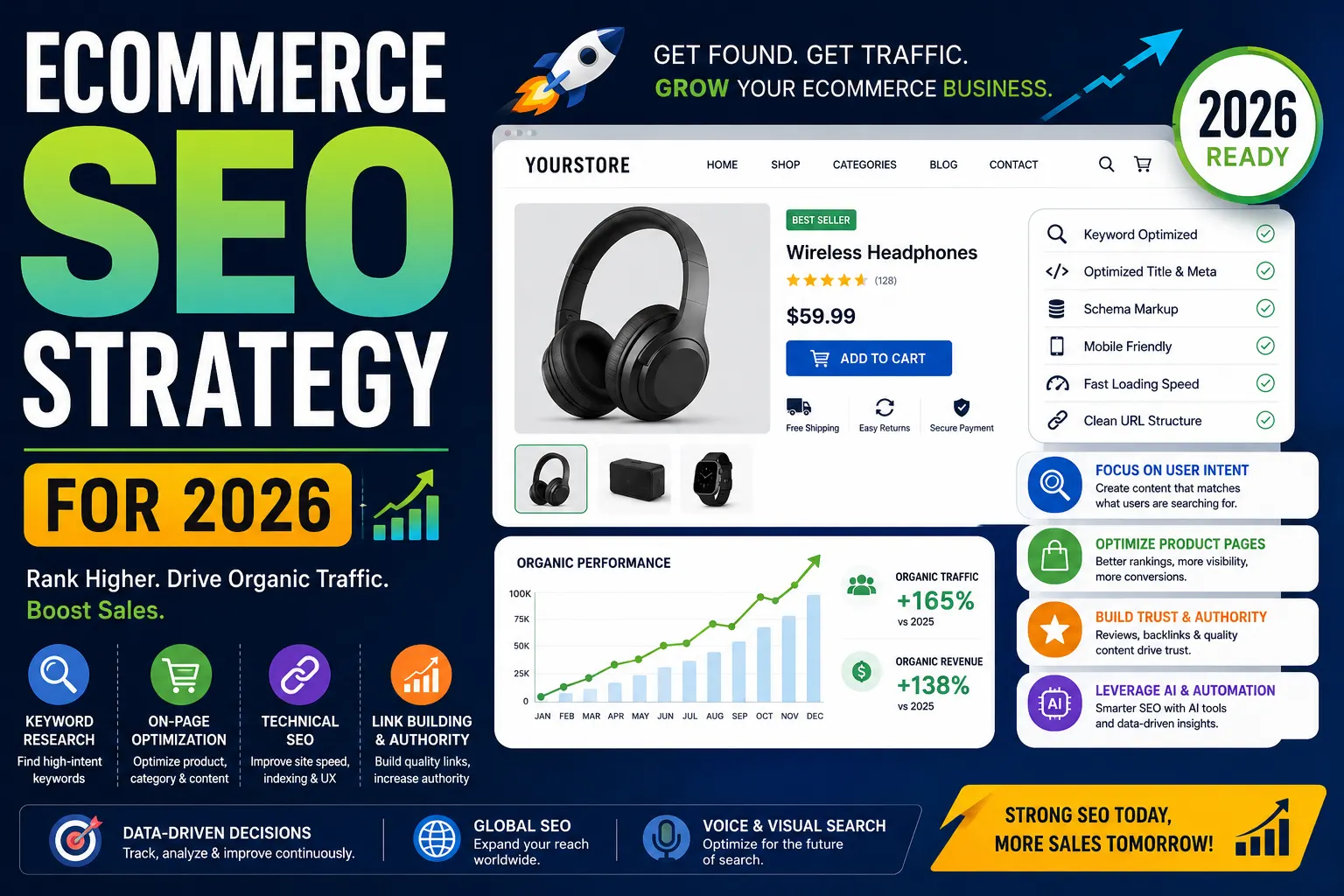
The Complete Guide to Ranking, Traffic Growth, and Online Store Success
Introduction
Ecommerce SEO continues evolving rapidly as search engines become smarter, user behavior changes, artificial intelligence transforms search experiences, and competition in online retail increases every year. Businesses that once relied heavily on paid advertising are now investing aggressively in long-term organic visibility because search engine optimization provides sustainable traffic, higher brand authority, lower customer acquisition costs, and long-term ecommerce growth.
In 2026, ecommerce SEO is no longer limited to inserting keywords into product pages or building random backlinks. Modern ecommerce SEO requires a comprehensive strategy focused on user experience, topical authority, search intent, technical performance, mobile optimization, AI-enhanced content strategies, structured data, Core Web Vitals, semantic search, and conversion-focused optimization.
Search engines like Google now prioritize websites that demonstrate expertise, trustworthiness, relevance, usability, and exceptional user experiences. Ecommerce stores that fail to meet these expectations often struggle to rank even if they have large product catalogs.
Official Resources:
- https://developers.google.com/search/docs
- https://www.bigcommerce.com/articles/ecommerce/ecommerce-seo/
- https://www.shopify.com/blog/ecommerce-seo
The rise of AI-driven search experiences, voice search, visual search, mobile-first indexing, and advanced personalization has dramatically reshaped how ecommerce SEO strategies are developed. Businesses must now optimize not only for traditional rankings but also for AI-generated search summaries, product discovery systems, rich snippets, and user engagement metrics.
This comprehensive guide explains the most important ecommerce SEO strategies for 2026, including keyword research, technical SEO, AI optimization, mobile SEO, structured data, content marketing, link building, Core Web Vitals, ecommerce architecture, conversion optimization, and future trends shaping search visibility.
Understanding Ecommerce SEO in 2026
What Is Ecommerce SEO?
Ecommerce SEO is the process of optimizing online stores to improve visibility in search engine results pages (SERPs). The goal is to attract relevant organic traffic from users searching for products, categories, buying guides, comparisons, reviews, and related transactional queries.
Ecommerce SEO involves optimizing:
- Product pages
- Category pages
- Technical performance
- Content marketing
- Site architecture
- Internal linking
- Mobile usability
- User experience
- Structured data
Why Ecommerce SEO Matters
Organic search remains one of the highest-converting traffic sources for ecommerce businesses.
Benefits include:
- Sustainable traffic growth
- Lower advertising dependency
- Higher brand credibility
- Better conversion rates
- Increased customer trust
- Long-term ROI
Unlike paid advertising, organic rankings continue generating traffic over time without requiring constant ad spend.
How Search Has Changed in 2026
Search engines now focus heavily on:
- Search intent
- User experience
- Semantic understanding
- AI-enhanced search results
- Helpful content
- E-E-A-T signals
Google increasingly evaluates whether content genuinely helps users rather than simply targeting keywords.
Official Resource:
Keyword Research for Ecommerce SEO
Importance of Keyword Research
Keyword research forms the foundation of ecommerce SEO.
Effective keyword targeting helps businesses attract users with strong purchase intent.
Types of Ecommerce Keywords
Transactional Keywords
Transactional keywords indicate buying intent.
Examples:
- Buy running shoes online
- Best gaming laptop under 1000
- Organic skincare products
Informational Keywords
Users search for educational content.
Examples:
- How to choose hiking boots
- Best skincare routine for dry skin
Commercial Investigation Keywords
Users compare products before purchasing.
Examples:
- iPhone vs Samsung comparison
- Best protein powder reviews
Long-Tail Keywords
Long-tail keywords often convert better because they target specific intent.
Example:
Instead of:
“Running shoes”
Use:
“Best lightweight running shoes for marathon training”
Keyword Research Tools
Ahrefs
Semrush
Google Keyword Planner
KeywordTool.io
Search Intent Optimization
Modern SEO focuses heavily on intent alignment.
Product pages should target transactional intent.
Blogs and guides should target informational intent.
Ecommerce Site Architecture
Importance of Site Structure
A well-organized website improves:
- Crawlability
- User experience
- Internal linking
- Conversion rates
Best Practices for Ecommerce Architecture
Simple Navigation Structures
Keep category structures logical.
Example:
Home → Electronics → Smartphones → Android Phones
Flat Site Architecture
Important pages should be accessible within a few clicks.
SEO-Friendly URLs
Use clean URLs.
Example:
https://example.com/mens-running-shoes
Avoid:
https://example.com/product?id=12345
Internal Linking
Strategic internal links distribute authority and improve discoverability.
Product Page SEO Optimization
Why Product Pages Matter
Product pages are primary revenue-driving pages.
They should optimize both:
- Search visibility
- Conversion rates
Product Title Optimization
Include:
- Product names
- Important attributes
- Primary keywords
Example:
“Men’s Lightweight Running Shoes – Breathable Marathon Sneakers”
Unique Product Descriptions
Avoid manufacturer duplicate content.
Write unique descriptions emphasizing:
- Benefits
- Features
- Use cases
- Specifications
Product Images and SEO
Optimize:
- File names
- Alt text
- Compression
- WebP/AVIF formats
Product Reviews
Reviews improve:
- User trust
- Fresh content
- Long-tail keyword coverage
Product Schema Markup
Use structured data for:
- Ratings
- Prices
- Availability
- Reviews
Official Resource:
Category Page SEO Strategy
Importance of Category Pages
Category pages often rank for high-volume commercial keywords.
Optimizing Category Content
Include:
- Introductory descriptions
- Buyer guidance
- Internal links
- FAQs
Filter and Faceted Navigation SEO
Poor filter management creates duplicate content.
Use:
- Canonical tags
- Noindex where necessary
- Parameter management
Official Resource:
Technical SEO for Ecommerce Websites
Importance of Technical SEO
Technical SEO ensures search engines can:
- Crawl pages efficiently
- Index content properly
- Understand site structures
Crawlability Optimization
XML Sitemaps
Submit sitemaps to Google Search Console.
Robots.txt
Control crawler access strategically.
Fix Broken Links
Broken links harm UX and SEO.
HTTPS Security
Secure websites build trust.
Official Resource:
Duplicate Content Management
Ecommerce websites commonly face duplicate content issues.
Solutions include:
- Canonical tags
- Unique descriptions
- URL parameter control
Core Web Vitals and Page Experience
Why Core Web Vitals Matter
Google prioritizes user experience signals.
Core Web Vitals measure:
- Loading speed
- Responsiveness
- Visual stability
Official Resource:
Key Metrics
Largest Contentful Paint (LCP)
Measures loading performance.
Target:
- Under 2.5 seconds
Interaction to Next Paint (INP)
Measures responsiveness.
Cumulative Layout Shift (CLS)
Measures layout stability.
Improving Ecommerce Performance
Image Optimization
Use:
- WebP
- AVIF
Lazy Loading
Improve page speed by delaying image loads.
Minify Code
Reduce CSS and JavaScript size.
Use CDNs
Content Delivery Networks improve global performance.
Providers:
Mobile SEO for Ecommerce
Mobile-First Indexing
Google primarily uses mobile versions for indexing.
Official Resource:
Mobile Optimization Best Practices
Responsive Design
Ensure layouts adapt across devices.
Fast Mobile Speeds
Optimize mobile loading times.
Touch-Friendly Navigation
Buttons should be easy to tap.
Mobile Checkout Optimization
Reduce friction during purchases.
Content Marketing for Ecommerce SEO
Why Content Marketing Matters
Content helps ecommerce businesses:
- Build topical authority
- Rank for informational keywords
- Attract backlinks
- Educate customers
Types of Ecommerce Content
Buying Guides
Help users make decisions.
Comparison Articles
Target commercial investigation searches.
Tutorials
Educational content improves engagement.
Trend Articles
Capture emerging search demand.
Topical Authority
Publishing interconnected content strengthens authority.
Example:
A fitness ecommerce store should cover:
- Workout equipment
- Supplements
- Nutrition
- Exercise guides
AI and Ecommerce SEO in 2026
AI-Driven Search Evolution
Search engines increasingly use AI to interpret intent and summarize information.
Optimizing for AI Search Experiences
Businesses should:
- Publish authoritative content
- Use structured data
- Provide concise answers
- Improve trust signals
AI Content Considerations
AI-generated content must still provide:
- Accuracy
- Originality
- Expertise
- Value
Semantic Search Optimization
Google understands topics beyond exact keywords.
Focus on:
- Context
- Related concepts
- Entity optimization
Link Building for Ecommerce Stores
Importance of Backlinks
Backlinks remain major ranking signals.
Ecommerce Link Building Strategies
Digital PR
Earn mentions from authoritative publications.
Resource Content
Publish link-worthy guides.
Influencer Collaborations
Partnerships generate visibility and links.
Guest Posting
Contribute valuable content to industry websites.
Avoid Black-Hat SEO
Avoid:
- Spam links
- Link fa