Blog
Ecommerce Business Models Explained (B2B, D2C)

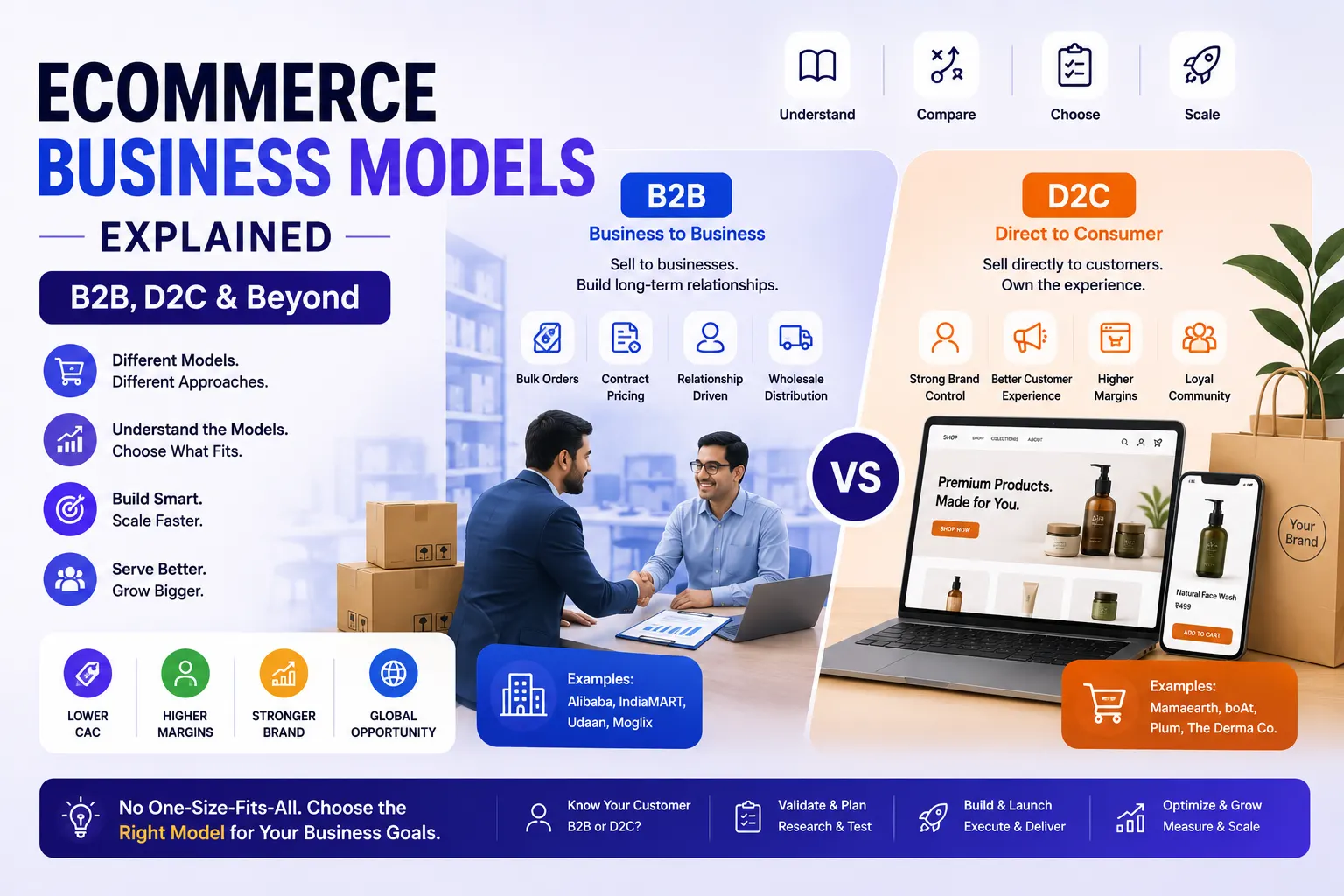
Introduction to Ecommerce Business Models Explained (B2B, D2C)
Ecommerce has transformed how businesses sell products and services across the world. In India and globally, digital commerce continues expanding rapidly as customers increasingly prefer online shopping experiences that are convenient, fast, mobile-friendly, and accessible from anywhere. As ecommerce ecosystems evolve, businesses now operate using several different ecommerce business models designed for different customer types, operational strategies, pricing structures, and growth objectives.
Among the most important ecommerce business models today are B2B (Business-to-Business) and D2C (Direct-to-Consumer). While both models operate within ecommerce environments, they differ significantly in customer targeting, branding strategies, marketing approaches, sales cycles, operational structures, customer relationships, and conversion optimization techniques.
Understanding ecommerce business models is essential for entrepreneurs, retailers, manufacturers, wholesalers, and startups because the chosen model influences nearly every aspect of business operations, including:
- Website design
- Customer experience
- Product pricing
- Marketing strategy
- SEO structure
- Logistics planning
- Customer support
- Technology requirements
Many ecommerce businesses fail because they launch stores without clearly understanding which ecommerce model aligns best with their products, target audience, operational capabilities, and long-term goals.
In 2026, ecommerce businesses are becoming increasingly specialized. Some brands focus on building direct emotional relationships with consumers through D2C experiences, while others prioritize wholesale distribution and large-volume transactions through B2B ecommerce systems. Some businesses even combine multiple ecommerce models simultaneously to maximize market reach and revenue diversification.
This comprehensive guide explains ecommerce business models in depth, focusing especially on B2B and D2C ecommerce, while also exploring hybrid models, operational differences, marketing strategies, UX considerations, SEO optimization, technology requirements, logistics systems, customer psychology, and future ecommerce trends shaping online commerce globally.
Understanding Ecommerce Business Models
An ecommerce business model defines how a business sells products or services online, who the customers are, how transactions occur, and how revenue is generated.
Different ecommerce business models serve different audiences and operational objectives.
Common ecommerce business models include:
- B2B (Business-to-Business)
- B2C (Business-to-Consumer)
- D2C (Direct-to-Consumer)
- C2C (Consumer-to-Consumer)
- Marketplace ecommerce
- Subscription ecommerce
- Wholesale ecommerce
The selected business model affects:
- Website architecture
- Product catalog structure
- Marketing channels
- Pricing strategies
- Customer relationships
- UX design priorities
Choosing the right ecommerce model requires understanding:
- Target customers
- Product demand
- Competition
- Operational scalability
- Long-term business vision
Modern ecommerce businesses increasingly adopt hybrid models that combine elements from multiple ecommerce approaches.
Understanding the strengths and limitations of each ecommerce model helps businesses build more sustainable and scalable online operations.
What is B2B Ecommerce?
B2B ecommerce stands for Business-to-Business ecommerce. In this model, businesses sell products or services directly to other businesses instead of individual consumers.
B2B ecommerce commonly involves:
- Manufacturers
- Wholesalers
- Distributors
- SaaS companies
- Industrial suppliers
Examples of B2B ecommerce transactions include:
- Wholesale grocery supply
- Industrial equipment sales
- Bulk office supplies
- Manufacturing raw materials
- Enterprise software subscriptions
B2B ecommerce platforms typically focus on:
- Bulk ordering
- Account-based pricing
- Long-term customer relationships
- Complex purchasing workflows
B2B ecommerce websites often require specialized features such as:
- Custom pricing systems
- Multi-user accounts
- Purchase approvals
- Bulk order management
- Credit systems
Unlike traditional retail ecommerce, B2B purchasing decisions often involve multiple stakeholders and longer sales cycles.
Key Characteristics of B2B Ecommerce
B2B ecommerce differs significantly from traditional consumer-focused ecommerce experiences.
Important characteristics of B2B ecommerce include:
Bulk Purchasing
B2B customers frequently place large-volume orders.
This affects:
- Pricing structures
- Inventory management
- Logistics planning
- Website functionality
Wholesale pricing and quantity discounts are common in B2B ecommerce.
Longer Sales Cycles
B2B purchasing decisions often involve:
- Procurement teams
- Budget approvals
- Vendor evaluations
- Negotiations
As a result, B2B sales cycles are usually longer than D2C or B2C ecommerce.
Relationship-Focused Sales
B2B ecommerce prioritizes long-term relationships rather than one-time purchases.
Businesses often focus on:
- Customer retention
- Account management
- Repeat ordering systems
Trust and reliability play major roles in B2B ecommerce success.
Customized Pricing
Many B2B businesses use:
- Contract pricing
- Customer-specific discounts
- Tiered pricing models
Pricing transparency may vary depending on customer accounts and agreements.
Advantages of B2B Ecommerce
B2B ecommerce offers several important advantages for businesses operating in wholesale or enterprise-focused industries.
Higher Order Values
B2B transactions often involve larger purchase quantities, resulting in:
- Higher average order values
- Stronger revenue stability
Bulk orders help improve operational efficiency.
Long-Term Customer Relationships
B2B ecommerce often focuses heavily on repeat business and recurring purchasing relationships.
Strong customer retention improves:
- Revenue predictability
- Customer lifetime value
- Operational stability
Scalable Operations
Once B2B systems are established, businesses can scale operations efficiently through:
- Automated ordering systems
- CRM integration
- ERP connectivity
Technology plays a central role in B2B scalability.
Predictable Demand
B2B customers often reorder products regularly based on business requirements.
This helps businesses:
- Forecast inventory
- Optimize supply chains
- Plan operations more effectively
Challenges of B2B Ecommerce
Despite its advantages, B2B ecommerce also involves several operational challenges.
Complex User Experience Requirements
B2B ecommerce websites often require:
- Advanced account systems
- Custom pricing functionality
- Multi-level permissions
- Bulk ordering tools
UX complexity is higher compared to standard consumer ecommerce stores.
Longer Conversion Cycles
B2B customers usually take longer to complete purchases because decision-making processes involve multiple stakeholders.
Businesses must invest in:
- Relationship building
- Content marketing
- Sales support
Higher Technical Requirements
B2B ecommerce platforms often require:
- ERP integration
- CRM connectivity
- Inventory synchronization
- Custom workflows
Technical development costs may be higher compared to simpler ecommerce models.
What is D2C Ecommerce?
D2C stands for Direct-to-Consumer ecommerce.
In this model, brands sell products directly to customers through their own websites instead of relying entirely on third-party marketplaces, wholesalers, or distributors.
D2C ecommerce has grown rapidly because businesses increasingly want:
- Better brand control
- Higher profit margins
- Direct customer relationships
- Customer data ownership
Examples of D2C brands include:
- Fashion startups
- Beauty brands
- Fitness companies
- Organic food brands
- Lifestyle products
D2C ecommerce businesses often focus heavily on:
- Branding
- Customer experience
- Social media marketing
- Mobile UX
- Conversion optimization
D2C brands usually prioritize emotional storytelling and brand identity strongly.
Key Characteristics of D2C Ecommerce
D2C ecommerce has several unique characteristics that differentiate it from B2B and traditional retail models.
Brand-Centric Experiences
D2C brands focus heavily on:
- Visual identity
- Brand storytelling
- Emotional engagement
The ecommerce website itself becomes a major branding tool.
Direct Customer Relationships
D2C brands interact directly with customers without intermediaries.
This allows businesses to:
- Collect customer insights
- Improve personalization
- Build stronger loyalty
Customer experience becomes a major competitive advantage.
Mobile-First Marketing
Many D2C brands rely heavily on:
- Instagram marketing
- Influencer collaborations
- Short-form video content
- Mobile advertising
Mobile UX optimization is essential for D2C growth.
Faster Purchasing Decisions
Compared to B2B ecommerce, D2C purchases are usually:
- Faster
- Emotion-driven
- Simpler
This affects:
- Website design
- CTA strategy
- Product page UX
Advantages of D2C Ecommerce
D2C ecommerce offers several major advantages for modern ecommerce brands.
Higher Profit Margins
Selling directly to customers removes intermediaries such as wholesalers and retailers.
This allows businesses to retain:
- More revenue
- Better pricing control
Stronger Branding Opportunities
D2C brands control:
- Website UX
- Packaging
- Messaging
- Customer experience
Strong branding improves:
- Recognition
- Customer loyalty
- Emotional engagement
Customer Data Ownership
D2C businesses collect valuable customer insights directly from ecommerce interactions.
This helps improve:
- Marketing personalization
- Product development
- Retention strategies
Better Customer Relationships
Direct communication improves:
- Trust
- Customer retention
- Community building
D2C brands often build highly engaged customer communities online.
Challenges of D2C Ecommerce
While D2C ecommerce offers strong branding opportunities, it also involves significant challenges.
High Customer Acquisition Costs
D2C ecommerce often relies heavily on:
- Paid advertising
- Social media campaigns
- Influencer marketing
Customer acquisition costs can increase rapidly in competitive markets.
Logistics Complexity
D2C businesses manage:
- Individual shipments
- Returns
- Customer support
- Last-mile delivery
Operational complexity increases as businesses scale.
Branding Pressure
D2C brands compete heavily on:
- Visual quality
- UX
- Storytelling
- Customer experience
Weak branding can reduce competitiveness significantly.
B2B vs D2C Ecommerce
While both B2B and D2C operate online, they differ significantly across multiple areas.
| Factor | B2B Ecommerce | D2C Ecommerce |
|---|---|---|
| Target Audience | Businesses | Individual consumers |
| Purchase Volume | Large bulk orders | Smaller personal purchases |
| Sales Cycle | Longer | Faster |
| Pricing | Negotiated or custom | Fixed retail pricing |
| Branding Focus | Moderate | Very high |
| Customer Relationship | Account-based | Emotional engagement |
| UX Requirements | Complex workflows | Simplicity-focused |
| Marketing Channels | LinkedIn, email, industry SEO | Social media, influencers |
Understanding these differences helps businesses design better ecommerce strategies.
Hybrid Ecommerce Models
Many businesses now combine multiple ecommerce models simultaneously.
Examples include:
- B2B + D2C
- Marketplace + D2C
- Wholesale + Retail ecommerce
Hybrid ecommerce strategies help businesses:
- Diversify revenue
- Expand market reach
- Reduce platform dependency
For example:
- Manufacturers may sell wholesale to retailers while also operating D2C websites
- Fashion brands may use marketplaces for visibility while prioritizing direct ecommerce stores
Hybrid models provide flexibility and scalability.
Ecommerce Website Design for B2B
B2B ecommerce websites require specialized UX strategies.
Important B2B UX priorities include:
- Easy bulk ordering
- Advanced search systems
- Account dashboards
- Quick reorder functionality
- Inventory visibility
B2B websites should prioritize:
- Efficiency
- Reliability
- Professionalism
Complex workflows should remain organized and intuitive.
Businesses developing advanced B2B ecommerce platforms often work with professional ecommerce UX and development specialists such as Sri Hayavadhana Solutions to build scalable ecommerce systems optimized for usability, SEO, and operational performance.
Ecommerce Website Design for D2C
D2C ecommerce websites prioritize:
- Branding
- Emotional storytelling
- Mobile UX
- Product presentation
- Conversion optimization
Important D2C design elements include:
- Strong visuals
- Lifestyle imagery
- Minimalist layouts
- Fast loading speed
- Social proof
D2C websites should create immersive and emotionally engaging customer experiences.
Product pages play a major role in influencing purchasing behavior.
Modern D2C ecommerce UX emphasizes:
- Simplicity
- Mobile-first design
- Trust-building
SEO Strategies for B2B Ecommerce
B2B ecommerce SEO often focuses on:
- Commercial keywords
- Industry-specific searches
- Long-tail keywords
- Educational content
B2B SEO strategies commonly include:
- Whitepapers
- Product guides
- Technical documentation
- Industry blogs
Long-form content helps establish:
- Authority
- Trust
- Search visibility
Helpful SEO resource:
B2B SEO usually targets lower search volumes but higher-value customers.
SEO Strategies for D2C Ecommerce
D2C ecommerce SEO often focuses on:
- Product-focused keywords
- Lifestyle searches
- Brand discovery
- Informational content
Important D2C SEO strategies include:
- Product page optimization
- Category page SEO
- Blogging
- Influencer-generated backlinks
Fast-loading websites and mobile optimization strongly influence D2C SEO performance.
Helpful SEO resource:
D2C SEO should support both:
- Customer acquisition
- Brand authority growth
Marketing Strategies for B2B Ecommerce
B2B ecommerce marketing often prioritizes:
- LinkedIn marketing
- Email campaigns
- Industry webinars
- SEO content
- Trade events
Trust and expertise are central to B2B customer acquisition.
B2B businesses frequently invest heavily in:
- Relationship building
- Thought leadership
- Technical content
Lead generation systems are important for B2B ecommerce growth.
Marketing Strategies for D2C Ecommerce
D2C marketing focuses heavily on:
- Social media
- Influencer marketing
- Video content
- Paid advertising
- Community building
Visual storytelling strongly influences D2C customer engagement.
Popular D2C marketing platforms include:
- YouTube
D2C brands often rely heavily on:
- Emotional branding
- Customer reviews
- User-generated content
Logistics in B2B Ecommerce
B2B logistics often involve:
- Bulk shipping
- Warehouse management
- Scheduled deliveries
- Supply chain coordination
Reliability and operational efficiency are critical.
B2B logistics systems frequently integrate with:
- ERP software
- Inventory systems
- CRM platforms
Operational scalability strongly influences B2B profitability.
Logistics in D2C Ecommerce
D2C logistics focus heavily on:
- Fast delivery
- Packaging quality
- Return management
- Customer communication
Customer satisfaction depends heavily on delivery experiences.
D2C brands often prioritize:
- Branded packaging
- Real-time tracking
- Faster fulfillment
Last-mile delivery efficiency strongly affects D2C customer retention.
Future Trends in Ecommerce Business Models
Ecommerce business models continue evolving rapidly as customer expectations and technology capabilities change.
Future trends may include:
- AI-powered personalization
- Voice commerce
- Subscription-based ecommerce
- Social commerce integration
- Omnichannel experiences
- Hyper-personalized UX
Hybrid ecommerce models will likely continue growing because businesses increasingly seek revenue diversification.
Mobile-first ecommerce strategies will remain dominant globally.
Businesses adapting early to changing ecommerce trends will remain more competitive.
Final Thoughts
Understanding ecommerce business models is essential for building scalable and sustainable online businesses.
B2B ecommerce focuses on:
- Efficiency
- Long-term relationships
- Bulk transactions
- Operational scalability
D2C ecommerce focuses on:
- Branding
- Emotional engagement
- Customer experience
- Mobile-first marketing
Both models offer unique opportunities and challenges depending on:
- Industry
- Target audience
- Product type
- Growth strategy
Successful ecommerce businesses align their:
- UX strategy
- Marketing
- SEO
- Technology
- Operations
with the specific requirements of their chosen ecommerce model.
Modern ecommerce customers expect online shopping experiences to feel fast, intuitive, trustworthy, and mobile-friendly across every device.
Businesses investing strategically in ecommerce UX, SEO, branding, and operational efficiency often achieve:
- Higher conversions
- Better customer retention
- Stronger brand authority
- Long-term growth
The future of ecommerce will increasingly revolve around personalization, AI-driven experiences, mobile convenience, and frictionless customer journeys. Businesses that continuously adapt to evolving ecommerce trends and customer expectations will remain competitive and profitable in the rapidly expanding digital commerce industry.